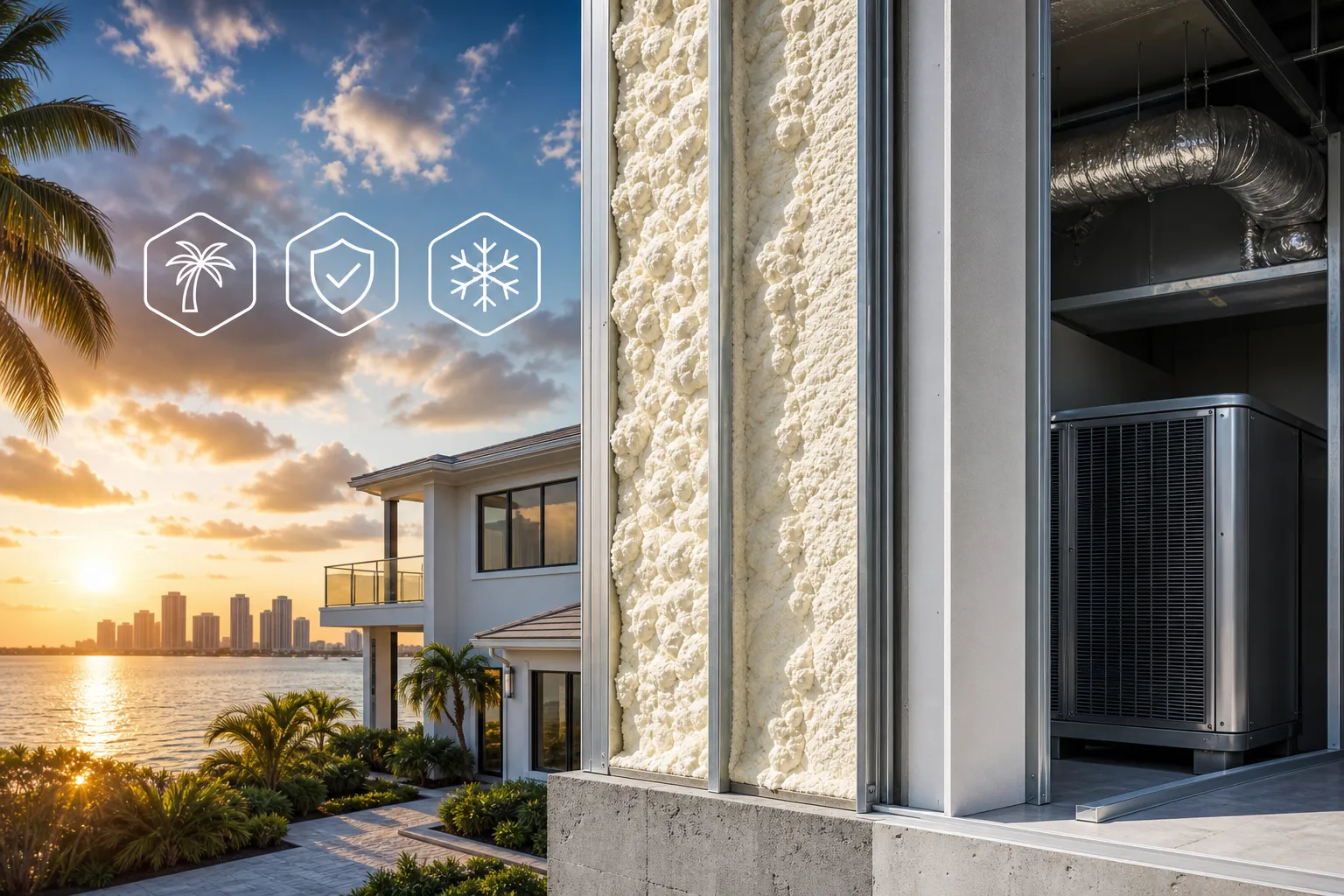
Florida Spray Foam Insulation: Costs, Climate, and Code
Spray foam insulation in Florida is not a substitute for conventional insulation, it is a fundamentally different category of building envelope engineering. Fiberglass batts and blown-in cellulose perform less effectively in hot-humid climates, where they face persistent vapor pressure differentials and extreme cooling loads that temperate-climate assemblies were not designed to handle. In IECC Climate Zone 1A, where South Florida operates, outdoor relative humidity remains generally high year-round, cooling loads dominate energy expenditure, and High-Velocity Hurricane Zone (HVHZ) wind pressures impose structural demands that passive insulation systems typically do not address. Spray polyurethane foam (SPF) is uniquely capable of managing thermal resistance, vapor diffusion, air infiltration, and structural reinforcement simultaneously, provided it is correctly specified and installed.
Broward Insulation has engineered SPF assemblies within the Broward, Palm Beach, and Miami-Dade Tri-County market since 1977, accumulating nearly five decades of field experience specific to Climate Zone 1A performance conditions. That operational depth informs every technical position in this article. The sections below cover foam type selection for Florida’s moisture and thermal profile, Florida Building Code compliance requirements for SPF installations, 2026 cost benchmarks and FPL rebate offsets, realistic energy savings projections for retrofit projects, and the contractor qualification criteria that separate compliant high-performance installations from the failure modes that drive warranty disputes and remediation costs.
Open-Cell vs. Closed-Cell Spray Foam: The Engineering Decision for Florida’s Climate
The selection between open-cell and closed-cell spray polyurethane foam is primarily an engineering decision, not a cost optimization exercise. Vapor permeability requirements, moisture resistance characteristics, and R-value per inch demands of the specific assembly and climate exposure drive the choice. In Climate Zone 1A, those parameters generally favor closed-cell SPF for primary envelope applications, though well-designed assemblies may accommodate open-cell foam in specific, controlled circumstances.
Vapor Permeability and Moisture Barrier Performance
Open-cell foam’s vapor-permeable structure allows moisture to migrate through the assembly. In a climate where exterior vapor pressure consistently exceeds interior vapor pressure for most of the year, a vapor-permeable insulation layer at the thermal boundary functions as a conduit rather than a barrier. Open-cell foam also has a documented capacity to absorb and retain liquid water, a critical liability in roof-deck and attic applications where leak events or condensation episodes occur. Closed-cell SPF, by contrast, achieves Class II vapor retarder classification at approximately 1.5 inches of installed thickness, blocking both air infiltration and vapor diffusion at the thermal boundary. Its hydrophobic structure resists liquid water absorption, which is a material engineering advantage in persistently humid assemblies. Exact performance thresholds vary by product; consult manufacturer test data for the specific system specified.
R-Value Per Inch and Thermal Envelope Implications
Open-cell SPF delivers approximately R-3.5 to R-4 per inch of installed thickness. Closed-cell SPF delivers approximately R-6 to R-7 per inch. In Florida attic and roof-deck applications, where rafter cavity depth is constrained and radiant heat loads from solar gain are extreme, the per-inch thermal efficiency of closed-cell foam directly determines whether the assembly achieves code-minimum R-values within the available cavity. For unvented attic assemblies, Florida Building Code requires a minimum of R-20 of air-impermeable insulation at the underside of the roof sheathing, a threshold that typically corresponds to approximately 3 to 4 inches of closed-cell foam, depending on the product’s tested R-value per inch. Verify the specific product’s performance data before specifying installed thickness.
Air Sealing and HVAC Load Reduction in High-Humidity Assemblies
Both foam types deliver superior air sealing performance relative to fiberglass batts or blown-in alternatives. Closed-cell foam’s rigid cured structure also provides structural reinforcement to roof decking, a relevant factor in HVHZ zones where uplift pressures govern roof assembly design. In unvented attic configurations permitted under specific Florida Building Code conditions, closed-cell SPF applied to the underside of roof decking substantially reduces the warm, humid air exchange that drives mold formation and accelerates mechanical equipment degradation. Limiting conditioned attic air infiltration directly reduces HVAC load, which is the primary driver of energy expenditure in Florida’s residential building stock.
Spray Foam Insulation Florida: Building Code Compliance Requirements
Florida Building Code Section 2603 classifies spray polyurethane foam as a foam plastic. Its requirements for thermal barriers, ignition barriers, and unvented attic assemblies carry legal weight that installer attestation alone cannot satisfy. Every spray foam insulation project in Florida must be permitted, inspected, and documented accordingly.
Thermal Barrier and Ignition Barrier Requirements
Under Section 2603, spray polyurethane foam must be separated from occupied interior space by an approved 15-minute thermal barrier. One-half inch Type X gypsum board is the standard compliant solution. In attics and crawl spaces used exclusively for service access, an approved ignition barrier may substitute for the full thermal barrier, but this substitution requires documentation and building department approval. Installer discretion is not an acceptable basis for deviating from these requirements. The absence of proper thermal barrier protection is a code violation that surfaces during resale inspections and appraisal processes.
Unvented Attic Assembly Requirements Under IECC Climate Zone 1A
Florida Building Code permits unvented attic assemblies with SPF under specific conditions, including the R-20 minimum at the roof deck, a blower door result below 3 ACH50 where required by the applicable code path, and a compliant mechanical ventilation system. Confirm the precise requirements with your local jurisdiction, as code editions and enforcement thresholds can vary. Compliance requires documentation at permit inspection, not simply installer attestation. The transition from a vented to an unvented attic assembly also requires deliberate handling of existing soffit and ridge vents. Failure to address those vent penetrations correctly creates both code violations and roofing system warranty conflicts.
Regarding roofing manufacturer warranties: some shingle manufacturers require full disclosure of assembly type changes and may exclude coverage when foam is applied to the underside of decking without prior written authorization. The Florida Roofing, Sheet Metal and Air Conditioning Contractors Association (FRSA) has issued industry guidance confirming that warranty positions vary by manufacturer, some permit foam-sealed decking, others do not. Obtain written confirmation from the specific shingle manufacturer before installation proceeds.
Permitting, Licensing, and Jurisdiction-Specific Enforcement
Spray foam installations that affect the building envelope require a valid building permit in Florida. The work must be performed under a Florida DBPR-certified contractor license authorizing building-envelope or insulation scope. Licensing classifications and permit authority vary materially across Broward, Miami-Dade, and Palm Beach counties. Miami-Dade’s HVHZ imposes additional product approval requirements that do not apply in Broward or Palm Beach. Verify contractor licensing status through the Florida Department of Business and Professional Regulation before executing any agreement, and confirm that the contractor has pulled and closed permits on comparable SPF projects within the relevant county jurisdiction.
Spray Foam Insulation Florida: 2026 Cost Benchmarks and Rebate Offsets
Evaluating an SPF retrofit requires precise cost benchmarking, regional averages routinely fail to account for South Florida market conditions and Climate Zone 1A installation requirements. The figures below reflect 2026 installed pricing in the Tri-County market; site conditions and project scope drive the final number.
Cost Per Square Foot and Typical Project Ranges
Installed open-cell SPF in Florida ranges from approximately $1.50 to $3.50 per square foot in 2026. Closed-cell SPF ranges from approximately $2.00 to $4.75 per square foot. For a standard attic retrofit, total project costs typically fall between $1,700 and $7,500, depending on attic square footage, foam type, and required installed thickness. Whole-envelope projects covering 1,000 to 1,500 square feet of surface area fall within a comparable range, with costs escalating for complex geometric configurations or phased commercial applications across multiple assemblies.
Cost Variables Specific to South Florida Projects
Several variables push South Florida project costs above national baseline estimates. Removal of existing degraded insulation adds both labor and disposal cost, and should be budgeted as a separate line item, not an afterthought. Low-slope roof deck configurations and limited attic access points require specialized equipment positioning and extend labor hours. High ambient humidity in the Tri-County market frequently requires surface conditioning and moisture verification before foam application; surfaces with moisture content exceeding 20% produce adhesion failure and delamination that is not visible at the surface but undermines air barrier continuity. HVHZ-compliant roof deck assembly documentation adds engineering and administrative costs that do not appear in non-hurricane zone projects.
Reducing installed closed-cell thickness below code-minimum R-value thresholds to cut project cost introduces both performance failure and active code non-compliance. Neither outcome serves the long-term financial interest of the property owner.
FPL Rebate Offsets and Financial Leverage for Qualifying Projects
As an FPL-Approved Contractor, Broward Insulation manages the utility rebate application process on behalf of clients, including ceiling insulation rebates applicable to qualifying spray foam insulation upgrades in the Tri-County service area. FPL’s documented instant rebate for qualifying ceiling insulation projects is $220, issued as a direct credit at invoice, verify current eligibility and terms at FPL’s rebate program page, as program details are subject to change. Rebate eligibility depends on the home’s existing insulation condition, property type, and the approved contractor’s certification status. Rebates are not retroactively available for work performed by non-approved contractors. Additional federal tax credit opportunities under the Inflation Reduction Act energy efficiency provisions may apply to qualifying insulation upgrades; confirm applicability with a qualified tax advisor before project execution.
Energy Savings and Payback Timeline for Florida Retrofits
Florida’s residential energy profile is dominated by cooling demand, which positions spray foam attic and roof-deck retrofits among the highest-ROI building envelope upgrades available in Climate Zone 1A. The projections below are grounded in documented retrofit data, not manufacturer marketing claims.
A properly executed closed-cell SPF retrofit targeting the thermal boundary substantially reduces the two primary drivers of HVAC overload in Florida homes: air infiltration through an unsealed building envelope and solar heat gain through an uninsulated roof deck. Documented energy bill reductions for Florida retrofit projects range from 15% to 25% in typical existing homes. Properties with severe pre-existing air leakage and inadequate insulation have achieved reductions approaching 40%, though those outcomes represent the upper performance boundary rather than the median expectation. The standard payback period for spray foam retrofit projects in Florida runs 3 to 5 years, calculated against cooling savings relative to installed project cost.
For real estate investors and property managers, the financial case extends beyond direct energy savings. Closed-cell SPF reduces HVAC replacement frequency by lowering operational load hours, mitigates moisture-related mold remediation liability by reducing vapor intrusion pathways, and supports the code-compliance documentation that appraisers and commercial lenders require for envelope-upgraded properties in South Florida’s high-scrutiny real estate market. These compounding benefits position a properly engineered SPF retrofit as both an operating cost reduction and an asset protection measure.
Installation Failure Modes and Licensed Contractor Selection in South Florida
Spray polyurethane foam failures in Florida are consistently installation-driven rather than material-driven. The foam system performs according to the conditions under which it was applied. Deficiencies in surface preparation, component mixing, application technique, or assembly design show up as measurable performance failures within months of installation. Short declarative point: bad installation produces bad results, regardless of product quality.
Common Installation Errors That Compromise Performance
Adhesion failure is the most frequently documented failure mode in South Florida SPF installations. It begins before the foam is even applied: surfaces with ambient moisture content exceeding 20% cause delamination that is invisible at the surface but destroys air barrier continuity. Incorrect A/B component mixing ratios produce foam that shrinks, cracks, or fails to cure to specified density, resulting in R-value degradation and structural weakness. Application lifts exceeding approximately 2 inches without intermediate cure time cause heat buildup, potential charring, and foam that does not achieve design R-value despite nominal thickness. Insufficient total installed thickness that fails to reach code-minimum R-values represents both a performance failure and an active code violation that cannot be remediated without re-application.
Roof Warranty and Assembly Design Conflicts
When closed-cell SPF is applied to the underside of roof decking, the transition from a vented to an unvented attic assembly must be designed, documented, and disclosed to the roofing system manufacturer before installation. Some major shingle manufacturers, including Atlas, state that spray foam applied directly to the bottom of the decking may void their limited warranty. The FRSA industry advisory confirms that warranty positions vary by manufacturer: some permit foam-sealed decking; others do not. A qualified South Florida SPF contractor provides written confirmation of roofing manufacturer warranty compatibility before the first pound of foam is applied, not after the assembly is sealed and the dispute has already materialized.
Contractor Vetting Criteria for Closed-Cell SPF in the Tri-County Market
A qualified spray foam contractor operating in Broward, Palm Beach, or Miami-Dade counties must demonstrate four verifiable qualifications before project execution:
- Florida DBPR-certified contractor license authorizing building-envelope or insulation scope, with county registration current in the project jurisdiction
- Documented HVHZ installation experience and familiarity with Miami-Dade product approval requirements where applicable
- Manufacturer certification for the specific SPF product system specified in the project scope
- A verifiable record of permit-closed SPF projects with inspection records available upon request
Broward Insulation has operated continuously in South Florida since 1977, holds FPL-Approved Contractor status, and maintains a documented record of closed-cell SPF installations across residential, commercial, and multi-family properties throughout the Tri-County region, all engineered to Florida Building Code compliance standards. When evaluating competing bids, request written documentation of all four qualifications before signing. Any contractor who cannot provide it presents material project risk.
Conclusion: The Technical and Financial Case for Licensed SPF Evaluation
In IECC Climate Zone 1A, building science data, Florida Energy Conservation Code requirements, and long-term retrofit performance consistently support closed-cell spray foam insulation as the technically superior choice for South Florida’s extreme humidity, radiant heat loads, and hurricane wind pressures. Open-cell foam serves specific applications where vapor permeability is acceptable and assembly design controls moisture exposure. For primary envelope, attic, and roof-deck applications across the Tri-County market, closed-cell SPF generally offers superior moisture control, higher R-value per inch, and meaningful structural contribution, factors that matter most in Climate Zone 1A conditions.
Material selection, however, is only one determinant of outcome. Precise specification of installed thickness to meet code-minimum R-values, correct assembly design for the transition to an unvented attic configuration, and licensed permit-backed installation are all equally critical. Together with roofing manufacturer warranty coordination, these factors determine whether the project delivers the thermal performance, code compliance, and financial return the investment requires.
Schedule a technical consultation with Broward Insulation by phone or through the contact form on this site. The site-specific evaluation will address R-value requirements for your roof assembly, permit scope and jurisdiction-specific compliance requirements, FPL rebate eligibility for your property type, and 2026 project cost benchmarks calibrated to your building’s square footage, existing conditions, and climate exposure. For spray foam insulation in Florida’s Tri-County market, Broward, Palm Beach, and Miami-Dade, start with a contractor who has engineered these assemblies here for nearly five decades.
Frequently Asked Questions: Spray Foam Insulation in Florida
How much does spray foam insulation cost in Florida in 2026?
Installed open-cell SPF ranges from approximately $1.50 to $3.50 per square foot; closed-cell ranges from approximately $2.00 to $4.75 per square foot. A typical attic retrofit runs $1,700 to $7,500 depending on square footage, foam type, and required thickness. South Florida project costs often run above national averages due to HVHZ compliance documentation, access constraints, and surface conditioning requirements.
Does spray foam insulation require a permit in Florida?
Yes. Any spray foam installation that affects the building envelope requires a valid building permit in Florida. The work must be performed by a Florida DBPR-certified contractor licensed for building-envelope or insulation scope. Permit requirements and enforcement thresholds vary by county, Broward, Miami-Dade, and Palm Beach each have jurisdiction-specific rules.
Is Broward Insulation an FPL-Approved Contractor?
Yes. Broward Insulation holds FPL-Approved Contractor status, which means clients can access FPL’s instant rebate program, currently $220 for qualifying ceiling insulation projects, as a direct credit at invoice. Rebates are not available retroactively for work performed by non-approved contractors.
Will spray foam insulation void my roof warranty?
It depends on the manufacturer. Some shingle manufacturers, including Atlas, state that spray foam applied to the underside of decking may void their limited warranty without prior written authorization. Obtain written confirmation from your specific roofing manufacturer before installation. A qualified contractor addresses this before the work begins, not after.