Best Insulation for South Florida Commercial Warehouses
Executive Summary
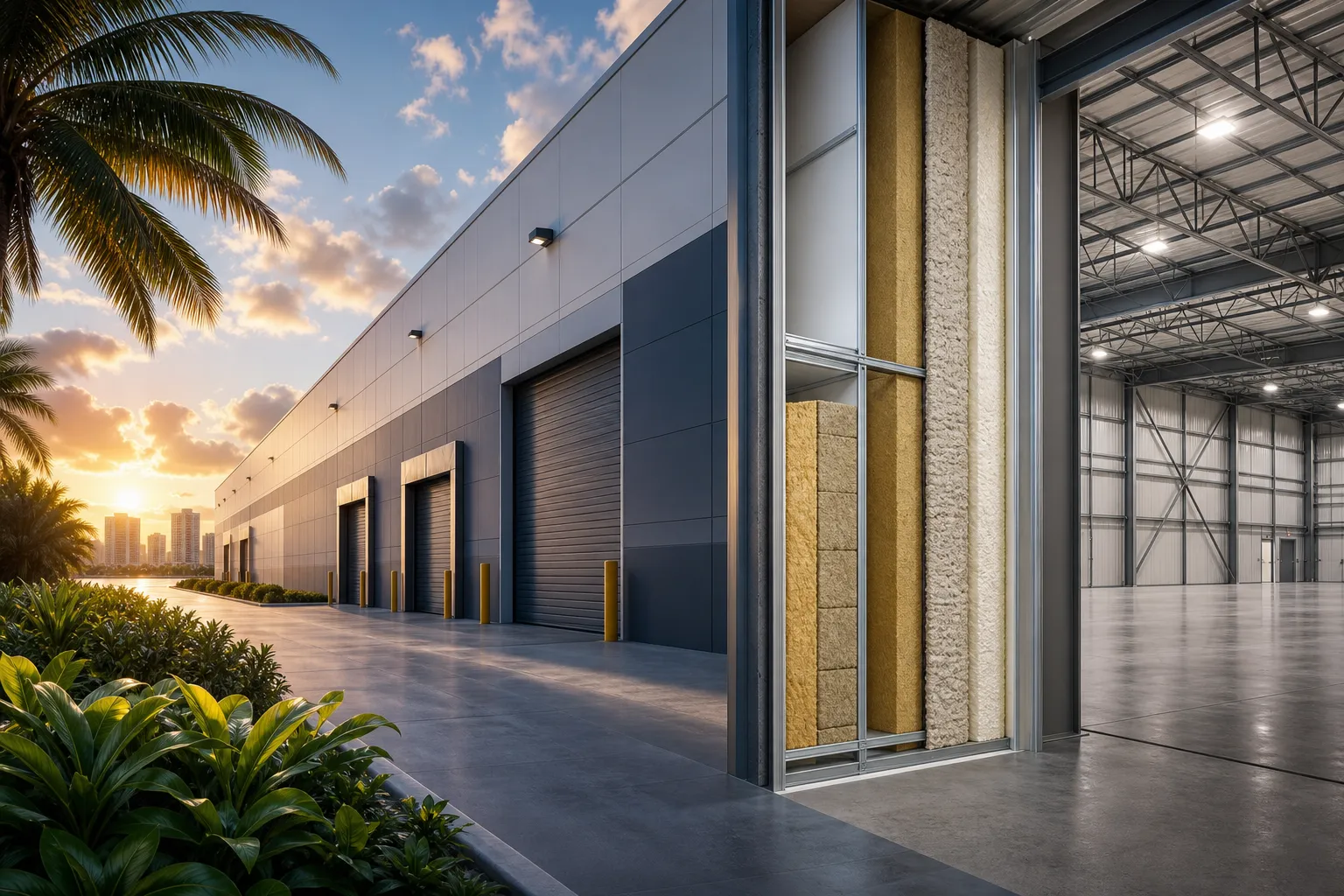
If you’re asking what type of insulation is best for a commercial warehouse in South Florida, the leading choices are closed-cell spray polyurethane foam (ccSPF), polyiso rigid board continuous insulation (CI), and reflective radiant barrier assemblies. Each system is evaluated against the Florida Building Code Energy Conservation commercial provisions, IECC Climate Zone 1A prescriptive and U-factor compliance paths, and, for Miami-Dade County structures, High-Velocity Hurricane Zone (HVHZ) product approval and NOA documentation requirements. Core performance criteria in this market extend well beyond nominal R-value. They encompass condensation control on metal substrates, sustained HVAC load reduction in a year-round cooling-dominant climate, and moisture-resilient envelope construction capable of maintaining interior relative humidity below 55% RH. Broward Insulation, a licensed Florida insulation contractor with nearly 50 years of continuous commercial field experience, engineers and installs all three system categories across warehouse and industrial facilities throughout Broward, Palm Beach, and Miami-Dade counties. This article serves as a technical decision guide for commercial architects, facility managers, and property investors selecting the correct thermal envelope strategy for large-footprint warehouse structures in South Florida’s extreme hot-humid climate.
Florida Energy Code Requirements for Commercial Warehouse Roofs and Walls
Florida Energy Code Prescriptive Targets for Commercial Roofs and Walls
The Florida Building Code Energy Conservation commercial provisions establish roof assembly targets in the R-38 to R-40 range under full prescriptive compliance paths, with a provision permitting reduction to R-30 when continuous insulation covers 100% of the ceiling area including the top plates at the eaves. Frame walls carry a prescriptive minimum of R-13; masonry and concrete block assemblies require R-7.8 interior insulation or R-6 exterior continuous insulation. Commercial buildings operate under assembly U-factor compliance paths rather than residential R-value tables. Continuous insulation credit is the primary mechanism contractors use to achieve code compliance in metal wall panel and low-slope roof assemblies where thermal bridging through structural members would otherwise degrade effective assembly performance.
Continuous Insulation (CI) Requirements and HVHZ Product Approval Obligations
Continuous insulation eliminates thermal bridging through metal framing and structural steel, a design-critical factor in warehouse construction where metal-framed wall panels and purlins can substantially degrade the effective thermal resistance of non-CI assemblies. In Miami-Dade’s High-Velocity Hurricane Zone, state energy compliance requirements are layered with HVHZ product approval and NOA documentation obligations focused on wind uplift ratings, fastener patterns, and roof-system attachment protocols. Any insulation system installed within the HVHZ must carry current Miami-Dade product approval documentation matching the exact assembly configuration and attachment method. Above-deck polyiso board installations, for example, require an NOA covering the specific insulation product, the adhesive or mechanical attachment method, and all related roofing system components as an approved assembly.
Why Prescriptive Minimums Are Insufficient for Climate Zone 1A Warehouse Performance
Code minimum represents the legal compliance floor, not the appropriate performance target for Climate Zone 1A’s practical demands. In South Florida, summer outdoor dewpoint temperatures commonly reach or exceed 70°F based on NOAA regional climate data, and solar irradiance can drive metal roof surface temperatures above 150°F under peak solar load on dark metal roofs. Cooling loads operate year-round without seasonal relief. Prescriptive-minimum assemblies are associated with increased risk of HVAC oversizing, condensation events on metal structural members, and accelerated envelope deterioration under these conditions. A properly engineered closed-cell spray foam building envelope can reduce HVAC loads by 15% to 40% relative to code-minimum construction, directly compressing mechanical equipment sizing requirements, annual utility expenditure, and HVAC maintenance costs over the facility’s service life.
What Type of Insulation Is Best for a Commercial Warehouse in South Florida: System Comparison
Closed-Cell Spray Foam as the Leading Specification for Metal Warehouse Envelopes
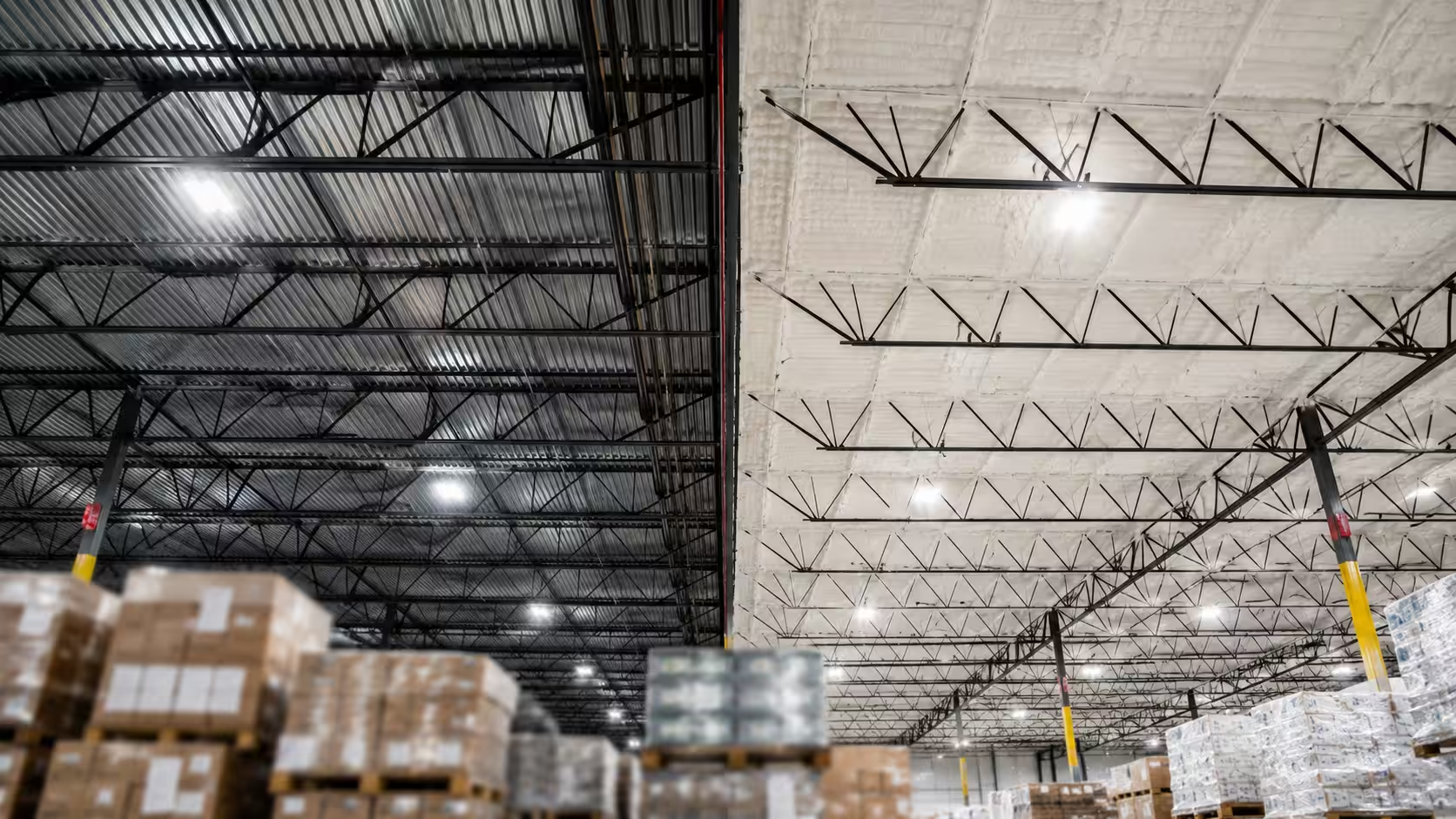
Closed-cell spray polyurethane foam delivers approximately R-6 to R-7 per inch, achieving required roof and wall thermal targets at thinner profiles than fiber-based alternatives. In Climate Zone 1A, controlling air movement is frequently more consequential than nominal R-value alone: exterior air carrying high moisture loads will bypass any insulation system that does not also function as a continuous air barrier. Closed-cell foam seals the building envelope at the point of application, eliminating the detailing failures (unsealed penetrations, board joint gaps, compressed batt cavities) that compromise bulk insulation performance in humid commercial environments. Few single materials offer the combined properties of thermal resistance, air sealing, and moisture resistance to the same degree as closed-cell SPF for hot-humid warehouse conditions. For professional installation and specifications tailored to commercial projects, see Broward Insulation’s Spray Foam Insulation Florida service.
Closed-Cell vs. Open-Cell Spray Foam for South Florida Warehouses
Not all spray foam performs equally in Climate Zone 1A. Closed-cell SPF, with a density of approximately 2 lb/ft³, delivers R-6 to R-7 per inch and functions as a low-permeance vapor retarder, making it the correct specification for metal deck and wall panel applications where condensation risk is high. Open-cell SPF, at roughly 0.5 lb/ft³, delivers approximately R-3.5 to R-3.7 per inch and is vapor-permeable, it does not provide meaningful vapor control and should not be specified as the primary moisture-management layer on metal substrates in South Florida’s humidity environment. For fully conditioned warehouse interiors where an independent vapor retarder and air-barrier system can be reliably executed, open-cell foam may serve secondary applications, but closed-cell remains the industry-preferred specification for primary envelope duty in Climate Zone 1A.
Condensation Prevention on Metal Roof Decks and Wall Panel Systems
Metal decks and wall panels act as cold surfaces during active HVAC operation, creating a dew-point risk whenever humid exterior air contacts them. Closed-cell spray foam applied directly to the underside of the roof deck or interior face of wall panels functions as a low-permeance vapor retarder, eliminating the air pathway that allows humid air to reach the metal substrate and condense. The actual permeability performance depends on foam formulation and installed thickness; specify products with documented perm ratings from the manufacturer for the target thickness in your assembly. Polyiso board systems, by contrast, do not self-seal at joints, penetrations, or perimeter transitions. Without meticulous detailing, humid air infiltration persists and condenses on the cooled metal deck beneath the board, initiating corrosion and mold colonization that progressively compromises structural integrity and insulation system performance.
Performance Boundaries and Appropriate Application Limits
Closed-cell spray foam for commercial warehouse roof and wall applications carries an installed cost ranging from approximately $3 to $5 per square foot in South Florida, with a 2026 planning midpoint of approximately $4 per square foot for metal deck and wall panel work. For fully unconditioned warehouse spaces where condensation risk is substantially lower, or for above-deck roof recover assemblies where adhered board systems suit the substrate better, polyiso rigid board may represent a more cost-efficient compliance path. The selection decision must be driven by a licensed technical assessment of the facility’s conditioning strategy, roof substrate condition, and moisture management requirements. For industry cost context and published market estimates on spray foam pricing, see general spray foam insulation cost estimates.
Polyiso Rigid Board Assemblies for Low-Slope Commercial Warehouse Roofs
Above-Deck CI with Polyiso: Thermal Performance in Controlled Thickness Profiles
Polyiso rigid board delivers approximately R-5.7 per inch under standard conditions, making it a commercially viable option for above-deck continuous insulation on low-slope TPO, EPDM, or modified bitumen roof systems. Temperature derating at low temperatures, a performance liability in cold climates, is largely irrelevant in Climate Zone 1A’s year-round heat-dominant environment. For warehouse roofs targeting R-30 or higher assembly values, polyiso installed as continuous insulation above the structural deck eliminates thermal bridging through the deck and framing system. Tapered board profiles deliver the positive drainage slope required under Florida’s low-slope roofing provisions within a single coordinated assembly.
Assembly Detailing Requirements: Seams, Tapers, and Airtightness in Humid Climates
Polyiso’s primary vulnerability in South Florida is joint integrity. Unlike closed-cell foam, polyiso board does not self-seal at board seams, deck penetrations, or perimeter wall conditions. In Climate Zone 1A’s consistently high outdoor vapor pressure environment, any unsealed joint creates a pathway for humid air to contact the cooler structural deck below. Critical detailing requirements include staggered offset joints between insulation layers, adhered rather than mechanically fastened installation where wind uplift ratings permit, and compatible air-barrier membranes at the deck or membrane interface. When these conditions are fully executed, polyiso performs reliably as a primary above-deck continuous insulation system. When they are not, the performance gap relative to spray foam becomes a real-world liability.
Reflective Foil and Radiant Barriers: Effective Supplements, Not Standalone Systems
How Radiant Barriers Reduce Solar Heat Gain on Metal Warehouse Roofs
Reflective foil radiant barriers reduce heat gain by reflecting solar radiant energy before it conducts into the conditioned space, a meaningful mechanism in South Florida’s extreme solar irradiance environment. On metal-roofed warehouses with low thermal mass, the radiant component of roof heat gain represents a substantial fraction of total cooling load. A correctly installed radiant barrier delivers measurable reductions in that load. Several technical comparisons consider the tradeoffs between radiant barriers and foam-based insulation; for a focused comparison, see an industry radiant barrier vs spray foam comparison and Green Builder Media’s analysis.
Critical Design Requirements and the Air-Gap Dependency
A radiant barrier delivers meaningful performance only when an adjacent air space exists on at least one side of the reflective surface. The U.S. Department of Energy specifies a minimum 1.0-inch air space between the foil and the adjacent roof surface. Industry installation standards recommend a functional minimum of 0.5 to 1.0 inch, with performance increasing as the air space dimension grows. A reflective foil layer foamed directly against a substrate or laminated to polyiso without a maintained air gap loses its radiant-reduction benefit entirely, functioning only as a conductive contact layer. For warehouse applications, the reflective surface must be positioned with a clearly maintained air gap on the underside of the roof assembly or as a facing layer within a ventilated system configuration. For related insulated-roof and attic service options, see our Attic Insulation Florida services.
Polyiso Plus Reflective Foil as a Combined Heat-Gain Reduction System
Combining foil-faced polyiso with a ventilated air space or reflective foil underlayment creates a two-mechanism strategy: polyiso addresses conductive heat transfer while the reflective layer addresses radiant heat transfer. This assembly is most appropriate for lightly conditioned or semi-conditioned warehouse spaces where condensation risk is lower, because it does not provide the vapor control that closed-cell foam delivers on metal deck applications and requires careful air-barrier detailing at all joints and penetrations to prevent humid air intrusion. The combination cannot substitute for a complete insulation and moisture-management strategy on fully conditioned facilities.
Condensation Control, Vapor Management, and Moisture-Resilient Envelope Design
Air Barriers and Vapor Retarders: Assembly Sequence and Material Selection
The distinction between an air barrier and a vapor retarder is critically important in Climate Zone 1A warehouse design. An air barrier controls bulk air movement and the high moisture loads it carries; a vapor retarder controls vapor diffusion through the assembly materials themselves. In South Florida, air infiltration is the dominant moisture transport mechanism, making continuous air barrier performance the primary design priority. The correct assembly sequence positions a continuous, uninterrupted air barrier at the building envelope and designs the vapor retarder to permit interior-facing drying, since exterior drying is rarely achievable in South Florida’s consistently high outdoor humidity environment.
Closed-cell spray foam functions simultaneously as both barrier and retarder, simplifying assembly design and eliminating the detailing risk inherent in separately specified air-barrier membrane systems. This dual function is one of the primary reasons closed-cell SPF is the preferred specification for insulation in commercial warehouses across South Florida’s Climate Zone 1A.
Active Dehumidification and Humidity-Controlled Ventilation for Warehouse Environments
Envelope control alone is rarely sufficient for large-footprint warehouse spaces in South Florida. Active dehumidification through energy-efficient mechanical dehumidifiers or desiccant systems is the most effective tool for maintaining interior relative humidity below 50% to 55% RH, the threshold below which mold colonization, metal corrosion, and hygroscopic material degradation are reliably controlled. Introducing uncontrolled outside air actively defeats dehumidification efforts. Mechanical ventilation must be integrated with humidity sensors, and exhaust fans and louvers should be interlocked to prevent uncontrolled humid air infiltration during peak outdoor moisture conditions.
Energy recovery ventilators (ERVs) that temper and dehumidify incoming outdoor air represent the appropriate ventilation strategy for conditioned or partially conditioned warehouse facilities in this climate.
Target Interior Conditions for Mold and Corrosion Prevention
Standard operating conditions for climate-controlled South Florida warehouse storage are an interior temperature range of 65°F to 75°F and relative humidity held below 50% to 55% RH. Facilities storing moisture-sensitive materials (electronics, pharmaceuticals, paper goods, metals) typically target the lower end of this range, holding RH below 50%. These conditions cannot be achieved through insulation selection in isolation. The insulation system and moisture-control strategy must be engineered as an integrated assembly. An insulation specification that delivers excellent thermal resistance but permits air infiltration will fail to maintain stable humidity conditions regardless of nominal R-value, which is why air-sealing continuity and active dehumidification are non-negotiable components of a complete South Florida warehouse envelope specification. For an example of a controlled-environment installation, see our Climate-controlled Data Suite project.
Comparing Systems: Installed Costs, HVAC Load Reduction, and ROI
Installed Cost Benchmarks and Relative First-Cost Comparison by System
Closed-cell spray foam for commercial warehouse roof and wall applications ranges from approximately $3 to $5 per square foot installed, with a 2026 market planning midpoint of approximately $4 per square foot for South Florida metal deck and wall panel applications. Polyiso above-deck systems carry lower material unit costs but are packaged within full roofing system contracts, TPO or EPDM recovers and new-build assemblies, making direct per-square-foot comparison with spray foam dependent on complete scope definition rather than insulation cost in isolation. Reflective radiant barriers represent the lowest installed cost among the three system categories, though a hybrid assembly budget must account for both the barrier and the required primary insulation system, which substantially narrows the apparent first-cost advantage when evaluated on a whole-assembly basis.
HVAC Load Reduction and Long-Term Operating Cost Implications
A correctly engineered warehouse insulation system reduces peak HVAC load, directly reducing mechanical equipment sizing requirements, monthly utility expenditure, and deferred maintenance costs on systems operating under sustained thermal stress. In Climate Zone 1A, where cooling loads are year-round and outdoor conditions are unrelentingly demanding, a properly engineered closed-cell spray foam building envelope delivers 15% to 40% HVAC load reduction relative to code-minimum construction. The financial return on a high-performance insulation system compounds through annual utility savings rather than resolving in a single first-year payback event. Florida Power and Light (FPL) commercial energy-efficiency programs offer incentive payments for documented HVAC load reductions from envelope improvements, program availability and amounts should be verified directly with FPL, but they represent a straightforward financial offset worth evaluating for major upgrade projects.
Broward Insulation: Nearly 50 Years of Commercial Envelope Engineering in South Florida
Broward Insulation is a licensed Florida insulation and acoustic contractor with nearly 50 years of continuous commercial operation across Broward, Palm Beach, and Miami-Dade counties. The firm engineers and installs closed-cell spray foam systems, polyiso continuous insulation assemblies, and hybrid moisture-control strategies with full IECC Climate Zone 1A compliance, HVHZ product approval alignment, and Florida Building Code documentation. For commercial facility managers, architects, and property investors specifying warehouse envelope systems, the defining value is not material selection in isolation: it is the licensed contractor’s capacity to engineer the complete assembly correctly, execute installation to specification, align documentation with Miami-Dade NOA requirements, and deliver a building envelope that performs reliably under South Florida’s extreme climate demands for decades. For reference on Miami-Dade product approval documentation, consult the relevant Miami-Dade NOA documentation.
Conclusion
For facility managers and engineers asking what type of insulation is best for a commercial warehouse in South Florida, the technical evidence consistently points to closed-cell spray foam as the primary specification for condensation-critical metal warehouse applications. It delivers simultaneous thermal resistance, air sealing, and vapor control in a single application, a combination no other single material matches at the same reliability level in Climate Zone 1A. Polyiso above-deck continuous insulation assemblies offer a code-compliant, cost-effective path for low-slope roof systems when assembly detailing is executed to the standard South Florida’s humidity environment demands. Reflective radiant barriers deliver meaningful performance exclusively as supplemental radiant-control layers within a complete insulation assembly.
HVAC load reduction, mold prevention, and Florida Building Code compliance in Climate Zone 1A converge on a single engineering principle: the insulation system must control heat, air, and moisture together. No material selection resolves this requirement without correct assembly design, licensed installation, and integration with active moisture-management systems. Contact Broward Insulation to schedule a licensed building envelope assessment engineered to your facility’s specific thermal, acoustic, and moisture-performance requirements.