Warehouse Insulation in Florida: Performance and Cost Guide
Executive Summary: Warehouse insulation florida projects represent a precision thermal engineering challenge, not a simple material selection exercise. South Florida’s IECC Climate Zone 1A brings high year-round outdoor humidity, dew points that regularly climb into the upper 60s°F across Miami-Dade and Broward counties during summer months, and solar irradiance levels that rank among the highest in the continental United States according to NREL solar resource data.
Those conditions make Florida warehouses a genuinely different design problem than cold-climate structures. Large-footprint metal structures amplify the challenge.
Uninsulated or under-insulated steel envelopes act as condensation surfaces, radiant heat collectors, and HVAC load multipliers all at once—a combination that generic heating-dominated insulation models simply aren’t built to address.
Broward Insulation has engineered high-performance thermal envelopes and mechanical room insulation systems for commercial and industrial facilities across Broward, Palm Beach, and Miami-Dade counties for decades. The technical framework in this article reflects documented field conditions from that operational history.
The sections below cover insulation material performance in hot-humid environments, Florida Energy Conservation Code assembly minimums, condensation control strategy for metal-frame buildings, installed cost benchmarks by material and assembly type, and available utility incentive programs for 2026.
Why Climate Zone 1A creates unique thermal and moisture demands for warehouses
Most national insulation guidance is calibrated for heating-dominated climates, where the engineering priority is retaining interior heat. In IECC Climate Zone 1A, the priority reverses: controlling solar heat gain, maintaining adequate dew point margins inside large unventilated steel envelopes, and managing outward vapor drive year-round from conditioned interiors to the warm, saturated exterior.
Large warehouse roof areas, which often span 50,000 to 500,000 square feet, function as continuous solar collectors when insulation is absent or inadequate, transferring thermal load directly to the occupied space and forcing mechanical cooling systems to run at elevated capacity around the clock.
Vapor pressure differential and the risk of interstitial condensation in metal buildings
South Florida’s outdoor dew point climbs above 65°F for extended stretches during the warmer months. Warm, humid exterior air infiltrates metal panel joints and migrates into insulation cavities, where it contacts cooled steel substrates.
Steel roof decks and wall panels in air-conditioned warehouses regularly drop below the ambient dew point, creating persistent condensation risk that degrades thermal performance, saturates insulation materials, and accelerates structural corrosion at panel fasteners and framing connections. This is not a seasonal problem; it is a continuous moisture management obligation throughout the year.
Solar irradiance, radiant heat gain, and HVAC load amplification
Metal roofing with low thermal mass absorbs radiant energy rapidly and transfers it to the building interior with minimal delay.
Research on metal building thermal performance consistently documents substantial heat flux through uninsulated or poorly insulated roof assemblies during peak summer hours in hot-humid climates, a direct driver of elevated cooling equipment runtime and utility expenditure.
For a large-footprint warehouse, even moderate reductions in roof-plane solar gain translate into meaningful cooling load relief for the mechanical system. This radiant load amplification is the baseline engineering problem that drives every material and system selection decision for commercial building envelopes.
Warehouse Insulation Florida: Materials Compared for Hot-Humid Environments
The most effective warehouse insulation florida system is the one that simultaneously addresses thermal resistance (R-value per inch), air barrier performance, and vapor control in a hot-humid climate. No single material excels equally across all three dimensions.
The optimal selection depends on building type, interior conditioning strategy, construction phase (new versus retrofit), and capital budget. The following evaluation addresses the materials most commonly specified in South Florida commercial applications.
Closed-cell spray foam: integrated air barrier, vapor retarder, and R-value
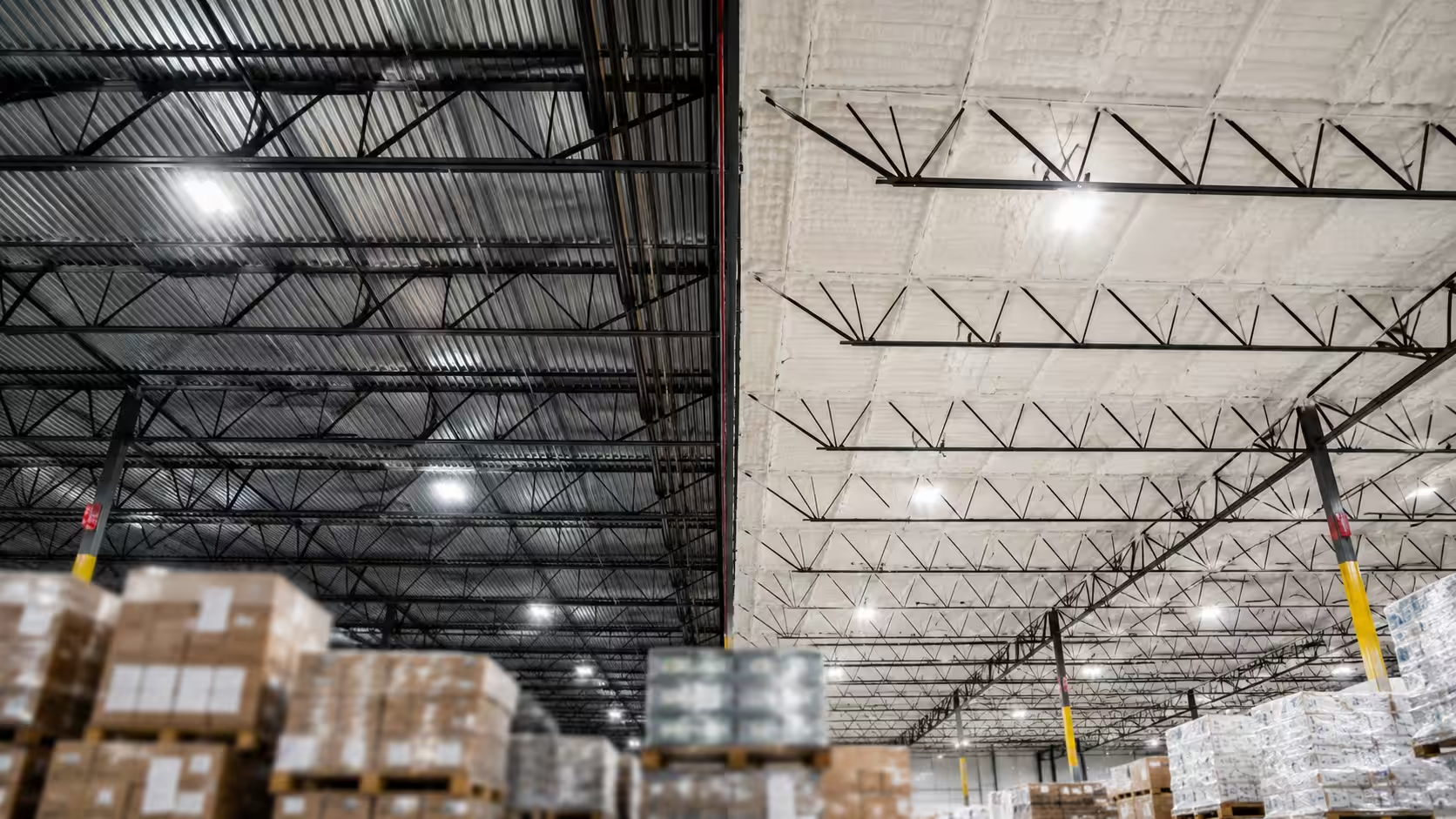
Closed-cell spray polyurethane foam, delivering approximately R-6.5 per inch, is the highest-performing option for metal building warehouse insulation in Florida’s Climate Zone 1A.
Applied directly to steel substrates, it adheres mechanically to the roof deck and wall panels, eliminating air infiltration paths at joints, penetrations, and perimeter connections. It performs as a Class II vapor retarder under ASTM E96 standards, removing the need for a separately specified membrane in most conditioned assemblies.
Closed-cell spray foam is the preferred system for conditioned warehouses, cold storage facilities, and any structure with a documented history of condensation or corrosion.
Fiberglass blanket systems
Fiberglass metal building blanket insulation is the most common cost-effective option for large-footprint applications. It is vapor-permeable and provides minimal air barrier performance without a properly installed facing system or supplemental air barrier membrane.
In moisture-vulnerable assemblies, it requires precise detailing at all laps, seams, and terminations to achieve reliable condensation control. When properly detailed, fiberglass blanket systems serve well-defined roles in unconditioned or budget-constrained warehouses.
Rigid foam board continuous insulation
Rigid foam board insulation provides a strong continuous insulation layer that reduces thermal bridging through steel framing members. It performs well as a component of a layered assembly but requires careful joint detailing at all penetrations.
This option suits projects that need to meet R-value requirements for Florida commercial structures without the cost of spray foam across the full envelope.
Reflective radiant barriers
Reflective radiant barriers reduce radiant heat gain at the roof plane but do not replace bulk insulation. Their performance peaks in ventilated assemblies and diminishes significantly when dust accumulates on the reflective surface.
They are best understood as a supplemental measure within a broader commercial insulation strategy for Florida facilities, not a standalone solution.
Insulated metal panels for new construction warehouse envelopes
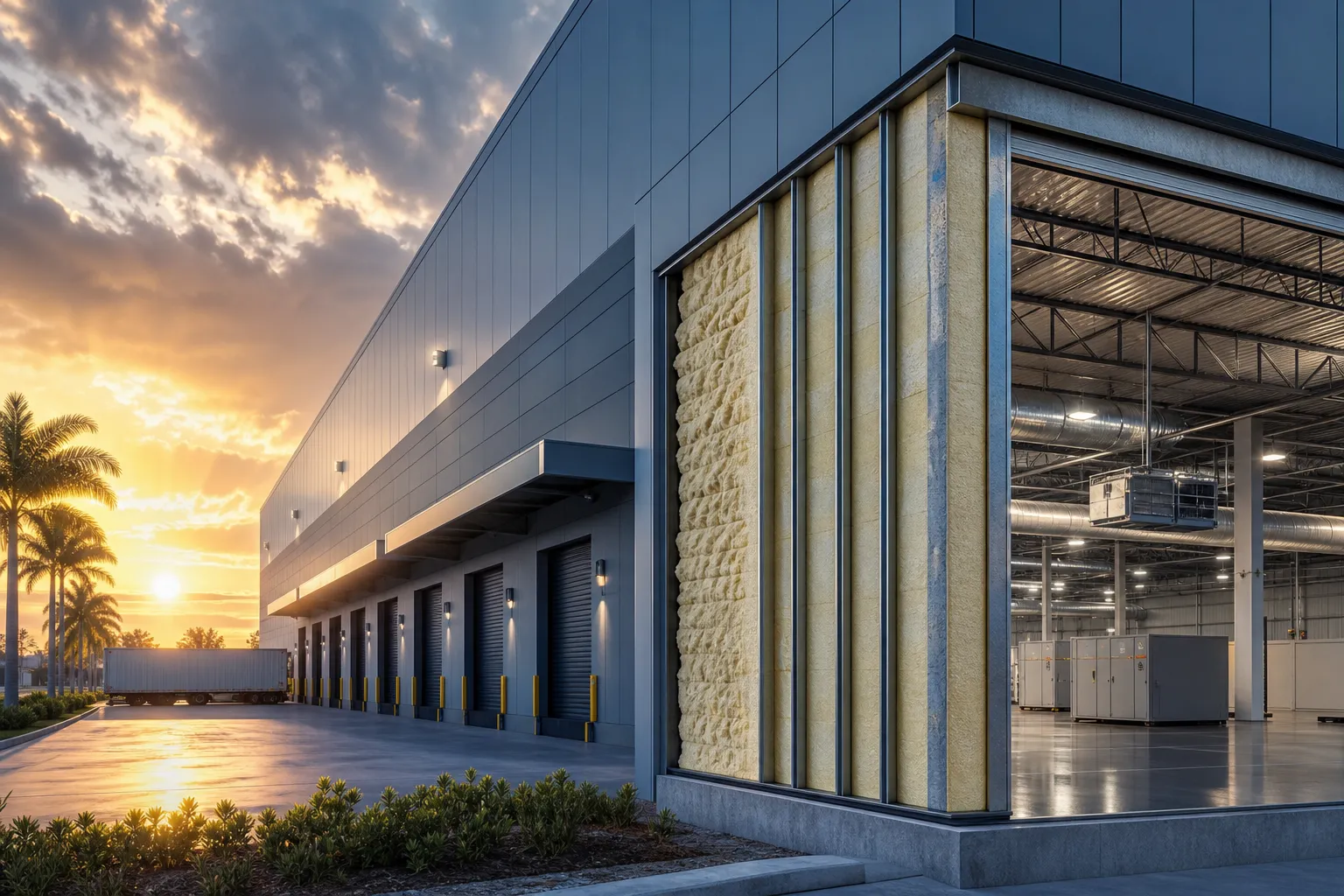
Insulated metal panels (IMPs) represent the premium integrated envelope system for new warehouse construction. IMPs combine structural facing, a continuous insulation core, and a finished interior surface in a single factory-fabricated panel, delivering excellent airtightness and consistent thermal performance when properly detailed at panel joints.
They eliminate thermal bridging through the framing plane almost entirely and significantly reduce long-term mechanical system sizing requirements. While the capital investment is substantially higher than field-applied alternatives, IMPs deliver a predictable, code-compliant envelope with reduced installation schedule risk for design-build and fast-track commercial projects.
Florida Commercial Code Requirements and Warehouse Insulation Envelope Minimums
The Florida Energy Conservation Code (FECC), based on the Florida Building Code Energy Conservation 8th Edition (2023 FBC-EC), governs commercial warehouse envelope performance statewide. The code applies assembly-based R-value minimums under Table C402.1.3, with requirements differentiated by climate zone and assembly type.
Florida is divided primarily between IECC Climate Zone 1A, covering Miami-Dade and the southernmost counties, and Climate Zone 2A, which governs most of the remainder of the state. Facility teams should verify their county’s specific climate zone assignment against the official IECC/FBC climate zone map or confirm with the applicable county building department, as zone boundaries can affect prescriptive minimums.
For a concise summary of Florida code guidance on insulation values and compliance pathways, see a practical overview of Florida Building Code insulation requirements.
Roof and wall assembly minimums for Zone 1A and Zone 2A commercial structures
Under 2023 FBC-EC Table C402.1.3 for Climate Zone 1A commercial metal building applications, the minimum continuous insulation requirement for roof assemblies with insulation entirely above the deck is R-20. Metal wall systems require a minimum of R-13 continuous insulation for exterior walls in Zone 1A.
For concrete masonry unit walls, the code specifies R-7.8 interior insulation or R-6 exterior insulation. These values represent the minimum compliance threshold for permitted construction; high-efficiency facilities serving cold storage, pharmaceutical, or food-grade tenants typically require substantially higher effective R-values to achieve acceptable energy and moisture performance.
Compliance path selection and how it affects insulation design
Florida commercial buildings may pursue either a prescriptive or energy cost budget compliance path. The prescriptive path requires each individual assembly to meet the minimum values specified in Table C402.1.3.
The energy cost budget path allows performance tradeoffs between building systems, which can be advantageous when upgrading insulation in specific zones or when mechanical system efficiency offsets envelope deficiencies.
Commercial projects must also comply with air leakage requirements, typically a maximum of 0.40 cfm per square foot at 1.57 pounds per square foot for the building envelope. A licensed contractor is required to document the selected compliance path and all assembly details on permitted construction drawings submitted to the applicable county building department.
Condensation Control Strategies for Florida Warehouse Insulation in Metal-Frame Buildings
Condensation in metal warehouse buildings is an assembly engineering problem, not a single-product fix. Effective mitigation requires managing three variables together: air leakage, vapor diffusion, and dew point margin within the wall and roof cavity.
A facility with high nominal R-value insulation but inadequate air sealing will still experience interstitial condensation because warm, moisture-laden exterior air bypasses the insulation through infiltration pathways at joints and penetrations. For additional design context on metal building detailing, refer to established metal building design guidance.
Air sealing as the primary mechanism for condensation prevention
Air sealing is the highest-leverage intervention for metal building moisture control. Steel panel joints, roof-to-wall intersections, pipe and conduit penetrations, and perimeter connections are the primary air infiltration pathways in large commercial structures.
Closed-cell spray foam applied to the interior face of the metal shell simultaneously insulates and seals these junctions in a single application pass. Fiberglass blanket assemblies require supplemental air barrier membranes or properly lapped and taped facing systems to achieve comparable leakage control, adding material cost and installation complexity that can offset the lower base material cost.
Vapor retarder selection and correct placement in hot-humid climates
In Climate Zone 1A, vapor control layer placement must account for the direction of vapor drive. In air-conditioned spaces, the interior surface is cooler than the exterior, making the interior face the condensing surface.
Vapor retarder products should therefore be positioned on the interior (cold) side of the assembly in conditioned warehouses, not on the exterior. Placing a Class I vapor barrier on the wrong side of the assembly traps moisture within the insulation cavity and promotes mold growth and structural degradation.
Closed-cell spray foam achieves Class II retarder performance inherently through its low vapor permeance. Fiberglass assemblies require separately specified vapor retarder products with precisely detailed joints and laps, and those details must be maintained throughout the service life of the assembly.
Warehouse Insulation Florida: Installed Cost Benchmarks, Energy Savings, and Utility Rebates
Warehouse insulation investment should be evaluated on a lifecycle cost basis: upfront installed cost measured against projected annual energy savings and available incentive offsets.
DOE commercial building retrofit data and industry case studies indicate that a comprehensive insulation upgrade in a previously under-insulated facility can reduce space-conditioning loads by up to 33%, though actual results depend on pre-upgrade insulation condition, building size, and the scope of measures installed.
Project-based examples from South Florida commercial retrofits document simple payback periods in the range of four to six years, not a universal guarantee, but a reasonable planning benchmark when current utility rates and facility-specific conditions are factored in.
Warehouse insulation cost per square foot: Florida installed benchmarks by material and assembly type
The following benchmarks reflect regional commercial installation conditions in South Florida. Confirm all figures through site-specific bids, as roof height, access conditions, construction phase, and local labor rates all affect final cost:
- Closed-cell spray foam: $1.00 to $2.50 per square foot installed
- Fiberglass metal building blanket: $0.50 to $1.50 per square foot installed
- Rigid foam board (continuous insulation): $1.00 to $3.00 per square foot installed
- Reflective radiant barrier: $0.10 to $0.75 per square foot installed
- Insulated metal panels (new construction): $5.00 to $10.00 per square foot installed
FPL commercial rebate programs and incentive documentation in 2026
Florida Power and Light operates commercial business efficiency programs, and some program pathways have historically included rebates connected to insulation and HVAC-related measures.
Commercial eligibility and current program terms for 2026 should be confirmed directly with FPL or an FPL-approved contractor, as program availability, qualifying measures, and incentive amounts are subject to FPL approval cycles and may differ from prior-year documentation.
The FPL commercial customized incentive pathway generally requires that a qualifying project reduce summer peak demand by a minimum of 25 kW and meet Florida Public Service Commission cost-effectiveness screening criteria. Facility managers and owners should use the ENERGY STAR Rebate Finder, searchable by ZIP code, to identify additional utility programs available in their service territory alongside any applicable FPL commercial offerings. Do not assume current eligibility based on prior-year program terms. For current program information and qualifying measure guidance, consult the official FPL commercial heating and cooling programs.
Selecting the right contractor and next steps
Getting warehouse insulation florida installations right requires precise alignment of material selection, vapor control strategy, code compliance documentation, and installation quality. That combination is harder to achieve than the spec sheet suggests.
Closed-cell spray foam remains the most technically defensible solution for conditioned metal-frame warehouse envelopes, delivering integrated thermal resistance, air barrier performance, and Class II vapor retarder function in a single applied system. Fiberglass blanket systems and reflective radiant barriers fill well-defined supplemental roles in unconditioned or budget-constrained applications, provided the detailing is done correctly.
Broward Insulation is a licensed Florida insulation contractor with extensive IECC Climate Zone 1A field experience, serving commercial and industrial facilities across Broward, Miami-Dade, and Palm Beach counties.
The firm engineers thermal envelope systems, mechanical room insulation, commercial pipe insulation for chilled water and HVAC distribution systems, and acoustic compliance assemblies for large-scale multi-family and commercial structures. All projects are executed in full compliance with Florida Building Code Energy Conservation requirements and applicable HVHZ structural provisions.
To view our scope of commercial work and past building envelope projects, explore our commercial insulation contractor services, inspect our project portfolio, or review our spray foam insulation solutions.
For warehouse insulation Florida projects of any scale, Broward Insulation offers technical consultations and site-specific assessments. Facility managers, commercial architects, general contractors, and property owners are welcome to reach out directly. A licensed engineer-reviewed scope of work, code compliance documentation, and FPL rebate pathway analysis are available as part of the initial project evaluation.