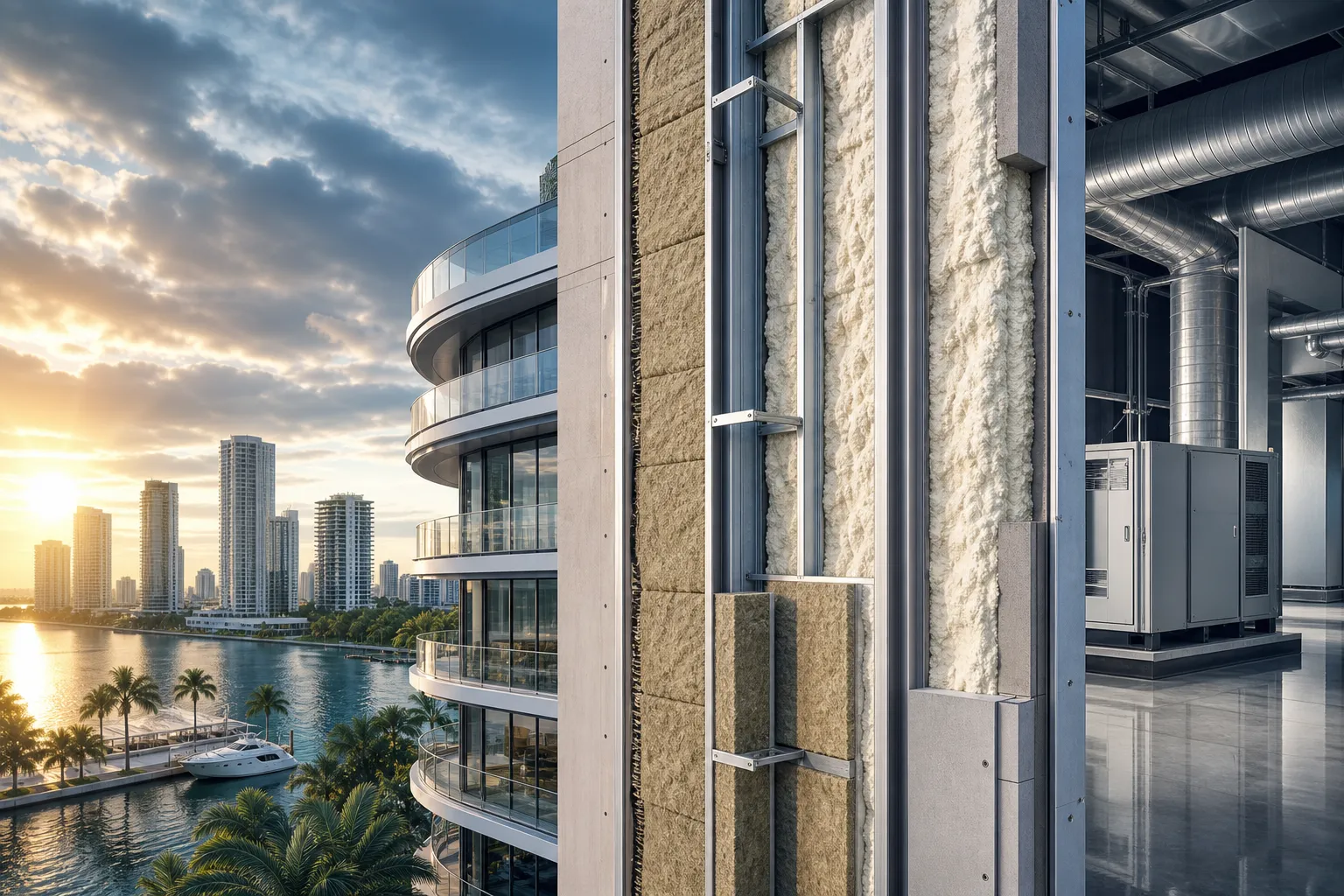
Vetting a Commercial Insulation Contractor in Broward County
Executive summary: Selecting a commercial insulation contractor in Broward County requires systematic verification across six non-negotiable criteria: Florida contractor licensure under a recognized Certified General Contractor (CGC), Certified Building Contractor (CBC), or applicable mechanical trade category; Broward County Board of Rules and Appeals (BORA) local registration; demonstrated IECC Climate Zone 1A code compliance with a minimum R-25 to R-30 for roof assemblies; verifiable commercial project credentials and industry certifications such as SPFA and ICAA; FPL-Approved Contractor status for access to Florida Power and Light utility rebate programs; and fully itemized contract terms with post-installation documentation requirements. Broward Insulation, founded in 1977 and operating continuously across Broward, Palm Beach, and Miami-Dade counties, meets the core criteria outlined in this guide. Building owners should verify specific items against primary sources as part of their due diligence process.
Florida licensing and Broward County registration: what to verify first
Florida does not issue a standalone insulation contractor license. Commercial insulation work must be performed under, or formally subcontracted through, a Florida-licensed Certified General Contractor (CGC), Certified Building Contractor (CBC), or applicable mechanical trade certification, depending on the scope. Spray foam, blown-in, and rigid board applications on commercial structures typically fall under the CGC or CBC scope. Pipe insulation and duct insulation associated with HVAC systems may require a mechanical contractor license. Building owners must confirm the exact license category against the permitted scope before execution of any agreement.
State licensure alone is insufficient to authorize commercial work in Broward County. Any state-certified contractor must maintain an active registration with the Broward County Board of Rules and Appeals (BORA) before pulling permits within county jurisdiction. An unregistered Florida certificate does not confer local permit authority. Building owners and facilities managers should request the contractor’s BORA registration number in writing at the outset of procurement and verify its current standing directly with BORA prior to contract execution.
Broward County’s contractor registration checklist further requires both a current workers’ compensation insurance policy, or a valid exemption certificate, and documented surety bond coverage. Request insurer-issued certificates directly, or verify coverage with the insurer, rather than relying on photocopies. Confirm that coverage dates extend through the full projected project schedule. A lapse in workers’ compensation coverage during the installation period can create liability and insurance coverage gaps that may expose the building owner; consult legal counsel or your insurer to understand your specific exposure before proceeding.
Florida Building Code requirements for commercial insulation in Broward County
Broward County falls within IECC Climate Zone 1A, which governs all thermal envelope specifications under the Florida Building Code. For commercial roof and ceiling assemblies, the prescriptive minimum for insulation installed entirely above the roof deck is R-25. Where continuous insulation covers the full ceiling area, the applicable minimum for attic-type assemblies is commonly R-30, with R-38 referenced as the stricter baseline in certain configuration types. All stated R-values apply exclusively to added insulation and do not include the thermal contribution of structural materials such as concrete masonry, framing, or gypsum board. Building owners should ask their commercial insulation contractor in Broward County to cite the specific Florida Energy Code table and section governing their assembly type. For an accessible summary of how Florida code addresses insulation requirements, consult a technical overview on Florida building code insulation requirements (Florida Building Code insulation requirements).
Commercial exterior wall performance under the Florida energy code is governed by assembly-specific U-factor targets rather than a single universal R-value. The commercial prescriptive target for shell construction approximates U-0.032, roughly equivalent to R-30, but the compliant insulation specification varies significantly based on whether the assembly is wood-framed, metal-framed, or concrete masonry unit (CMU) construction. CMU structures require a different insulation strategy than framed walls, and the specifying contractor must confirm the compliant assembly for each building type and applicable code edition.
Broward County’s location within the High-Velocity Hurricane Zone (HVHZ) adds a compliance layer that does not apply in other Florida markets. HVHZ designation restricts approved materials and installation methods; certain foam system chemistries and attachment methods require specific Florida Product Approval documentation before installation. A commercial spray foam contractor in Broward County must demonstrate active familiarity with HVHZ-compliant specifications, not simply general IECC knowledge.
Material selection cannot be driven by cost-per-square-foot alone. Closed-cell spray foam, rigid continuous insulation board, and batt insulation each produce different effective R-values per inch and follow distinct code-compliance pathways. The specifying contractor is responsible for matching the material to the assembly type and demonstrating that the installed system meets the applicable Florida Building Code prescriptive or performance path for the specific building envelope configuration.
Evaluating contractor qualifications, experience, and commercial references
Industry credentials and certifications to request
Industry certifications serve as verifiable proxies for commercial-grade technical capability. The most directly applicable credential for commercial building insulation work is the ICAA Certified Commercial Building Insulation Contractor designation. For spray foam scopes, the Spray Polyurethane Foam Alliance (SPFA) Professional Certification Program provides a multi-level credentialing structure, from SPF Assistant through SPF Project Manager, administered under ISO 17024 standards. For details on contractor certification programs for SPF installers, see the SPFA contractor certification infographic (SPF Contractor Certification).
Manufacturer certification for spray foam systems is a prerequisite for product warranty validity and should be confirmed for each system specified in the bid. OSHA 10-hour Construction training represents the baseline safety credential for field crews. Building owners should request certificate copies for all credentials listed and confirm they apply to the crew members assigned to the project, not only to principals.
The distinction between a residential insulation company that accepts occasional commercial assignments and a Broward County commercial insulation contractor with a documented project history is operationally significant. A qualified commercial insulation contractor in Broward County should be able to provide named references for comparable scope projects: warehouse facilities, office buildings, multi-family high-rises, or condominiums. Years of continuous operation in South Florida’s specific climate and code environment is a material differentiator, particularly for Climate Zone 1A moisture control and HVHZ compliance experience.
How Broward Insulation measures up
Broward Insulation | Licensed Florida Insulation Contractor Since 1977 illustrates what strong credential documentation looks like in practice. Established in 1977 and operating continuously for nearly five decades across the South Florida Tri-County market, the company holds FPL-Approved Contractor status and maintains the capacity to provide direct commercial facility and condominium project references. As of 2026, the company carries consistently high ratings across verified third-party platforms, reflecting the level of documented, verifiable performance building owners should require of any contractor submitting a commercial insulation bid in Broward County.
Commercial insulation cost ranges and how to structure a competitive bid
The following installed cost ranges reflect 2026 South Florida commercial market conditions and should be treated as planning benchmarks rather than fixed-price references. Final pricing is determined by application type, access conditions, substrate preparation requirements, and code-required thickness. All ranges are approximate installed costs.
- Closed-cell spray foam: $1.75 to $3.00 per board foot installed
- Open-cell spray foam: $1.00 to $1.50 per board foot installed
- Rigid continuous insulation board: $1.50 to $4.00 per square foot installed
- Batt insulation: $0.75 to $2.00 per square foot installed
A complete commercial insulation bid must itemize every cost component to allow accurate comparison across contractors. Required line items include: material type and manufacturer, R-value or board-foot thickness by application zone, total square footage or linear footage by zone, labor, vapor barrier or air-sealing scope, permit fees, fire-rated assembly requirements where applicable, and post-installation inspection protocol. Treat significant omissions from a submitted bid as a serious deficiency requiring clarification before any contract discussion proceeds.
Low bids in commercial insulation procurement often signal omissions, not efficiency. Substrate preparation, fire-rated assembly specifications, and the cost of bringing existing envelope assemblies into current Florida Building Code compliance are frequently excluded from stripped-down estimates. A technically complete scope from a licensed and registered Broward commercial insulation contractor will consistently carry a higher unit cost than an unverified, non-permitted estimate. The differential represents avoided risk, not margin. For a practical market view of spray foam installed costs to inform your budget conversations, review a current spray foam insulation cost guide (spray foam insulation cost guide).
Utility rebates and federal incentives available in 2026
Florida Power and Light’s commercial energy-efficiency rebate programs require that the installation be performed by an FPL-Approved Contractor, specifically a Participating Independent Contractor (PIC) registered in FPL’s contractor portal. Building owners served by FPL cannot access these rebates through a contractor that lacks approved status, regardless of the quality of the installation. The typical FPL workflow includes submission of a project proposal prior to installation, pre- and post-installation inspections, and a rebate application filed within one year of project completion; verify current program rules and timelines directly with FPL or the applicable program page before committing. Broward Insulation holds current FPL-Approved Contractor status and can guide qualifying commercial clients through the process. For details on FPL’s PIC enrollment, see the FPL Participating Independent Contractor program page (FPL PIC program).
The federal Section 179D Commercial Building Energy Efficiency deduction provides an additional financial lever for qualifying commercial insulation upgrades. To preserve eligibility under current rules, construction must begin on or before June 30, 2026. Qualifying projects must demonstrate a minimum 25 percent reduction in total annual energy and power costs relative to the applicable ASHRAE 90.1 reference building baseline. Documentation requirements include a certified energy analysis, plans and specifications confirming the insulation as a building envelope component, and placed-in-service records. Building owners should engage a qualified tax professional to confirm eligibility and manage the deduction claim on the applicable federal return. For an overview of the Section 179D deduction and how it applies to energy-efficiency measures, see this summary on Section 179D tax provisions (Section 179D Energy Efficiency Deduction).
Contract terms, inspection rights, and questions to ask before signing
Five questions every building owner must ask
Before executing any commercial insulation contract in Broward County, building owners must obtain written answers to the following questions from each prospective contractor:
- Which Florida license category covers this specific insulation scope?
- Is your BORA registration current, and what is your BORA registration number?
- Does your company pull the permit directly, or does permit authority run through a third party?
- What Florida Building Code sections govern the specified R-value and assembly type for this project?
- Do you hold current FPL-Approved Contractor status?
What the contract must include
Verbal representations carry no contractual weight. Require that all answers be incorporated into the written contract or documented in a formal pre-contract correspondence record. Require the contract to identify the insulation manufacturer, the specific product line, and the full warranty term. For spray foam systems, the contract must confirm that the contractor holds active manufacturer certification. Liability provisions must explicitly address thermal performance failure, moisture intrusion, and code non-compliance identified at inspection. Without clear contractual allocation of these responsibilities, the building owner may face financial exposure for rework or failed inspections; negotiate this language before signing and consult legal counsel if needed.
The post-installation documentation package is a contractual deliverable, not an optional courtesy. The contract should require the contractor to deliver the closed permit with final inspection sign-off, thermal performance reports where applicable, FPL rebate application materials, and manufacturer warranty registration confirmation. This package is a material asset in any subsequent commercial real estate transaction, insurance review, or appraisal.
Conclusion: apply a verifiable standard to every commercial insulation contractor in Broward County
The six-step vetting framework outlined in this guide, encompassing Florida licensure and BORA registration, Climate Zone 1A code-compliant R-value specification, verified commercial credentials and project references, complete and itemized bid comparison, FPL-Approved Contractor status, and enforceable contract terms, gives building owners and facilities managers a defensible, documentation-based selection process. Each criterion is independently verifiable. None of them requires the building owner to rely on marketing representations.
For building owners ready to apply this framework, Broward Insulation offers nearly five decades of continuous commercial insulation work across South Florida’s Climate Zone 1A environment, a depth of climate-specific and code-specific experience that a recently established contractor or national franchise operating from a generic model cannot replicate. Insulation Contractor Ocean Ridge FL | Spray Foam & Attic | Broward Insulation Contact Broward Insulation to request a fully itemized commercial insulation estimate and credential documentation package for your Broward, Palm Beach, or Miami-Dade facility. Contact Broward Insulation | Florida’s Licensed Spray Foam Contractor