Broward County Insulation Permit: Your 2026 Complete South Florida Guide
Executive Summary: A Broward County insulation permit is required for most new insulation installations, spray foam projects, and major insulation replacements that affect a building’s thermal envelope. The primary required forms are the Broward County Uniform Building Permit Application (revised effective March 9, 2026) and the Insulation Certificate, which must itemize manufacturer, type, thickness, and R-value for each assembly. Projects utilizing a Private Provider must also include the Notice to Building Official form 61G20-2.005-2002.01. The standard permit fee is 1.85% of declared job value with a $125 minimum. Approval timelines range from 21 to 25 business days for incorporated municipalities to 30 to 50 business days for unincorporated Broward County. The most common cause of failed insulation inspections is installed R-value that does not match the specifications submitted with the permit application. Property owners achieve the most predictable outcomes by engaging a licensed South Florida insulation contractor who manages the permitting process from application through final inspection approval.
Obtaining a building permit for insulation work in Broward County is not a bureaucratic formality. It is a legally binding compliance requirement under the Florida Building Code, and errors in the application process carry direct financial and timeline consequences. For property owners, investors, and building professionals operating in the South Florida Tri-County market, understanding the precise requirements before initiating work is the difference between a project that closes on schedule and one that stalls in plan review for months.
This guide covers every stage of the process: permit trigger thresholds, required documentation, ePermits OneStop submission procedures, current fee structures, approval timelines, and the inspection standards that determine final approval under IECC Climate Zone 1A building science requirements.
When a Broward County Insulation Permit Is Actually Required
Scope of work that triggers a permit
Any new insulation installation, full replacement of existing insulation, or spray foam application that modifies the building’s thermal envelope requires a permit under the Florida Building Code. This applies to all property classifications throughout Broward County. Closed-cell spray foam, open-cell spray foam, and blown-in attic insulation upgrades exceeding routine maintenance all fall within permit jurisdiction. Any insulation work tied to HVAC system modifications does as well. Florida Building Code provisions governing the building envelope make the permit trigger clear: any work that alters the conditioned space boundary is a regulated activity, regardless of project scale.
Unincorporated Broward County vs. incorporated municipality jurisdiction
In our permitting experience, the jurisdiction distinction is the factor property owners most consistently fail to verify before submission. Properties located in unincorporated Broward County are governed directly by the Broward County Building Code Division, and applications are submitted through the county’s ePermits OneStop portal using county-standardized forms. Properties within incorporated municipalities, including Fort Lauderdale, Hollywood, and Pompano Beach, are processed through each city’s independent building department and permitting portal. Fort Lauderdale, for example, uses its LauderBuild system with its own specific submission requirements. Applicants who submit to the wrong jurisdiction must restart the process entirely, adding weeks to the timeline. Confirming jurisdiction before preparing a single document is non-negotiable. For guidance on related permitting and code requirements, see our Florida Building Code Insulation resources.
Work that typically does not require a permit
Minor repairs and partial top-up additions to existing insulation that do not modify the building envelope may qualify for exemption from the permitting requirement. Exemption from permitting, however, does not mean exemption from code compliance. All installed insulation in a Climate Zone 1A structure must satisfy the minimum R-value requirements established by the Florida Building Code, regardless of permit status. No remedial work or partial installation creates a basis for installing substandard materials.
Required Forms and Documentation for a Broward County Insulation Permit
The Broward County Uniform Building Permit Application
The Broward County Uniform Building Permit Application is the primary submission form for all insulation permit applications. The revised version, effective March 9, 2026, is the only version accepted for applicable permit types, prior versions are no longer valid. The application must be completed with the licensed contractor’s information, the precise project address, an accurate scope of work description, and the correctly declared job value. Projects utilizing a Private Provider for inspections must attach the Notice to Building Official form 61G20-2.005-2002.01 as a mandatory component of the submittal package.
Insulation Certificate and R-value compliance documentation
The Broward County Insulation Certificate is a mandatory supporting document that must accompany every permit application. The form requires the licensed contractor to identify the manufacturer, type, thickness, and R-value for each insulation assembly, masonry wall, stud wall, ceiling and roof, garage ceiling, and any other applicable assembly. All R-values declared on the certificate must represent insulation-only values that are tested and labeled by the manufacturer. Energy compliance documentation must accompany the application and identify the specific insulation type, installation method, and R-values for all exterior-adjacent wall and roof assemblies. Any design modification that affects the thermal envelope after initial submission requires a revised energy compliance report before inspection approval will be granted. You can review the county’s sample Insulation Certificate for formatting and required fields.
Contractor license and manufacturer specification requirements
The submittal package must include the licensed contractor’s Florida state license number and Broward County registration. Manufacturer product specification sheets must be submitted alongside the energy compliance documentation to substantiate the performance values declared on the Insulation Certificate. Discrepancies between the product specifications and the declared values on the permit forms are among the most frequent causes of application rejection during plan review. The specification sheet and the Insulation Certificate must reference the same product, assembly type, and performance ratings without exception.
How to Submit Your Application Through Broward ePermits OneStop
- Navigate to the Broward County Building Code Division ePermits OneStop portal, or the specific municipal ePermitting page corresponding to the project’s jurisdiction.
- Create a new ePermits account if one does not already exist. Existing users sign in directly.
- Initiate a new permit application and select the correct permit type for the insulation scope of work.
- Upload the completed Uniform Building Permit Application, Insulation Certificate, energy compliance documentation, manufacturer specification sheets, and all plans showing insulation type, placement, and R-values by assembly.
- Verify municipality-specific requirements before submission. Certain jurisdictions, including Tamarac, require a notarized jurat within the application package. Omitting municipality-specific attachments results in an incomplete application flag.
- Monitor application status under the “My Applications” section of the ePermits dashboard following submission. Applications flagged for missing or incorrect documentation during plan review will reset your timeline from the date the corrected submittal is received.
A complete, accurate first submission is the single most effective way to control your timeline. Every correction cycle adds weeks to the approval process and creates financial exposure, particularly on time-sensitive investment or renovation projects.
Broward County Insulation Permit Fees and Approval Timelines
How Broward County calculates insulation permit fees
The standard fee is calculated at 1.85% of the declared job value, with a minimum base permit fee of $125. Standard inspections are included within the permit fee. Property owners and contractors must also account for ancillary fees. A $50 permit extension fee applies when an active permit requires a time extension, and the minimum fee for an expired permit is $125. Permits renewed within 180 days of expiration require payment of one-half of the original permit fee. Those renewed after that window require a full new application, with all required approvals obtained from the beginning. Declared job value must be accurate; underreported values create compliance risk and can invalidate the permit upon discovery. For the county’s official fee breakdown, refer to the Broward County fee schedule.
County-level vs. city-level review timelines
Residential plan review for projects in unincorporated Broward County typically takes 30 to 50 business days for complete submittals. Incorporated municipality review is generally faster, averaging 21 to 25 business days for applications submitted without deficiencies. These timelines apply to complete packages only. An incomplete application flagged during plan review delays approval from the corrected resubmittal date, making first-submission accuracy a direct financial and schedule variable. Broward County insulation permits are valid for 180 days from issuance, and all work must commence and progress within that window.
What to Expect During the Insulation Inspection and Why Applications Fail
When and how inspections are scheduled
Have you ever had a finished wall fail inspection simply because the inspector couldn’t see what was behind it? That’s exactly what this sequencing requirement is designed to prevent. Insulation inspections are conducted after installation is complete and before drywall or wallboard is closed over the insulated cavities. This allows the building inspector to physically verify the installed insulation type, depth, placement, and coverage against the approved permit documents. Inspections are requested through the same ePermits portal or municipal building department portal used for the original application. Scheduling an inspection before installation is fully complete, or after drywall has been installed, will result in an automatic failure or a deferred inspection that adds time to project completion.
The most common reasons insulation inspections fail in Broward County
- Insufficient R-value: Installed insulation does not meet the minimum R-20 in wall cavities or R-38 in roof and ceiling assemblies required under Florida Building Code Climate Zone 1A standards.
- Incomplete coverage: Gaps around roof sections, wall cavities, or penetration points reduce effective thermal performance below code minimums.
- Improper installation depth or density: Product installed inconsistently with the manufacturer’s instructions or the approved permit plans.
- Missing thermal or ignition barrier: Spray foam left exposed without the required 1/2-inch gypsum thermal barrier in occupied spaces, or without an approved ignition barrier in limited-access attic and crawlspace areas, fails inspection regardless of R-value compliance.
- Documentation mismatch: Installed product differs from the manufacturer specifications submitted with the permit, or the Insulation Certificate contains incomplete or inaccurate entries.
Pre-inspection verification to pass on the first attempt
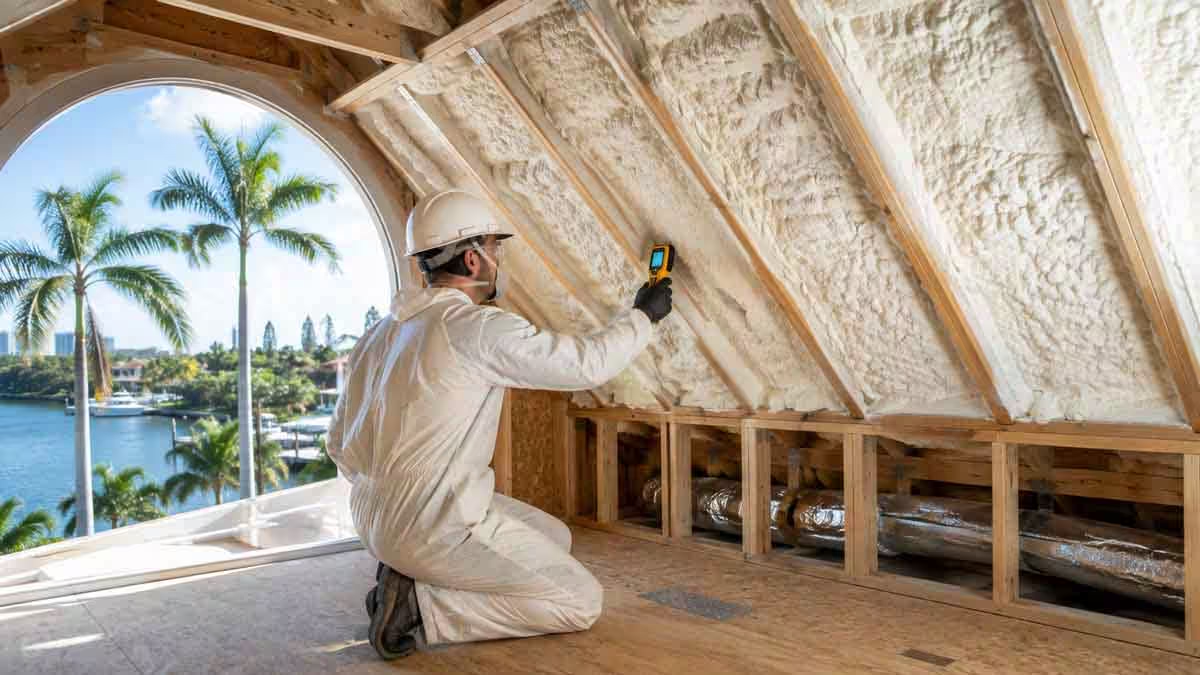
Before scheduling the inspection, verify that installed R-values and product labels correspond exactly to the permit documents on file. Confirm that all cavities are fully covered without gaps and that spray foam applications include the required thermal or ignition barrier appropriate to the assembly location. If any structural or layout modifications were made during installation that deviate from the approved plans, a revised submittal is required before inspection can proceed.
Why Licensed Contractors Manage the Permitting Process for You
Navigating Broward County’s insulation permitting process requires current knowledge of jurisdiction-specific forms, Florida Building Code R-value requirements by assembly type, ePermits submission protocols, and inspection preparation standards. An application error at any stage, whether an incorrect form version, a missing attachment, or a declared R-value that does not match the product specification, triggers a full correction cycle that generates additional fees and delays. For commercial properties and multi-family buildings in IECC Climate Zone 1A, the compliance scope extends further, incorporating energy documentation, mechanical coordination, and HVAC compliance review that exceeds the requirements of a standard residential permit submittal. For official county guidance on building code and permitting, see the Broward County Building Code & Permits page.
Broward Insulation has operated continuously in the South Florida Tri-County market since 1977. As a licensed Florida insulation contractor with nearly five decades of direct experience in Broward County, Palm Beach County, and Miami-Dade County, Broward Insulation manages the complete permitting process on behalf of its clients. That includes form preparation, Insulation Certificate completion, energy compliance documentation, ePermits submission, and inspection scheduling and coordination. Clients are not required to interface directly with the Broward County Building Code Division or any municipal building department. Every submittal is prepared to be complete, code-compliant, and inspection-ready on the first attempt. See examples of past work on our Portfolio page.
For projects that qualify for FPL utility rebates, the same permitting documentation required for Florida Building Code compliance also supports the rebate application, so clients capture the financial benefit without any separate documentation effort.
Conclusion
A Broward County insulation permit is a structured compliance requirement with defined triggers, mandatory forms, fee obligations, and inspection standards that carry real financial and timeline consequences for applicants who submit incomplete or inaccurate packages. The required documentation, the updated Uniform Building Permit Application, the Insulation Certificate, and supporting manufacturer and energy compliance materials, must be current, accurate, and submitted to the correct jurisdiction. Approval timelines of 21 to 50 business days apply only to complete submittals, and the 180-day permit validity window begins upon issuance, not application.
The most common points of failure on insulation inspections are entirely preventable. R-value mismatches, incomplete coverage, and missing fire barriers on spray foam applications all come down to systematic pre-installation verification against the approved permit documents. Properties in unincorporated Broward County and those within incorporated municipalities face different submission portals and review processes, and submitting to the wrong system means restarting the application timeline from scratch.
Property owners, investors, and building professionals who need a fully managed, code-compliant insulation installation with accurate Broward County insulation permit processing can contact Broward Insulation directly. The firm serves the complete South Florida Tri-County region, Broward County, Palm Beach County, and Miami-Dade County, and manages every stage of the permitting and installation process to ensure first-attempt approval and inspection compliance. For dedicated support tailored to property owners and developers, see our Contractors information.