Spray Foam vs. Fiberglass for Florida Attics: Which Wins?
If you’re asking is spray foam or fiberglass better for a Florida attic, the direct answer for most South Florida assemblies is closed-cell spray foam, and the gap between the two options is wider than most homeowners expect. Standard cold-climate insulation logic does not apply in IECC Climate Zone 1A, where ambient relative humidity ranges from 74 to 95 percent and summer attic air temperatures in vented assemblies typically reach 117°F to 130°F, with poorly ventilated configurations exceeding 155°F. The Florida Building Code 8th Edition imposes distinct R-value and air-impermeability requirements for vented and unvented attic configurations, and those requirements carry direct consequences for HVAC load, moisture integrity, and long-term asset value.
The core finding is this: closed-cell spray foam is the superior thermal and moisture control solution for the majority of South Florida attic assemblies, particularly where HVAC equipment or ductwork is located in the attic. Blown-in fiberglass retains viability in strictly budget-constrained scenarios with specific assembly conditions. Broward Insulation has served the Tri-County market since 1977, conducting engineering assessments calibrated exclusively to Climate Zone 1A building science, and the data below reflects that operational depth.
R-Value Performance: Is Spray Foam or Fiberglass Better for a Florida Attic?
R-value per inch: what the numbers mean for Florida heat loads
Nominal R-values per inch are not interchangeable across climate zones. Closed-cell spray foam delivers R-6.0 to R-6.5 per inch. Open-cell spray foam provides R-3.6 per inch. Fiberglass batts range from R-3.2 to R-3.4 per inch, and blown-in fiberglass performs at R-2.4 to R-3.0 per inch under installation conditions. In South Florida, where hip-roof and low-slope geometries constrain available attic depth, R-value per inch is a primary engineering variable, not a secondary consideration. For independent testing and comparative R-values per inch, see the spray foam R-value per inch analysis. You can also review one of our local case studies on Improved Attic R-value installations to see how R-value constraints were resolved in a constrained attic.
Why effective R-value diverges from nominal ratings in humid climates
Fiberglass is a porous, hygroscopic material. In sustained high-humidity conditions, moisture infiltration degrades the batt matrix. Blown-in fiberglass in particular can see effective performance drop to R-2.0 to R-2.5 per inch under real-world Florida conditions, though batt fiberglass typically shows smaller losses. Closed-cell foam maintains its rated R-6.5 per inch regardless of ambient humidity because its closed-cell matrix does not absorb moisture. Code compliance is established using nominal R-values from product technical data sheets; marketing “effective R-value” claims are not the compliance standard.
Florida code minimums versus performance targets
The Florida Building Code 8th Edition requires R-30 at the attic floor for vented assemblies and a minimum of R-20 air-impermeable insulation applied to the underside of the roof deck for unvented assemblies. ENERGY STAR recommends R-30 to R-60 for Climate Zone 1A, exceeding code minimums for both configurations. Achieving code compliance and achieving optimal energy performance are distinct thresholds. Conflating the two produces installations that satisfy inspectors while generating persistently high utility bills.
Moisture Migration, Condensation Risk, and Mold in South Florida Attics
How fiberglass performs under 74 to 95 percent relative humidity
Blown-in and batt fiberglass are air-permeable materials. In South Florida’s ambient humidity environment, warm exterior air migrates through the attic assembly and condenses on cooled surfaces, roof sheathing, HVAC equipment casings, and supply ductwork. Once the fiberglass matrix reaches saturation, it loses structural integrity, sustains mold colonization, and contributes directly to roof sheathing rot. When sheathing replacement and mold abatement costs are factored against the original price difference between fiberglass and closed-cell foam, fiberglass can prove more expensive over a ten-year lifecycle than the upfront premium for foam.
Closed-cell foam as a Class II vapor retarder and air barrier
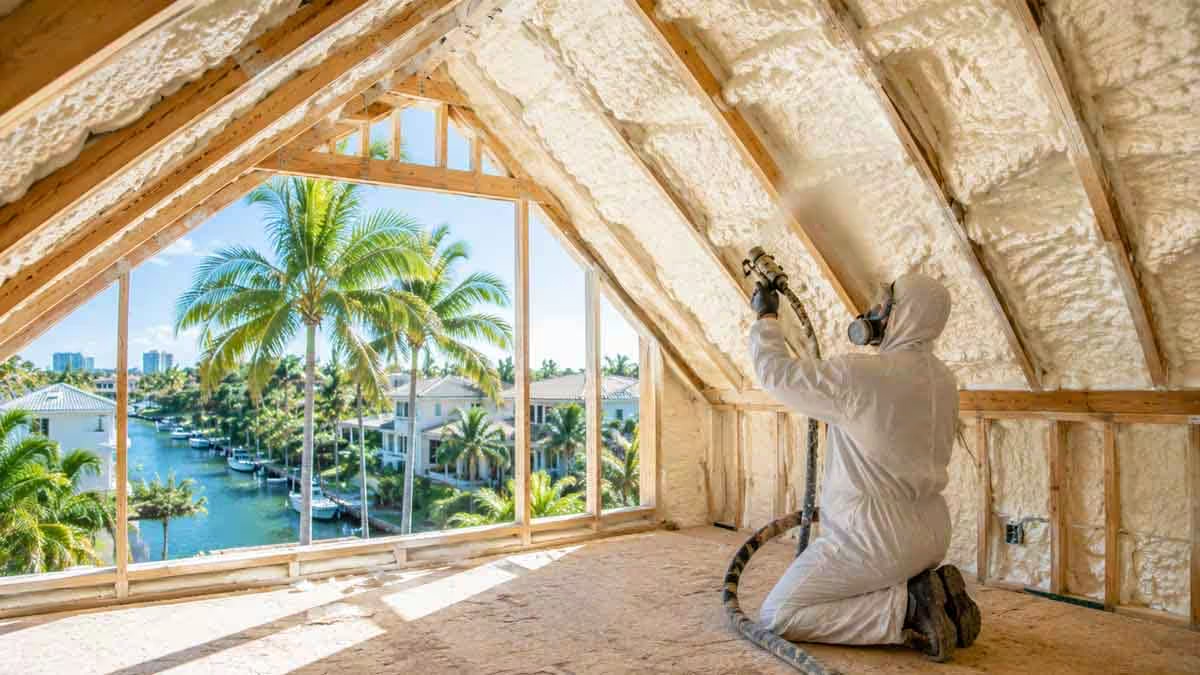
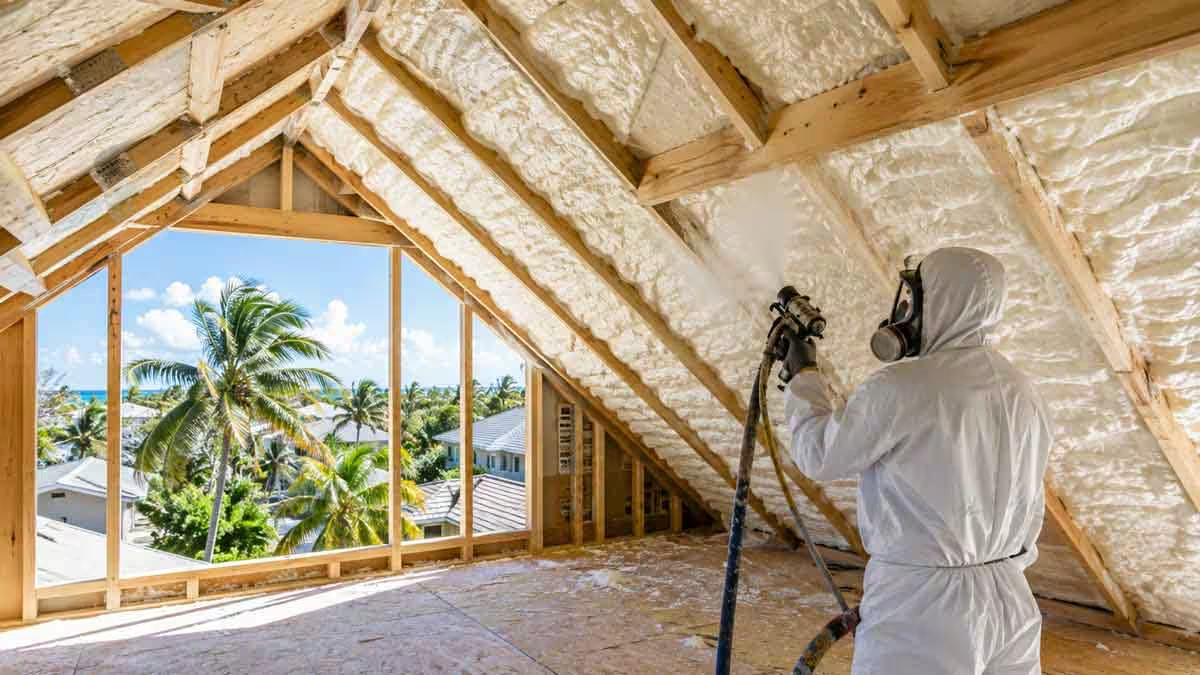
Closed-cell spray foam serves a dual function in Florida attic assemblies. It operates simultaneously as a Class II vapor retarder, blocking moisture vapor diffusion through the assembly, and as a continuous air barrier, eliminating convective moisture transport through ceiling penetrations and attic bypasses. When applied at code-minimum thickness, it blocks over 95 percent of moisture transfer. The material is water-resistant and does not readily support mold growth under sustained high-humidity exposure. One nuance worth noting: closed-cell foam applied at the roof deck can conceal active water intrusion, which is why a thorough moisture assessment before installation matters. For guidance on converting attic assemblies, resources on how to convert a Florida attic from vented to unvented are useful additional references when planning that transition.
Roof sheathing rot: the hidden cost of moisture failure
A vented attic assembly with fiberglass on the attic floor exposes roof sheathing and rafter members to sustained condensation throughout South Florida’s air-conditioned months. Summer relative humidity in the Tri-County region consistently reaches 85 to 95 percent, and that moisture-laden air contacts cool roof surfaces continuously. The resulting cycle of condensation, mold colonization, and structural wood decay is a documented failure mode in South Florida residential construction, one that generates remediation costs far exceeding the upfront investment in a closed-cell foam assembly.
Energy Savings and HVAC Load Reduction in South Florida Homes
Conditioned attic versus vented attic: impact on AC runtime and duct efficiency
In a standard vented South Florida attic, summer air temperatures typically reach 117°F to 130°F, with poorly ventilated configurations exceeding 155°F. HVAC ductwork located in that thermal environment loses 20 to 30 percent of its cooling capacity to radiant heat gain before conditioned air reaches the living space. Converting to an unvented assembly with closed-cell foam at the roof deck reduces attic air temperatures to approximately 85°F to 90°F. That single change keeps ductwork within the thermal envelope and substantially reduces HVAC runtime and compressor cycling, two of the largest contributors to high electric bills in this climate zone.
Expected savings by insulation type: data-supported projections
Florida homeowners converting from a fiberglass-on-floor assembly to spray foam at the roof deck can expect 30 to 50 percent reductions in heating and cooling energy use. Where attic ducts are present and the prior assembly lacked air sealing, savings toward the higher end of that range are well-documented in Florida building science research. Annual utility bill reductions of $400 to $1,200 are realistic depending on home size, existing HVAC efficiency, and prior assembly condition. Payback periods for open-cell spray foam run approximately two years on a net ROI basis; closed-cell spray foam reaches payback at approximately 3.8 years. Blown-in fiberglass carries a shorter nominal payback period but requires eventual replacement and provides no air sealing benefit.
The stack effect: a building science factor with direct financial consequences
The pressure differential between a superheated attic and an air-conditioned living space drives continuous air infiltration through ceiling penetrations, recessed lighting fixtures, and attic bypasses. Air leakage accounts for 25 to 40 percent of cooling costs in South Florida homes. Fiberglass installed on the attic floor does not seal those penetrations. Closed-cell spray foam applied at the roof deck eliminates them entirely. Attic-related heat gain, ceiling heat flux, duct heat transfer, and duct leakage combined, accounts for approximately one-third of the total cooling load in standard residential construction in this climate zone.
Installation Costs, Building Code Compliance, and FPL Rebate Leverage
Cost per square foot: 2026 Florida market rates
Blown-in fiberglass installs at approximately $0.50 to $1.20 per square foot, representing the lowest-entry option for attic insulation. Open-cell spray foam ranges from $1.50 to $3.00 per square foot installed, with total attic projects typically falling between $2,500 and $7,500. Closed-cell spray foam ranges from $1.75 to $4.50 per square foot, with projects generally between $4,500 and $7,000. Attic accessibility constraints, prior insulation removal, and vapor barrier requirements for open-cell foam applications can add $0.50 to $2.00 per square foot to base labor costs. For real-world project examples showing cost, scope, and thermal results, see our Improved Attic R-value portfolio entry.
Florida Building Code requirements for vented and unvented assemblies
FBC 8th Edition requires vented assemblies to achieve R-30 at the attic floor with compliant ventilation ratios of one square foot of free vent area per 150 square feet of ceiling area. Unvented assemblies require a minimum of R-20 air-impermeable insulation applied in direct contact with the underside of the roof deck, a blower door test result below 3 ACH50 per ANSI/RESNET/ICC 380, and whole-house mechanical ventilation. Fiberglass cannot satisfy the air-impermeable requirement for unvented assemblies under any installation methodology. Open-cell foam also requires a vapor diffusion port in unvented Climate Zone 1A assemblies where it is used below structural sheathing. Short answer: when the question is whether spray foam or fiberglass is better for a Florida attic that must meet unvented assembly code, spray foam is the only compliant path. For context on the statewide implementation of the R-20 unvented attic approach, see the industry summary on Florida implements R-20 unvented attic with ducts in conditioned space.
FPL rebate eligibility and ROI acceleration
Broward Insulation operates as an FPL-approved Professional Insulation Contractor, giving qualifying homeowners access to the current $220 instant rebate for ceiling insulation upgrades in Broward County. This rebate applies to both spray foam and blown-in fiberglass installations where existing attic insulation measures below R-8. Homeowners may also qualify for a 30 percent federal tax credit up to $1,200 through the IRS for qualifying insulation improvements, independent of material type. Rebate eligibility is tied to specific installation standards and contractor credentials, Broward Insulation handles that process as part of every qualifying project assessment. For details on program rules and ceiling insulation guidance, refer to FPL’s ceiling insulation resources.
Which Attic Insulation Solution Fits Your South Florida Property?
When closed-cell spray foam is the engineering standard
Closed-cell spray foam is the technically correct specification when HVAC equipment or ductwork is located in the attic, when the property sits in a coastal or high-humidity microclimate, when there is a documented moisture or mold history, or when the project requires FBC-compliant unvented attic assembly conversion. For High-Velocity Hurricane Zone assemblies, closed-cell foam is commonly specified, and in many cases required by the assembly design, where structural adhesion to roof sheathing is a hurricane-resistance criterion; confirm the applicable HVHZ assembly requirements with your design professional. For high-net-worth residential and commercial properties throughout the Tri-County market, closed-cell foam is the insulation standard that protects long-term asset value and delivers measurable HVAC load reduction from the first billing cycle.
When blown-in fiberglass remains a defensible option
Blown-in fiberglass to R-30 is defensible in strictly budget-constrained retrofits where HVAC equipment sits entirely within the conditioned space, where the attic floor is intact, and where all penetrations have been air-sealed with a separate code-compliant material before insulation is installed, and where the project scope is a near-term code-compliance measure preceding a full-envelope retrofit. All three conditions need to apply simultaneously, which narrows the qualifying scenarios considerably. Any attic configuration with ductwork, air handlers, or documented moisture infiltration removes fiberglass from consideration as the primary insulation solution.
Broward Insulation’s attic assessment: what it evaluates
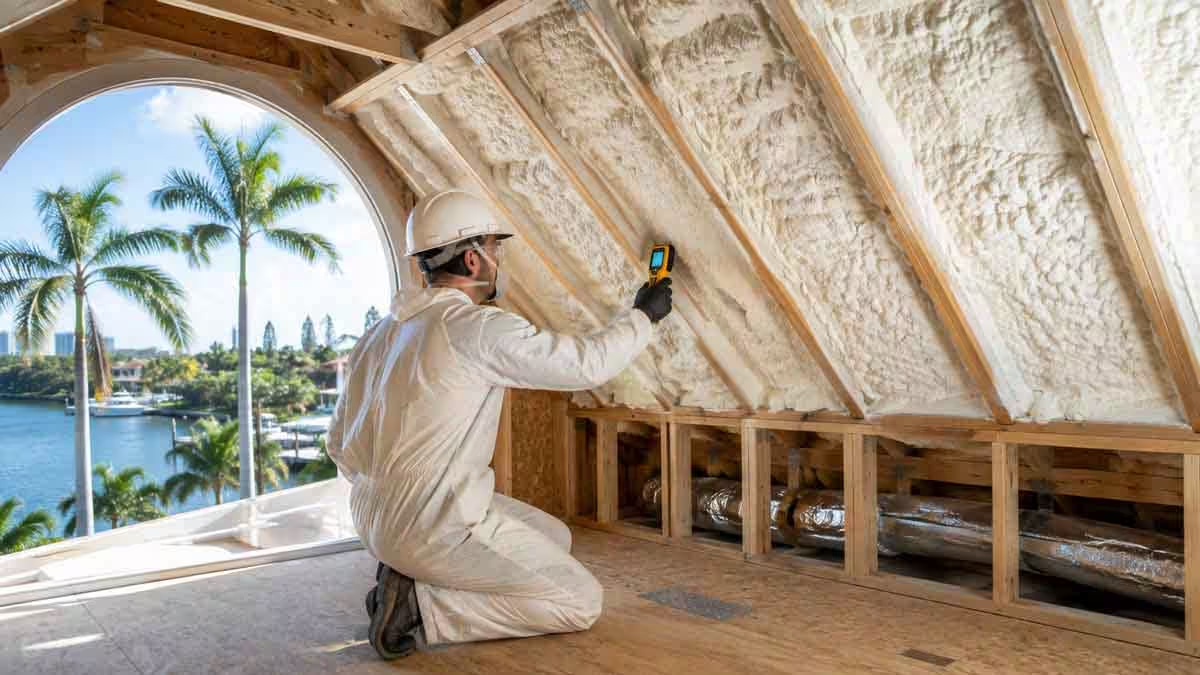
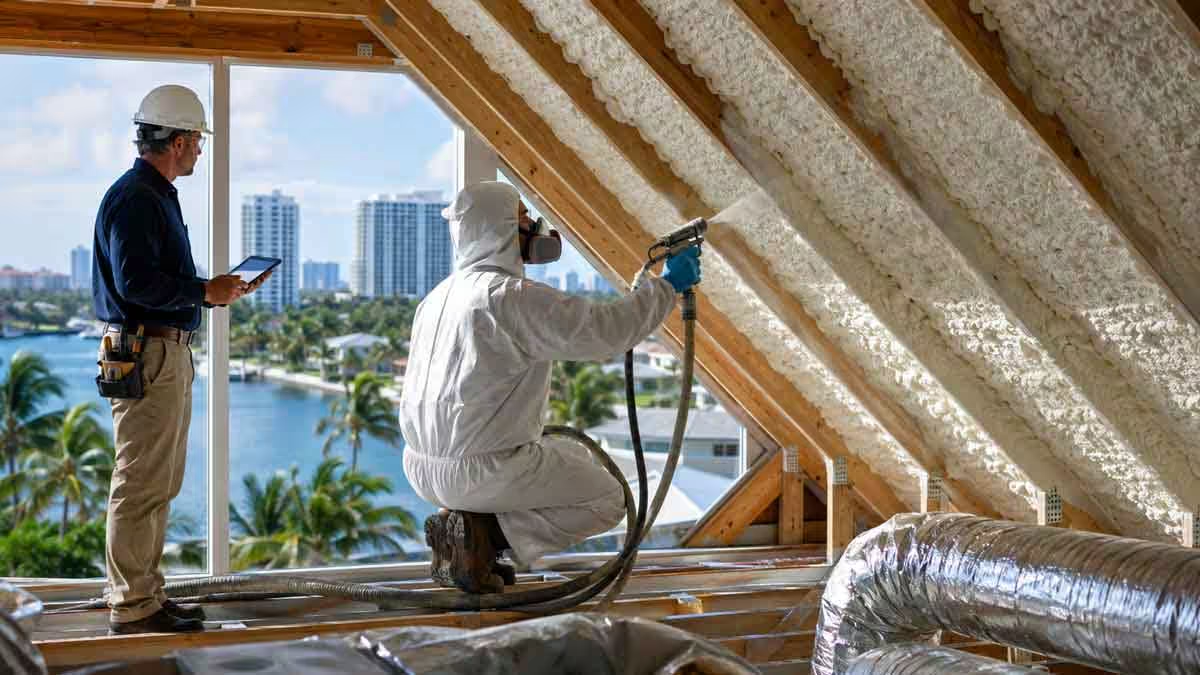
Broward Insulation provides complimentary site assessments for residential and commercial properties throughout Broward, Palm Beach, and Miami-Dade counties. Each assessment evaluates the existing attic configuration (vented versus unvented), current R-value and measured moisture condition, duct location and condition, stack effect indicators, FPL rebate eligibility, and the precise insulation specification required to achieve FBC compliance and maximum HVAC load reduction. That evaluation draws on nearly five decades of continuous operation in Climate Zone 1A, experience that translates directly into fewer surprises after installation. You can review another example of our work in the Improved Attic R-value portfolio entry.
Conclusion: Spray Foam vs. Fiberglass for a Florida Attic Is an Engineering Decision
So, is spray foam or fiberglass better for a Florida attic? The answer depends on attic configuration, moisture exposure risk, duct location, regulatory requirements, and long-term financial objectives, not product preference. Closed-cell spray foam delivers superior R-value stability, continuous air sealing, Class II vapor retardancy, and full FBC compliance for unvented assemblies in the majority of South Florida applications. Blown-in fiberglass retains a limited role in cost-constrained scenarios with specific, verified assembly conditions.
If you skip a professional assessment of your existing attic conditions, duct placement, and moisture history, you risk code violations, accelerated component failure, and ongoing utility costs that quickly exceed the price of getting the installation right the first time. Contact Broward Insulation to schedule a technical attic assessment before committing to either material. The evaluation is complimentary, and it’s backed by nearly 50 years of Climate Zone 1A building science.