1970s Home Insulation Upgrade: A Florida Retrofit Guide
Executive Summary: Residential structures built in South Florida during the 1970s operate with thermal envelopes fundamentally incompatible with current IECC Climate Zone 1A performance mandates under the Florida Building Code 2023 (8th Edition). A 1970s home insulation upgrade in this region is no longer optional for owners seeking code compliance, reduced operating costs, or competitive appraisal positioning.
Original fiberglass batt assemblies, installed without continuous air barriers or Class II vapor retarders, have degraded through five decades of coastal humidity cycling, dropping effective R-values well below original specification. A code-compliant retrofit must address thermal envelope continuity, moisture management, and stack-effect infiltration pathways simultaneously.
Piecemeal upgrades that address only one variable deliver substandard results. Qualified retrofit engagements through a licensed, FPL-Approved Contractor deliver measurable HVAC load reduction, Florida Building Code compliance documentation, FPL rebate capture, and appraisal value improvements that directly affect net asset value for owners of older properties across Broward, Palm Beach, and Miami-Dade counties.
Why 1970s Florida Homes Fail the Thermal Envelope Test
The original insulation materials found in 1970s Florida residential construction follow a consistent profile: loose fiberglass batts in attic cavities, minimal or absent wall cavity fill, no continuous exterior insulation layer, and no Class II vapor retarder.
These assemblies were not designed with the hygrothermal performance standards that Climate Zone 1A building science now demands. Coastal salt air, cyclic thermal expansion, and decades of high relative humidity have further degraded the effective R-value of surviving fiberglass batt installations to a fraction of their original specification.
The compounding risk in pre-1980 assemblies is the confirmed presence of asbestos in certain insulation products used during that construction era. Any insulation removal project on a structure built before 1980 requires a licensed asbestos assessment prior to disturbance. Confirmed asbestos abatement in Broward and Miami-Dade counties carries removal costs of $10.00 to $25.00 per square foot, a mandatory line item in any accurate project budget for a 1970s Florida retrofit.
The financial consequences of this thermal performance deficit are real and measurable. Elevated HVAC operating hours, accelerated equipment degradation, moisture infiltration into wall cavities, and structural moisture accumulation in unventilated attic zones all translate to increased capital expenditure for property owners. Learn how to address these legacy structural challenges in our comprehensive old home insulation retrofit guide.
1970s Home Insulation Upgrade: Diagnostic Steps
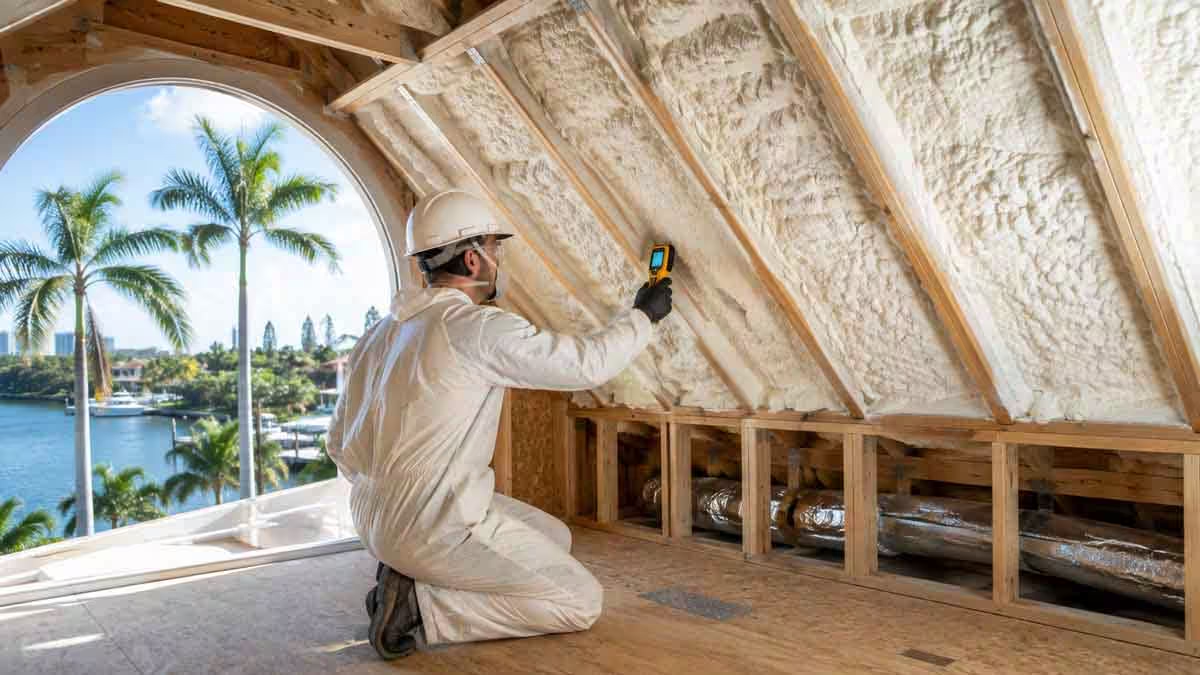
Infrared thermal imaging is the primary diagnostic instrument for legacy assembly evaluation. During a Climate Zone 1A cooling season scan, temperature differentials across wall and ceiling surfaces reveal missing or degraded insulation with high spatial resolution.
Uninsulated or partially degraded wall cavities appear as thermal anomalies against a uniform conditioned background, providing a complete map of envelope deficiency without drywall demolition.
The blower door test provides complementary air infiltration data. By pressurizing the building envelope to a standardized differential, the protocol exposes specific air leakage pathways at assembly junctions, penetrations, and structural transitions where stack-driven infiltration is most severe. The ACH50 measurement this test generates establishes the baseline infiltration rate against which post-retrofit performance can be quantified for Florida Building Code compliance documentation.
For 1970s stucco-clad and CBS construction, the drill-and-probe inspection method provides wall cavity verification without full exterior cladding removal. A licensed contractor drills a small-diameter access point into the wall cavity and inserts a probe or camera to confirm the presence, material type, and approximate density of any existing cavity fill.
This step is mandatory before specifying a blown-in retrofit. It determines whether existing material requires removal or whether the cavity can accommodate additional dense-pack fill without creating moisture trapping conditions. You can review examples of our retrofit capabilities in our insulation projects portfolio.
A professional energy audit incorporating all three diagnostic protocols delivers the thermal mapping, ACH50 measurement, cavity fill confirmation, moisture content readings, and compliance gap analysis required to specify an accurate retrofit scope of work. For additional homeowner-facing guidance on insulating older homes, see This Old House’s guide on insulating an old house.
Retrofit Methods Evaluated for South Florida’s Climate Conditions
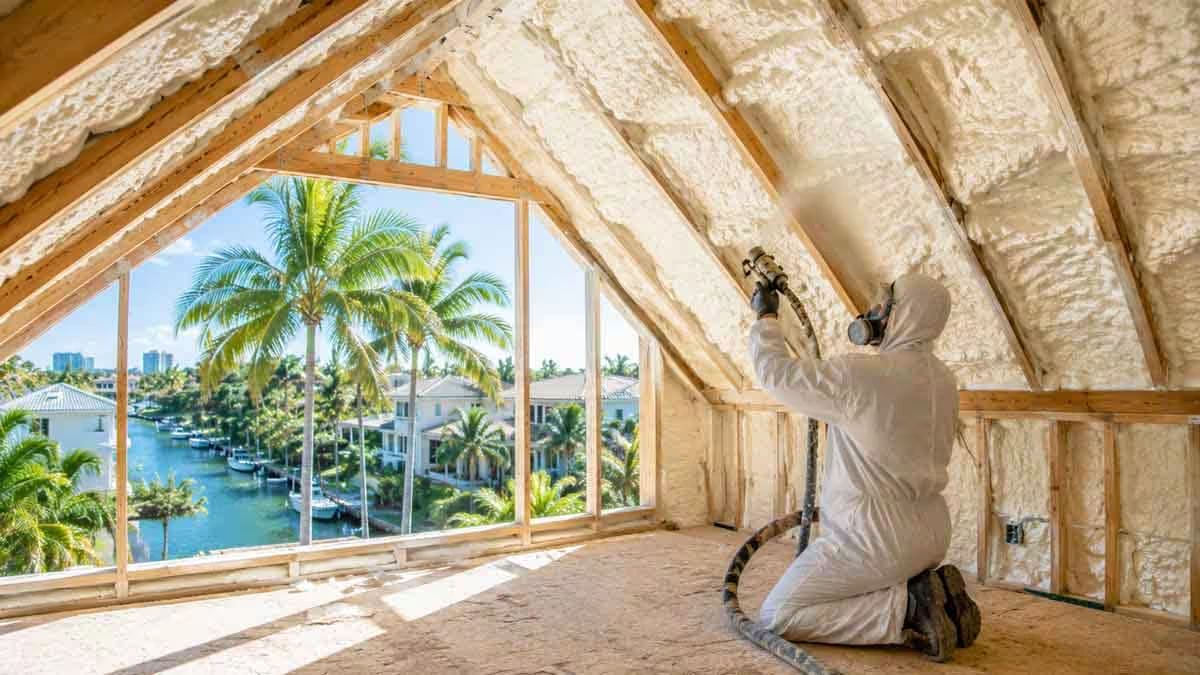
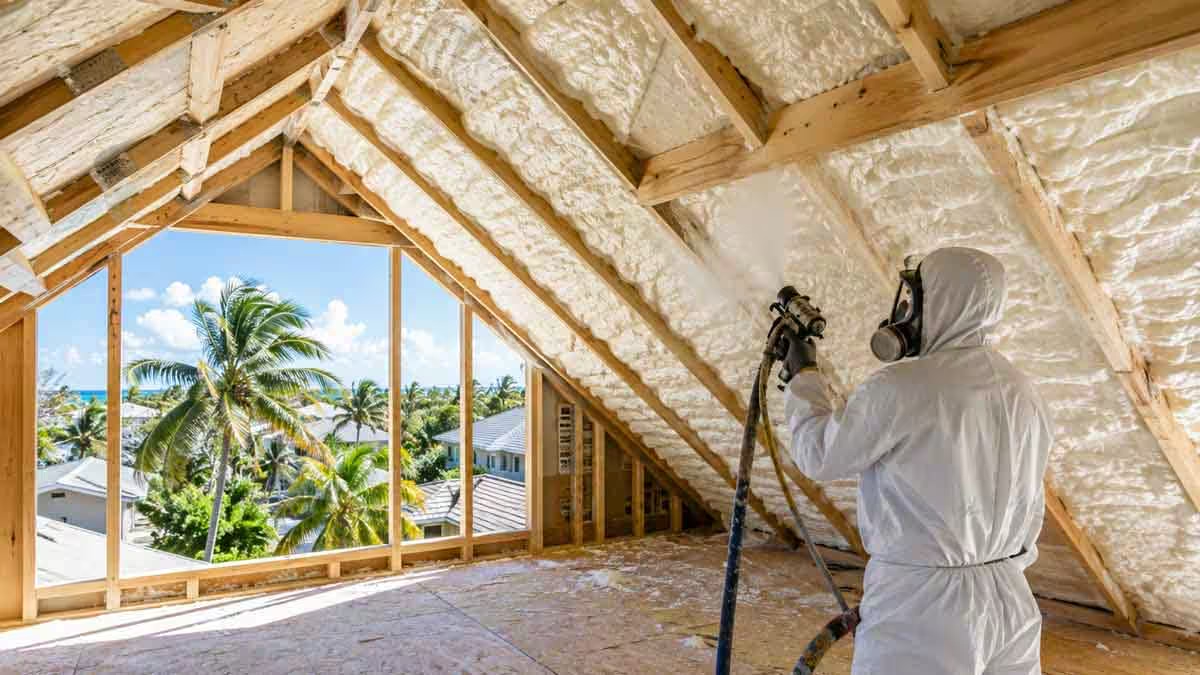
Closed-cell spray foam (CCSF) applied to the underside of the roof deck is the highest-performance retrofit option for 1970s attic assemblies in Climate Zone 1A. At R-6.0 to R-7.0 per inch, CCSF functions simultaneously as a Class II vapor retarder and a continuous air barrier, eliminating the humidity-saturated unconditioned attic zone that drives stack-effect infiltration in legacy construction.
The unvented attic configuration this creates converts the attic into conditioned space, removes the duct loss pathway that unconditioned attic zones impose, and eliminates the condensation risk inherent in vented attic assemblies under South Florida humidity conditions. Installation costs range from $3.00 to $10.00 per square foot. That premium is justified by measurable HVAC load reduction and the elimination of moisture-driven degradation pathways that compromise long-term structural integrity. For background on how R-values translate to material performance, consult this resource on insulation R-values explained.
Blown-In Cavity Fill for 1970s Wall Assemblies
Dense-pack blown-in cellulose and blown-in fiberglass are the primary retrofit options for wall cavity fill in 1970s Florida homes, applicable through the drill-and-fill method without full exterior cladding removal. In 2×4 framing at 16-inch centers, cavity fill achieves R-13 to R-15 at maximum density.
This meets the R-13 wall assembly minimum under Florida Building Code 2023 for Climate Zone 1A, but it does not address the thermal bridging losses created by the framing members themselves. Framing at standard 16-inch spacing reduces the effective whole-wall R-value by 15 to 20 percent below the installed material specification, a performance gap that cavity fill alone cannot resolve.
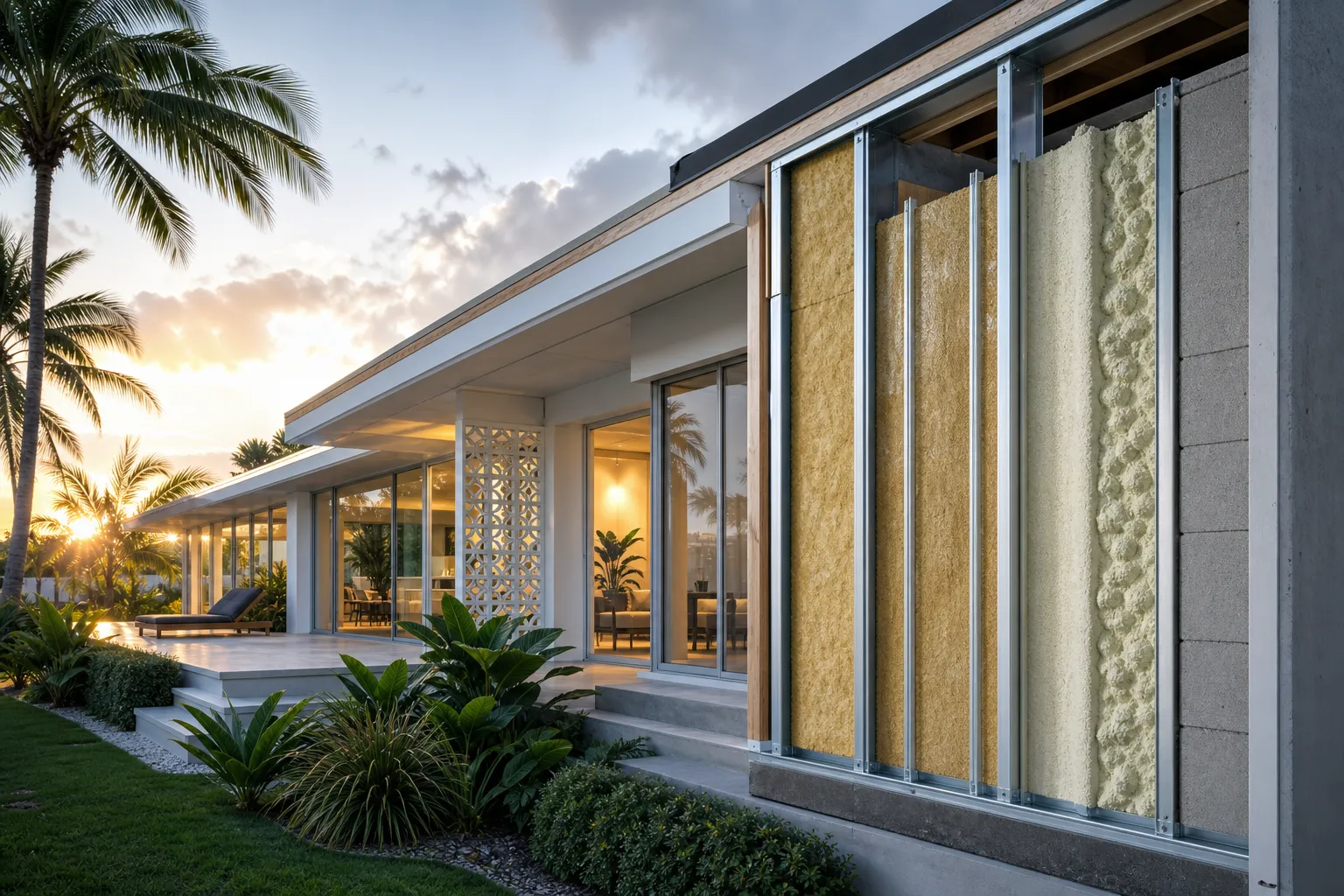
Exterior continuous insulation applied over the original wall assembly is the only retrofit method that addresses whole-wall thermal bridging directly. Rigid foam board or mineral wool panel exterior CI shifts the condensation plane to the exterior of the wall assembly, protects the original 1970s sheathing and framing from moisture accumulation, and adds measurable R-value without occupying interior floor space.
Achieving a true R-20 whole-wall performance value in a 1970s 2×4 structure requires a minimum of R-15 cavity fill combined with an R-5 exterior CI layer. This standard is achievable only during a full cladding replacement, and the Department of Energy specifies that when exterior cladding is removed, both cavity fill and exterior continuous insulation must be addressed simultaneously to achieve code compliance.
R-Value Targets and Florida Building Code Compliance for Zone 1A Assemblies
The Florida Building Code 2023 (8th Edition) establishes the following prescriptive minimums for IECC Climate Zone 1A residential assemblies under Section R402.1.2: R-30 for vented attic floor assemblies, R-20 closed-cell spray foam applied to the roof deck for unvented (conditioned) attic configurations, and R-13 for 2×4 wood-frame wall cavities. Slab and crawl space assemblies carry no insulation requirement in Zone 1A.
These figures represent the minimum compliance threshold, not the performance optimization target. Property owners seeking maximum HVAC load reduction and appraisal impact should target R-49 for vented attic assemblies. The incremental cost difference between R-30 and R-49 is consistently outpaced by long-term utility savings and equipment preservation value at the higher specification. For a technical overview of how jurisdictions treat insulation under different climate maps, see the official ICC IECC Residential Climate Zone Maps and Requirements.
Moisture and vapor control obligations under Florida’s High-Velocity Hurricane Zone building codes add a critical constraint to retrofit specifications. CCSF assemblies constitute a Class II vapor retarder. Combining interior spray foam with low-permeance exterior cladding creates a double vapor barrier condition that traps moisture within the wall assembly and accelerates structural degradation under South Florida’s sustained humidity loads. A licensed contractor with direct HVHZ experience must evaluate each assembly configuration individually before specifying material combinations to avoid this failure mode.
1970s Home Insulation Upgrade Costs, FPL Rebates, and Appraisal Value
Accurate project budgeting for a 1970s home insulation upgrade requires separate line items for removal and installation. Loose-fill and batt removal carries a cost of $1.00 to $1.50 per square foot. Existing closed-cell foam removal requires industrial grinding at $5.00 to $12.00 per square foot. Confirmed asbestos abatement ranges from $10.00 to $25.00 per square foot and requires a licensed hazmat contractor.
For new installation, blown-in attic insulation ranges from $2.00 to $6.00 per square foot including labor, closed-cell spray foam from $3.00 to $10.00 per square foot, and exterior continuous insulation from $4.00 to $8.00 per square foot. A complete attic retrofit for a 1,000 to 1,500 square foot assembly in a 1970s South Florida home typically carries a total project investment of $6,000 to $18,000 depending on existing conditions, required abatement, and target R-value specification.
FPL rebates available through vetted FPL-Approved Contractors in 2026 include an instant $220 credit applied directly to the installation invoice for qualifying ceiling insulation upgrades. Eligibility requires that existing attic insulation measure below R-8 and that installation be completed by an FPL Preferred Installation Contractor with full attic access provided for inspection.
This rebate applies across FPL’s service territory in Miami-Dade and Broward counties and significant portions of Palm Beach County. The rebate reduces the net capital outlay for qualifying projects and is captured at point of invoice, requiring no separate application process when a vetted contractor manages the engagement. See our guide on how to qualify for an FPL insulation rebate or check FPL’s ceiling insulation resources for official eligibility criteria.
A documented Florida Building Code-compliant insulation retrofit directly affects the property’s energy performance rating and appraisal classification. According to the Remodeling Magazine Cost vs. Value Report, attic insulation upgrades return approximately 166 percent of investment in real estate value within 12 months. NAR research further shows that high-performing energy assets, including spray foam and high-density cellulose, correlate to selling price premiums of approximately 5 percent over comparable non-upgraded properties.
What a Precision Thermal Envelope Retrofit Engagement Delivers
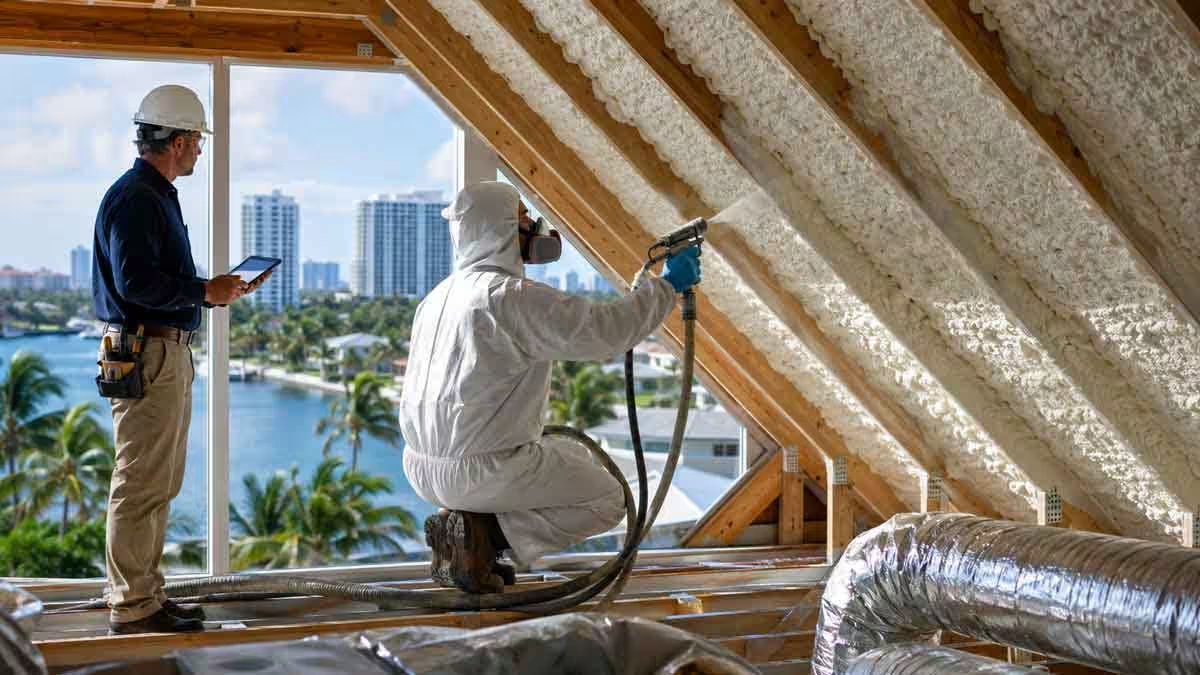
Broward Insulation’s retrofit engagement begins with a comprehensive thermal imaging audit and existing assembly documentation, followed by a Florida Building Code compliance gap analysis that maps each assembly zone to the appropriate material, R-value target, and installation protocol.
The written retrofit specification produced from this process accounts for HVHZ structural constraints, IECC Climate Zone 1A moisture dynamics, and the specific construction assembly of the property under evaluation. This is not a generic contractor estimate. It is an engineered specification built from 49 years of continuous field work in South Florida’s coastal building environment. Explore our attic insulation services to learn more about our installation protocols.
Permit and inspection requirements for insulation retrofits in Broward, Palm Beach, and Miami-Dade counties vary by project scope. Attic insulation removal and replacement alone does not typically require a building permit under current Florida Building Code provisions. When associated work exposes or requires repair of electrical systems, structural framing, or roof decking, separate permits for those systems are mandatory.
Florida Statute 489.103 requires a licensed contractor to manage all work on residential structures. Broward Insulation’s established relationships with local building departments across the Tri-County market support rapid permit processing and first-submission inspection pass rates for projects that require formal review.
National franchise contractors applying cold-climate insulation specifications to South Florida assemblies introduce moisture management failures that surface within years of installation. Climate Zone 1A building science requires specific knowledge of coastal salt-air corrosion, hurricane wind load constraints, and how CBS construction behaves under continuous high-humidity conditions. That body of knowledge does not transfer from cold-climate markets. It develops through decades of continuous operation in the specific environment where the work is performed.
The thermal performance deficit of a 1970s South Florida assembly is a quantifiable liability. A precision Florida Building Code-compliant 1970s home insulation upgrade is the intervention that resolves it permanently. The financial case is supported by FPL rebate capture, HVAC load reduction, extended equipment lifespan, and documented appraisal value improvements. Schedule your assessment today; contact Broward Insulation to receive a diagnostic thermal imaging audit and a compliant retrofit specification engineered to the specific assembly conditions of your property.