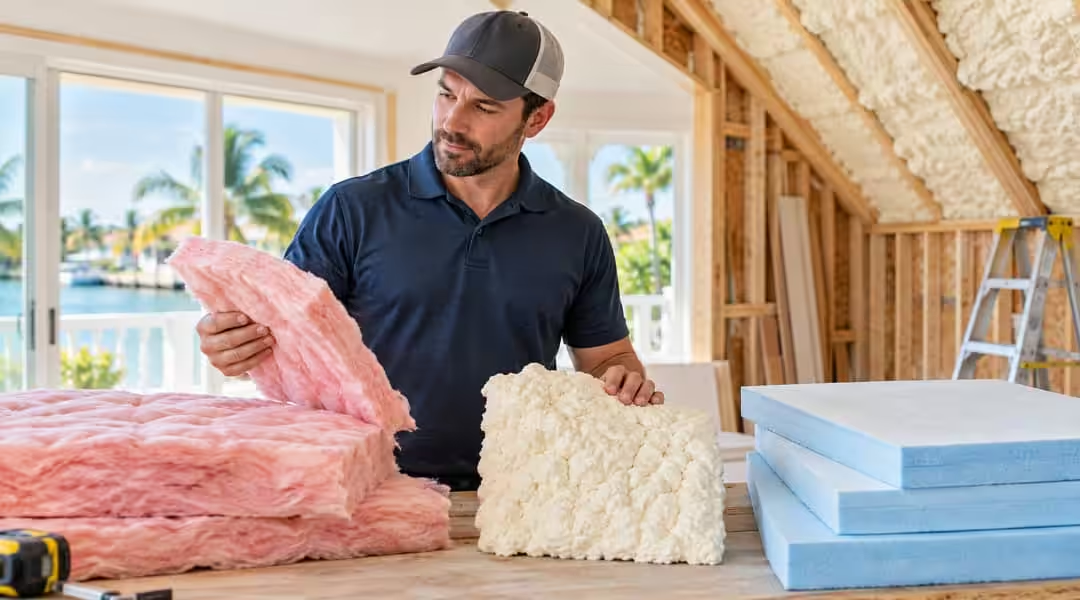
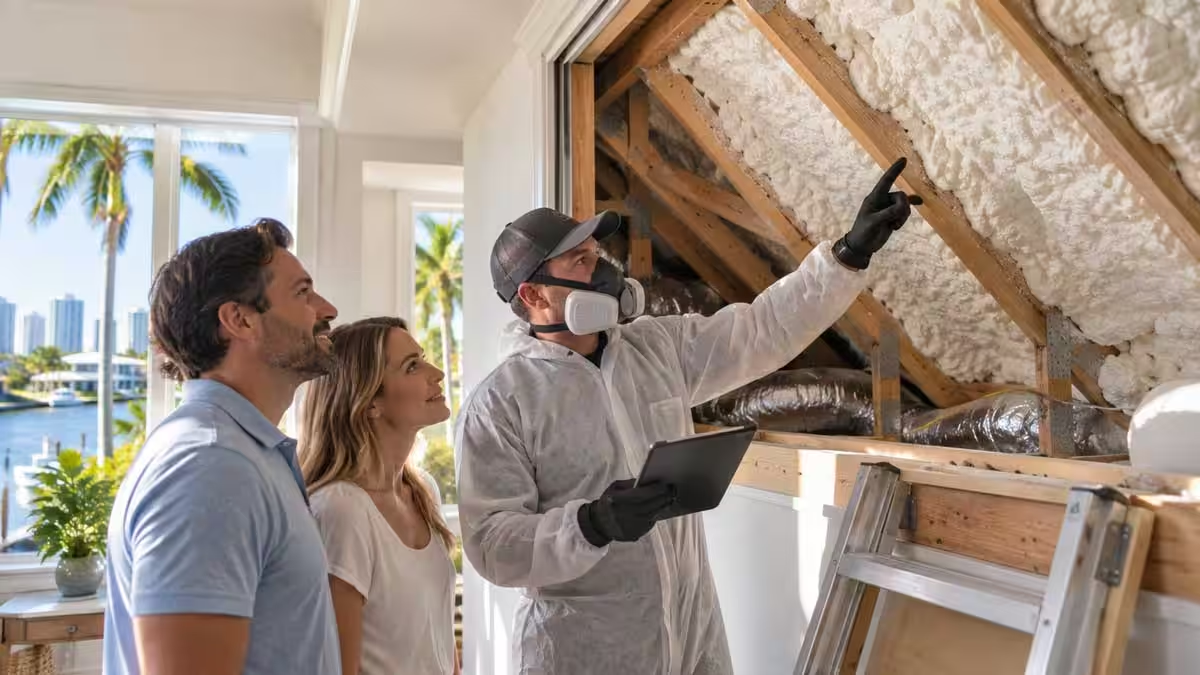
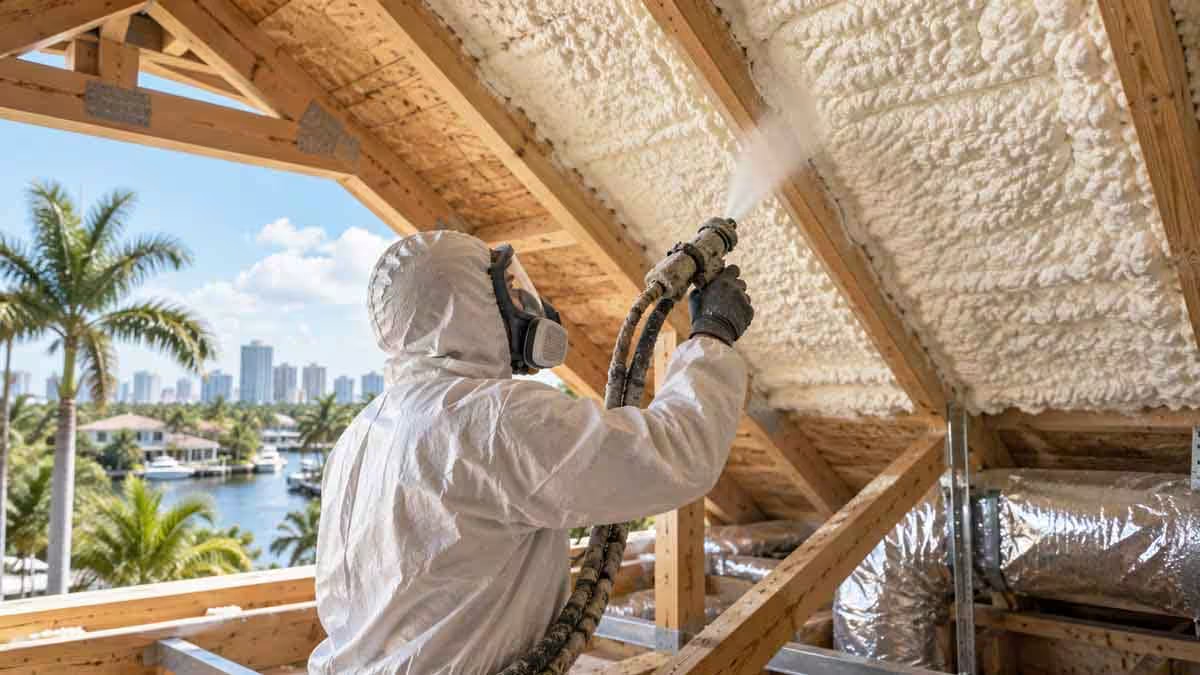
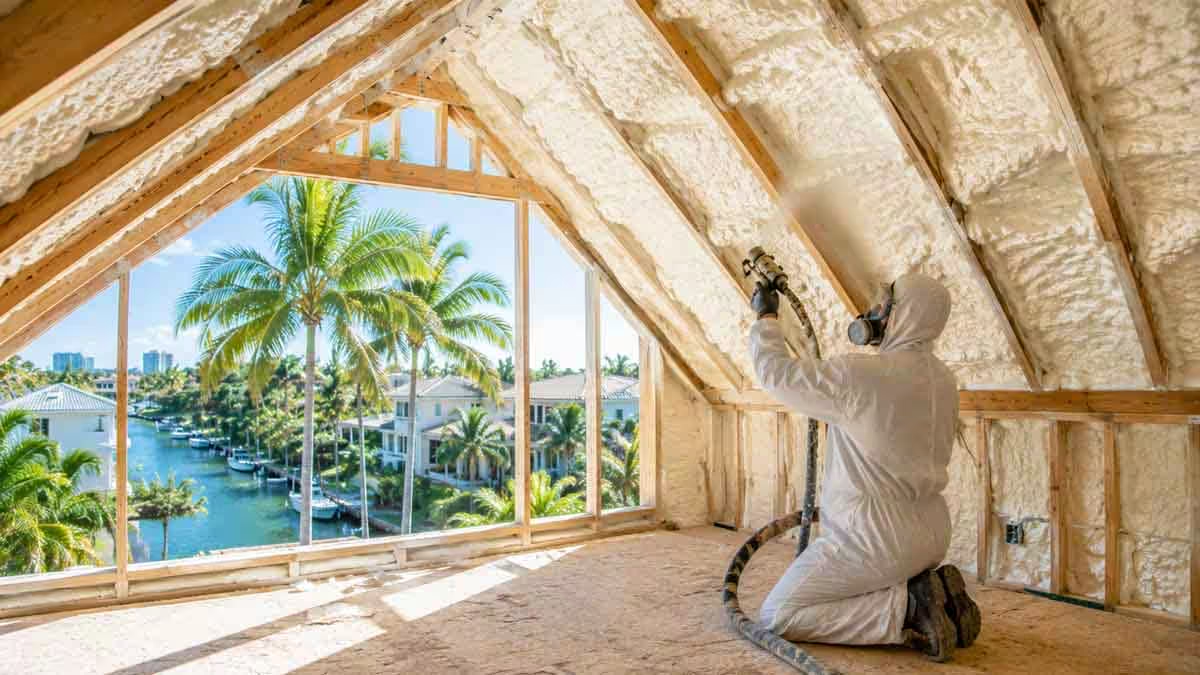
Selecting insulation for a luxury coastal home is rarely an either-or choice. Thermal insulation helps manage heat flow, while acoustic insulation addresses sound transfer. Fort Lauderdale projects often need both. That distinction anchors the article’s central point. A high R-value alone cannot ensure quiet rooms, privacy, or a calm interior near water, equipment, and multi-level living spaces. The key specification question is how materials, ratings, and assembly details work together.
Broward Insulation Service approaches that choice as a comfort, durability, and performance decision, not a comparison based on one number.
What acoustic and thermal insulation each actually measures in a coastal home
In a coastal home, thermal and acoustic insulation solve different comfort problems. Thermal insulation slows heat flow through the building shell. ENERGY STAR says insulation levels are specified by R-value, which measures thermal resistance. A higher R-value means better resistance to heat moving in or out. That matters in Fort Lauderdale, where cooling loads stay important for much of the year. Acoustic insulation, by contrast, is about reducing sound transfer and softening interior noise paths.
It does not describe heat control by itself. That distinction matters because a product can help with temperature control yet do little for privacy or waterfront noise. It also works the other way around. Materials and assemblies that quiet rooms may not deliver the needed thermal resistance alone. For Broward Insulation Service, that is the real starting point behind insulation contractor options in Fort Lauderdale: specify for both heat and sound, not one by assumption.
Why R-value alone misses comfort problems in luxury waterfront builds
Because R-value only describes resistance to heat flow, it cannot predict quiet or privacy. It cannot show whether a luxury waterfront home will feel calm. That gap matters in Fort Lauderdale. Comfort complaints often involve more than room temperature alone. A wall or roof assembly can post a strong thermal number. Still, interior spaces may remain exposed to waterfront noise. Mechanical sound can also travel between suites and floors. R-value says little about leakage paths at gaps, joints, and penetrations.
Those paths can undermine perceived comfort. This can happen even when the insulation level looks strong on paper. In high-end coastal projects, a thermal target can be necessary. It is not sufficient by itself. The safer specification mindset treats R-value as one part of a broader comfort package. It is not the whole answer. If the project brief includes privacy, quiet bedrooms, or calm entertaining spaces, judge the insulation plan on sound control.
Heat control matters too.
The ratings that matter most: R-value, STC, NRC, and air-sealing performance
Rather than chasing one headline number, sort ratings by the comfort problem they answer. R-value still matters for heat control, especially in Fort Lauderdale. However, it does not show whether a bedroom stays quiet. It also cannot show whether a media room feels isolated. That is why STC and NRC belong beside thermal performance on the review list. STC is the rating to watch when the goal is limiting sound transfer between spaces.
NRC matters more when the goal is reducing reflected sound within a space itself. Air-sealing performance affects both categories. Gaps, joints, and penetrations can weaken the comfort a strong insulation layer seems to promise on paper. The practical takeaway is simple. Broward Insulation Service should treat these ratings as a set in a luxury coastal specification. If the brief calls for calm interiors, privacy, and stable cooling performance, choose the assembly as a whole.
The best choice is rarely the one with the highest R-value alone.
Which insulation materials pull double duty on heat and noise
Material choice gets harder here because true double duty is not guaranteed. Some insulation products may improve thermal comfort, but that does not prove strong sound control. A 2024 paper in Materials shows why caution matters. In one external-wall insulation case, a layer had thermal conductivity of 0.035 W/(m·K). Its thickness was 0.14 m, and its heat-transfer coefficient was 0.192 W/(m2·K). The paper also found that linear heat transmittance rose by an average of 4%.
This increase occurred when measured conductivity values replaced declared values. That finding addresses thermal performance first. Still, it supports a broader specification lesson. Product labels and nominal values do not equal performance in place. For Broward Insulation Service, all-purpose claims should earn two checks. Materials need to support heat control and separate acoustic proof. Only then should contractors treat them as true two-in-one selections.
A thermal result alone cannot establish reliable sound control.
When layered assemblies beat single-product insulation choices
Single-product choices often solve only part of the problem. In luxury coastal homes, that pattern is common. Cavity insulation may slow heat flow, yet the full wall or ceiling can still leak sound through framing, gaps, or rigid surface connections. The reverse can happen too. A denser layer may help with noise, but it may still fall short on thermal targets or moisture control. That is why specifications should focus on assembly behavior, not product claims.
Pairing insulation with air sealing, decoupling details, and heavier finish layers often creates a more balanced result than asking one material to do everything. The assembly must work as a whole. The tradeoff is added complexity. More layers can add labor, coordination, and thickness. They may also affect trim, mechanical runs, or window and door detailing. Still, layered design is often the safer path for high-end Fort Lauderdale projects when the brief calls for quiet interiors and steady cooling performance at the same time.
Where sound control matters most in Fort Lauderdale luxury homes
Priorities shift by room, not by insulation label. In Fort Lauderdale luxury homes, sound control matters most where noise and privacy overlap. Primary suites, waterfront living areas, media rooms, home offices, and spaces near mechanical equipment usually deserve the strongest assemblies first. The reason is practical. A small sound leak in a gallery hall may be tolerable. Near a bedroom or office, that same leak can weaken the entire comfort brief. This is where careful specification matters.
A quiet interior depends less on one standout product than on the right assembly at each key boundary. Start with walls and ceilings that separate sleep, work, and entertaining areas from exterior noise, elevators, garages, or equipment rooms. Not every partition needs the same treatment. Overbuilding every surface can waste space and budget. Targeted control is the better approach. Focus on locations where calm, privacy, and speech separation provide the greatest value.
How windows, roof decks, and floor systems change the insulation plan
Openings matter here. These assemblies change the weak points, not just the product list. Windows rarely behave like insulated walls. A quiet, efficient room depends on the full glazing package, frame quality, and perimeter sealing working together. Roof decks shift the plan too. When insulation moves to the roofline, the attic and ceiling below no longer do the same job. This change can affect how heat, air, and exterior noise move through the upper envelope.
Floor systems create a different tradeoff. A floor between stories may need impact control, speech separation, and thermal control at once. One layer seldom solves all three needs. Specifications therefore often diverge by assembly. Use stronger window detailing at the facade. Match the roof-deck strategy to the attic design. Choose the floor buildup for the type of noise expected above and below. The practical takeaway is simple: specify by boundary condition, not by one blanket insulation choice.
Why moisture and salt-air exposure can erode both sound and thermal performance
Coastal exposure changes the question from product choice to durability at the edges. A U. S. Environmental Protection Agency report, EPA/600/2-91/060, investigated heat leakage through gaskets. It underscores a simple building lesson: when seals break down, heat can bypass insulated sections.
That matters in Fort Lauderdale, where moisture and salt-laden air can stress joints, fasteners, and perimeter seals over time. Even a strong insulation layer can lose practical value in practice when surrounding details admit air. Once leakage starts, thermal performance drops first on the lived-in side, not just on a data sheet. Sound control can also erode at those weak points, since small gaps give noise an easier path. The limitation is important: the EPA report examined gasket heat leakage, not luxury coastal wall assemblies.
Still, the implication travels well. In high-end coastal specifications, long-term comfort depends not only on insulation type, but on moisture-resistant detailing that protects the assembly’s seals and continuity.
The detailing mistakes that weaken insulation after specification
Details often decide whether a strong specification performs as intended. The most common failure is broken continuity. An insulation layer may be well chosen on paper, then weakened by gaps at corners, soffits, slab edges, and service penetrations. Compression is another quiet loss. When batt or blanket products are squeezed to fit around wiring, piping, or framing conflicts, the installed layer no longer matches the intended assembly. Trade coordination also matters.
If air sealing, insulation, and interior finishes are treated as separate scopes, small openings can remain at transitions where sound and heat both pass more easily. Misaligned layers create similar trouble. A wall can include good acoustic and thermal components, yet still underperform if the control layers do not stay continuous across junctions. That does not mean every project needs the same detail at every surface.
It means luxury coastal specifications should reserve extra attention for transitions, penetrations, and installation tolerance, because execution errors can undo expensive material choices.
Luxury coastal homes in Fort Lauderdale usually need both. Thermal insulation handles heat flow, while acoustic control limits sound transfer and improves privacy. Neither job is reliably covered by R-value alone. The strongest result usually comes from whole assemblies that combine insulation, air sealing, and detailing matched to each boundary. That matters most at windows, roof decks, floors, penetrations, and room separations near bedrooms, offices, living areas, or equipment.
The main limit is simple: no single product or headline rating predicts comfort by itself. Broward Insulation Service should therefore specify by assembly and room priority. One insulation number should not guide the entire project on its own.