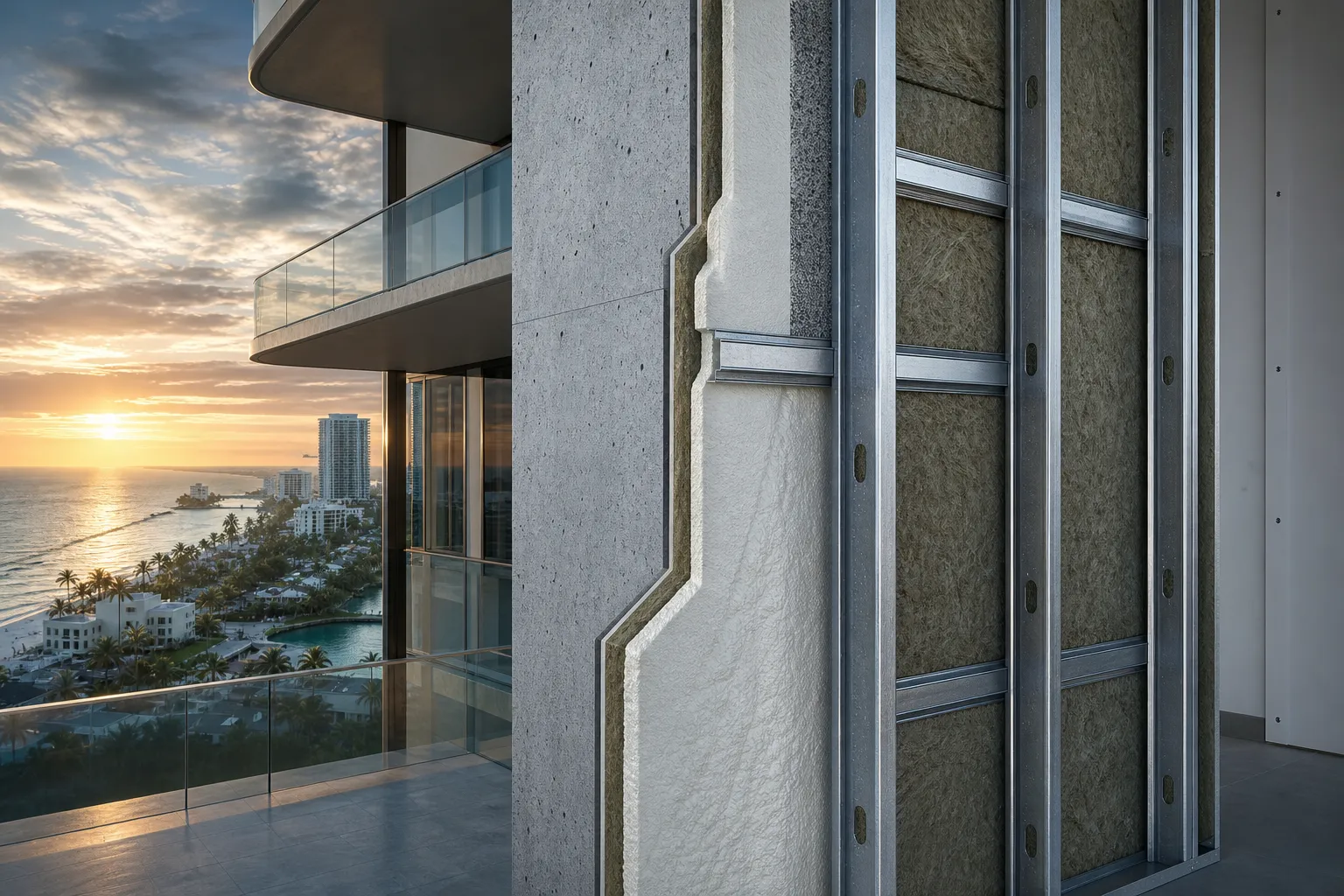
Best Insulation for a Florida Condo Unit: A Complete Guide
Executive Summary: What is the best insulation for a Florida condo unit? The answer depends on zone, assembly type, and compliance objective, and it is never a simple material swap. Insulation specification within a Florida condominium is a precision engineering decision governed by IECC Climate Zone 1A thermal and moisture loads, Florida Building Code 2023 (8th Edition) R-value mandates, and increasingly stringent HOA-imposed STC and IIC acoustic performance thresholds.
The variables unique to multi-unit construction, shared structural boundaries, asymmetric heat loads, and chronic humidity infiltration, demand material selection and assembly design that far exceed the criteria applied to standard single-family residential work. Broward Insulation, a Fort Lauderdale-based licensed contractor with nearly 50 years of continuous operation in South Florida, specializes in engineering thermal and acoustic assemblies for luxury condo owners and HOA boards across Broward, Palm Beach, and Miami-Dade counties.
This article provides a technical reference framework for identifying the correct insulation system by zone, material performance profile, and compliance requirement.
What Is the Best Insulation for a Florida Condo Unit? Start with the Engineering
The compounding threats of Climate Zone 1A heat and chronic moisture infiltration
South Florida’s IECC Climate Zone 1A classification represents one of the most thermally and hygroscopically demanding environments in the continental United States. Exterior temperatures frequently exceed 90°F during summer months, and relative humidity levels regularly surpass 80%.
This creates conditions in which warm exterior air contacts cooled interior surfaces within wall and ceiling cavities, producing condensation that accelerates mold growth, degrades structural framing, and reduces insulation R-value over time. Hygroscopic materials such as fiberglass batts and cellulose absorb moisture, lose thermal resistance when wet, and provide no meaningful vapor control without supplemental vapor barrier assemblies.
In Climate Zone 1A, these materials are unsuitable as primary wall cavity solutions unless integrated within a rigorously designed moisture management system. The thermal performance requirements in this climate zone are non-negotiable.
The Florida Building Code 2023 (8th Edition) mandates a minimum R-30 for ceiling and attic assemblies and R-13 for wood-frame exterior walls in Climate Zone 1. However, achieving code minimum does not guarantee energy performance sufficient for FPL rebate qualification or meaningful HVAC load reduction.
Per ASHRAE 90.1 guidance and FPL published rebate program documentation, performance targets for Zone 1 frequently exceed code minimums, with R-38 recommended for attic assemblies when maximum utility rebate qualification is the objective.
How multi-unit construction amplifies thermal and condensation risk
Condominium construction introduces structural complexities absent in single-family residential work. Shared exterior walls, roof decks, and mechanical spaces create asymmetric heat and moisture loads that vary unit by unit. A top-floor unit absorbs direct solar radiation through the roof deck. A mid-floor unit shares thermal boundaries with adjacent conditioned spaces. A ground-floor unit contends with slab moisture migration. Each configuration requires a distinct engineering response, not a generalized material application.
Air movement through penetrations, seams, and utility chases can transport humid air into ceiling and wall cavities, increasing condensation risk, particularly in high-rise assemblies where pressure differentials drive infiltration upward. Air-sealing performance is therefore as important as R-value in any condo thermal and moisture control strategy. Materials that do not function as continuous air barriers, regardless of nominal R-value, leave this infiltration pathway open.
Comparing the Three Core Insulation Options for Florida Condo Units
Closed-cell spray foam: the benchmark for thermal and moisture control
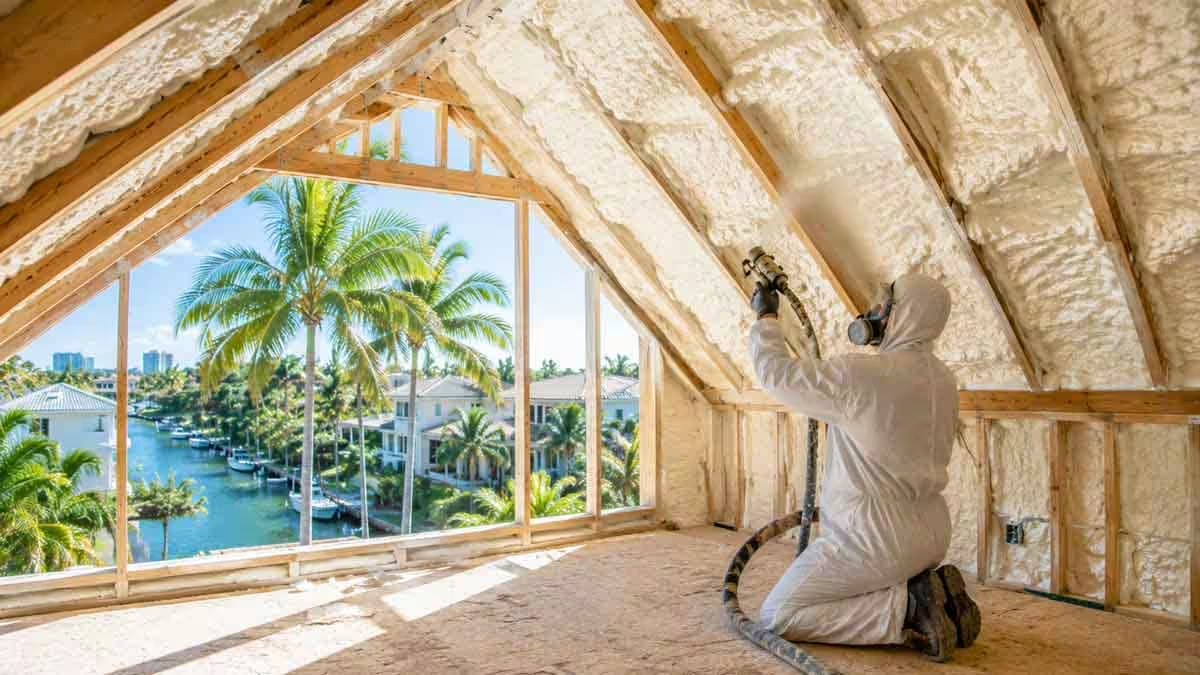
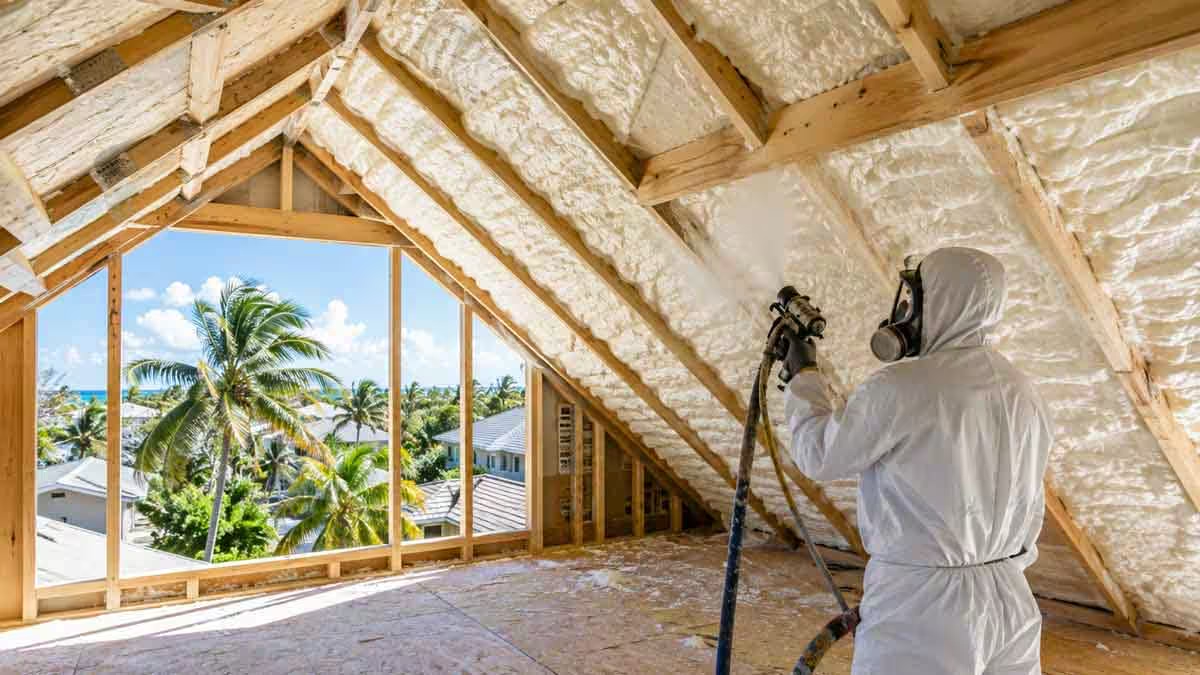
Closed-cell spray polyurethane foam delivers an R-value of R-5.8 to R-6.8 per inch, the highest thermal resistance per inch of any commercially available insulation material. At a minimum application thickness of 2 inches, it achieves a vapor permeance of approximately 0.63 perms, qualifying it as a Class II vapor retarder under ASTM E96 classification standards.
This combination of thermal resistance, vapor retardancy, and continuous air barrier performance makes closed-cell foam the definitive specification for exterior wall cavities, roof deck undersides, and any assembly subject to direct humidity exposure within a Florida condo envelope.
Retrofit performance data from Climate Zone 1A projects shows median cooling cost reductions of 15 to 25 percent when closed-cell foam replaces existing fiberglass batt assemblies, with severely compromised existing assemblies achieving reductions approaching 40 percent in documented upper-bound cases. The installed cost range of $4.00 to $8.00 per square foot, combined with FPL rebate access and reduced HVAC operational costs, produces a payback period of 3 to 7 years against a material service life of 20 to 30 years.
Blown-in insulation and fiberglass: appropriate applications and key limitations
Blown-in fiberglass and cellulose products deliver R-values of R-2.2 to R-3.8 per inch and remain cost-effective for attic floor applications where installation depth can be maximized to meet or exceed the R-30 code minimum. Their installed cost range of $1.00 to $2.50 per square foot and payback period of 3 to 5 years make them a financially sound specification for attic floor scenarios where vapor-drive risk is controlled and air sealing is addressed through supplemental measures.
However, blown-in products are not appropriate for exterior wall cavities in Climate Zone 1A without vapor control assemblies. Susceptibility to moisture absorption and R-value degradation under sustained humidity makes them a thermal liability in any wall assembly facing exterior vapor-drive pressure.
Fiberglass batts share the same moisture vulnerability. Without supplemental vapor retarder installation, fiberglass batts do not meet compliance standards in high-humidity environments. Within a Florida condo, their application should be limited to interior partition walls and scenarios where acoustic or fire-separation specifications drive the selection rather than thermal performance.
Best Insulation for a Florida Condo Unit: Zone-by-Zone Priorities
Ceiling assemblies, roof decks, and attic access spaces
The Florida Building Code 2023 prescribes R-30 as the minimum for ceiling and attic assemblies in Climate Zone 1 multi-family residential construction. When duct systems are located within unconditioned attic spaces, a separate R-8 duct insulation requirement applies for ducts 3 inches in diameter or greater; ducts in other building portions require a minimum of R-6.
These values define the compliance floor, not the performance optimum. For maximum FPL rebate qualification and meaningful HVAC load reduction, an R-38 attic assembly is the target specification in Zone 1, consistent with ASHRAE 90.1 performance guidance. For practical guidance on recommended insulation levels and R-value recommendations in Florida attics, see this resource outlining regional targets.
The choice between closed-cell spray foam applied to the roof deck underside and blown-in insulation on the attic floor depends on whether the attic is intended to become conditioned space. When duct systems are located in the attic, converting to a conditioned attic via closed-cell roof deck application eliminates the R-8 duct exposure requirement while significantly reducing total HVAC load.
Radiant barriers are a recognized supplemental measure for Florida attic assemblies. They carry no assigned R-value but reflect solar radiant heat energy before it converts to conducted heat within the assembly, reducing the thermal load imposed on the primary insulation layer. If you’re evaluating how much attic insulation is needed for depth and performance, this guide provides practical insulation depth guidelines, and our project work includes HOA attic re-insulation examples detailed in our project portfolio.
Exterior walls, party walls, and mechanical duct systems
Exterior wall assemblies in wood-frame condo construction require a minimum of R-13 under the Florida Building Code. Concrete and masonry mass wall assemblies require R-4, or R-3 continuous insulation. For exterior-facing wall cavities, closed-cell spray foam is the correct specification: it delivers the required R-value, eliminates vapor infiltration, and provides continuous air barrier performance within a single material application.
In most cases, no supplemental vapor retarder is required when closed-cell is applied at a minimum of 2 inches, based on ASTM E96 permeance data and applicable FBC provisions, though assembly configuration and local inspection authority interpretations can affect this determination.
Party walls shared with adjacent units present a different engineering objective. Thermal control is secondary here; acoustic performance drives the specification. Open-cell spray foam or mineral wool may be appropriate in these interior cavities where sound absorption is the primary design criterion and vapor-drive risk through interior boundaries is minimal.
The distinction between exterior-facing and interior-facing assemblies matters: because STC and IIC ratings are assembly-level measures, applying closed-cell foam to interior party walls without acoustic engineering analysis will not achieve the STC and IIC compliance thresholds required by most South Florida HOA governing documents, insulation material alone cannot substitute for a properly decoupled assembly.
HOA Acoustic Compliance and STC/IIC Performance Engineering
Understanding STC and IIC rating mandates in South Florida high-rise buildings
Sound Transmission Class (STC) measures an assembly’s ability to attenuate airborne sound transfer between adjacent units. Impact Isolation Class (IIC) measures the attenuation of impact-generated noise through floor-ceiling assemblies.
The Florida Building Code establishes minimum thresholds of STC 50 and IIC 50 for multi-family residential assemblies measured under laboratory conditions. South Florida HOAs governing luxury high-rise developments routinely impose standards that exceed these code floors, with STC 55 to STC 60 common for wall assemblies and IIC 60 to IIC 65 frequently mandated for floor-ceiling assemblies in premium buildings.
These ratings apply to the entire assembly, not to individual materials in isolation. Selecting a high-density insulation product does not, by itself, constitute an acoustically compliant assembly. Non-compliance can trigger HOA enforcement actions, work stoppages, or remediation requirements depending on the building’s governing documents, each of which adds cost and delays unit usability well beyond the original project budget.
How structural decoupling and precision insulation engineering achieve compliance
Acoustic compliance in multi-unit construction is achieved through a systems engineering methodology. Structural decoupling of floor and ceiling assemblies using resilient channels or isolation clips severs the mechanical pathway through which impact noise transfers between units.
High-density insulation within decoupled cavities then absorbs residual airborne sound energy. Open-cell spray foam and mineral wool both outperform fiberglass batts in this application due to superior sound absorption coefficients at the frequencies relevant to residential impact noise.
Broward Insulation’s acoustic engineering practice is built on nearly 50 years of designing and installing assemblies engineered to exceed HOA STC and IIC mandates in luxury tri-county condo developments. The firm provides full compliance documentation packages for HOA board submission, including assembly specifications, independent acoustic test data, contractor licensing and insurance documentation.
This end-to-end compliance management separates a technically adequate installation from one that clears HOA architectural review on the first submission. Learn more about sound mitigation strategies in our luxury condo soundproofing retrofit guide.
Florida Building Code Compliance, Installed Costs, and Financial ROI
Code-minimum R-values versus performance targets for efficiency and rebate qualification
The 2023 Florida Building Code prescribes the following minimums for Climate Zone 1 multi-family residential construction: R-30 for attic and ceiling assemblies, R-13 for wood-frame exterior walls, R-4 for mass (concrete and masonry) walls, R-8 for duct systems in unconditioned attics, and R-6 for ducts in other building locations.
These values represent the legal compliance threshold under Broward County building permit requirements. FPL rebate programs and energy efficiency certifications typically require exceeding these minimums. R-38 for attic assemblies is the recommended performance target for maximum utility rebate qualification in Zone 1. For authoritative context on the 2023 energy code changes and official code language, consult the Florida Building Code 2023 energy code changes.
Broward Insulation holds vetted FPL-Approved Contractor status, providing direct financial access to utility rebate programs for qualifying condo owners. This status streamlines the rebate application and documentation process, accelerating the financial return on insulation investment and reducing net project costs for owners seeking to leverage available utility incentive programs. For practical homeowner-focused weatherization and insulation guidance applicable to Florida residences, see the state resource on weatherization and insulation guidance.
Installed cost ranges, payback periods, and long-term asset value
Blown-in insulation installs at $1.00 to $2.50 per square foot with a documented payback period of 3 to 5 years in the South Florida climate. Closed-cell spray foam installs at $4.00 to $8.00 per square foot with a payback period of 3 to 7 years, against a material service life of 20 to 30 years.
Old insulation removal adds $500 to $2,000 in project costs depending on volume and contamination level; this cost is frequently recoverable through FPL rebate qualification when the replacement material meets program thresholds. Across a 20-year service life, the compounding financial benefit of reduced HVAC load, combined with improved acoustic compliance and moisture barrier performance, consistently exceeds total project cost in properly engineered Zone 1A assemblies.
Navigating HOA Approval, Permitting, and Contractor Engagement
HOA board approval requirements and permitting obligations for condo insulation upgrades
In most Florida condominium structures, roof decks, exterior walls, and attic spaces are classified as common areas under HOA jurisdiction. Individual unit owners are legally prohibited from modifying these elements without prior board approval, regardless of whether the modification benefits the shared structure.
A compliant submission package for HOA architectural review typically includes engineering plans, material safety data sheets, contractor licensing and insurance documentation, and in many cases, physical material samples for board inspection. Broward County additionally requires a signed and notarized Condominium Approval Letter confirming HOA awareness of proposed work prior to permit issuance.
Florida Statute 489.127(1)(f) prohibits unlicensed individuals, including unit owners, from performing permitted construction work within condominium structures. All insulation upgrades in multi-family residential buildings in Broward County require a licensed contractor to pull the permit, coordinate staged inspections through the ePermits Online system, and complete all rough and final inspections within 180 days of permit issuance. Unpermitted insulation work creates stop-work liability, mandatory removal obligations, and material complications for unit resale.
When to commission a professional thermal and acoustic assessment
Four conditions each warrant an immediate professional evaluation:
- Unit cooling costs exceeding code-baseline projections despite functional HVAC equipment
- Audible noise transfer through shared walls or floor-ceiling assemblies
- Visible moisture damage or staining in ceiling cavities
- Receipt of an HOA compliance notice regarding thermal or acoustic performance
Each condition signals a compromised building envelope or assembly failure that will not resolve without licensed contractor intervention.
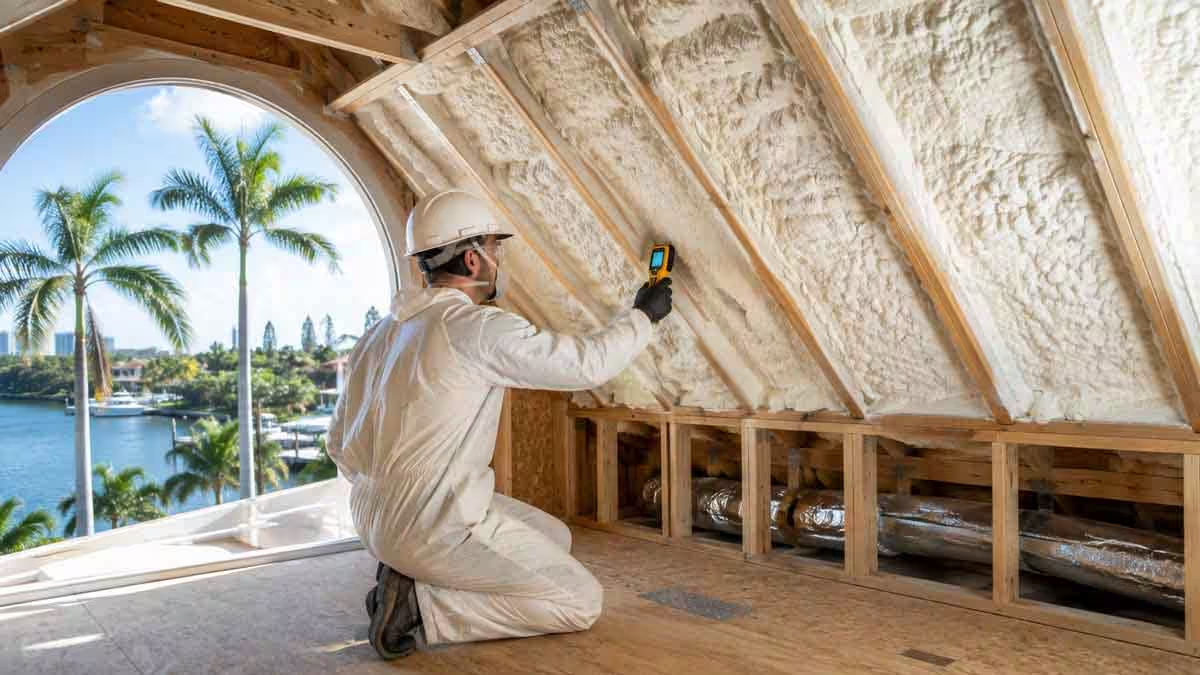
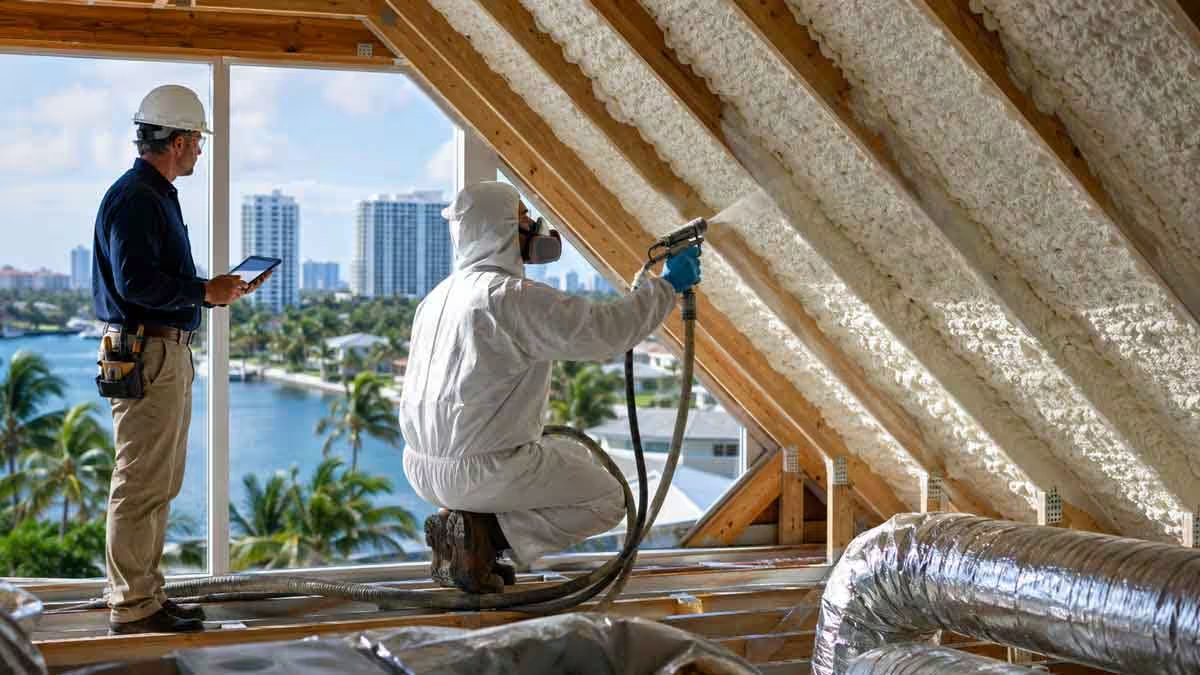
Broward Insulation provides professional thermal and acoustic assessments for luxury condo owners throughout the South Florida tri-county market. The firm manages the full compliance cycle, from initial engineering assessment through HOA submission, permitted installation, and final inspection closeout.
With nearly 50 years of hyper-local IECC Climate Zone 1A expertise and a documented track record in acoustic compliance engineering for South Florida’s most demanding high-rise communities, the firm is the technical authority of choice for condo owners, HOA boards, and real estate investors requiring precision building envelope performance. For professional attic insulation services and options, visit our service page: Attic Insulation Services | Broward Insulation.
Conclusion: Choosing the Best Insulation for a Florida Condo Unit
The best insulation for a Florida condo unit is determined by zone, assembly type, and compliance objective, not by a single material preference. Closed-cell spray foam is the benchmark specification for exterior wall cavities and roof deck assemblies where thermal resistance, vapor retardancy, and air barrier performance must be achieved simultaneously.
Blown-in insulation serves attic floor applications where installation depth can achieve R-30 code compliance within a controlled moisture environment. Acoustic performance in party wall and floor-ceiling assemblies requires a systems engineering approach that combines structural decoupling with precision insulation selection; no single product substitutes for that methodology.
Florida Building Code compliance, HOA STC and IIC mandates, FPL rebate access, and Broward County permitting requirements all require licensed contractor expertise to navigate correctly. Broward Insulation’s nearly 50 years of continuous operation in South Florida’s most demanding thermal, moisture, and acoustic environments positions the firm as the engineering authority of record for luxury condo owners, architectural review boards, and property investors throughout Broward, Palm Beach, and Miami-Dade counties. Contact Broward Insulation to commission a professional thermal and acoustic assessment for your property.