Moisture Control for Florida Homes: How to Stop Mold for Good
Executive Summary: Moisture control florida projects in IECC Climate Zone 1A—which covers Broward, Miami-Dade, and Palm Beach counties—demand a multi-layer engineered approach, not a single-product fix. Outdoor dew points in South Florida regularly exceed 75°F, creating persistent vapor pressure differentials that push moisture through every building assembly lacking a properly specified control system.
The indoor relative humidity target for South Florida residential and commercial properties is 30% to 60%, with 50% as the performance benchmark. Sustained levels above 60% initiate mold colonization, accelerate structural wood degradation, and increase HVAC mechanical failure rates.
The most effective moisture control strategy for South Florida structures addresses four coordinated layers: below-slab and crawlspace vapor transmission, building envelope air sealing, attic assembly design using closed-cell spray foam, and HVAC latent capacity optimization supplemented by dedicated dehumidification.
Installed costs in 2026 range from $1,000 to $3,000 for crawlspace dehumidification, $1,500 to $3,800 for whole-house integrated dehumidifier systems, and $5,000 to $20,000+ for full crawlspace encapsulation, depending on scope and site conditions. FPL-approved contractors, including Broward Insulation, provide access to a $220 ceiling insulation rebate and may qualify eligible projects for additional utility incentive programs.
Deferred intervention consistently produces downstream costs that far exceed proactive system installation; mold remediation runs $3,000 to $30,000+ and structural framing replacement starts at $5,000. Broward Insulation, with nearly five decades of continuous operation in Climate Zone 1A, treats moisture management as an integrated building science discipline rather than a menu of isolated products. Every assessment evaluates each infiltration pathway and vapor drive mechanism before any system component is recommended.
Why Florida Homes Face a Structural Moisture Problem
Climate Zone 1A Conditions Driving Indoor Humidity
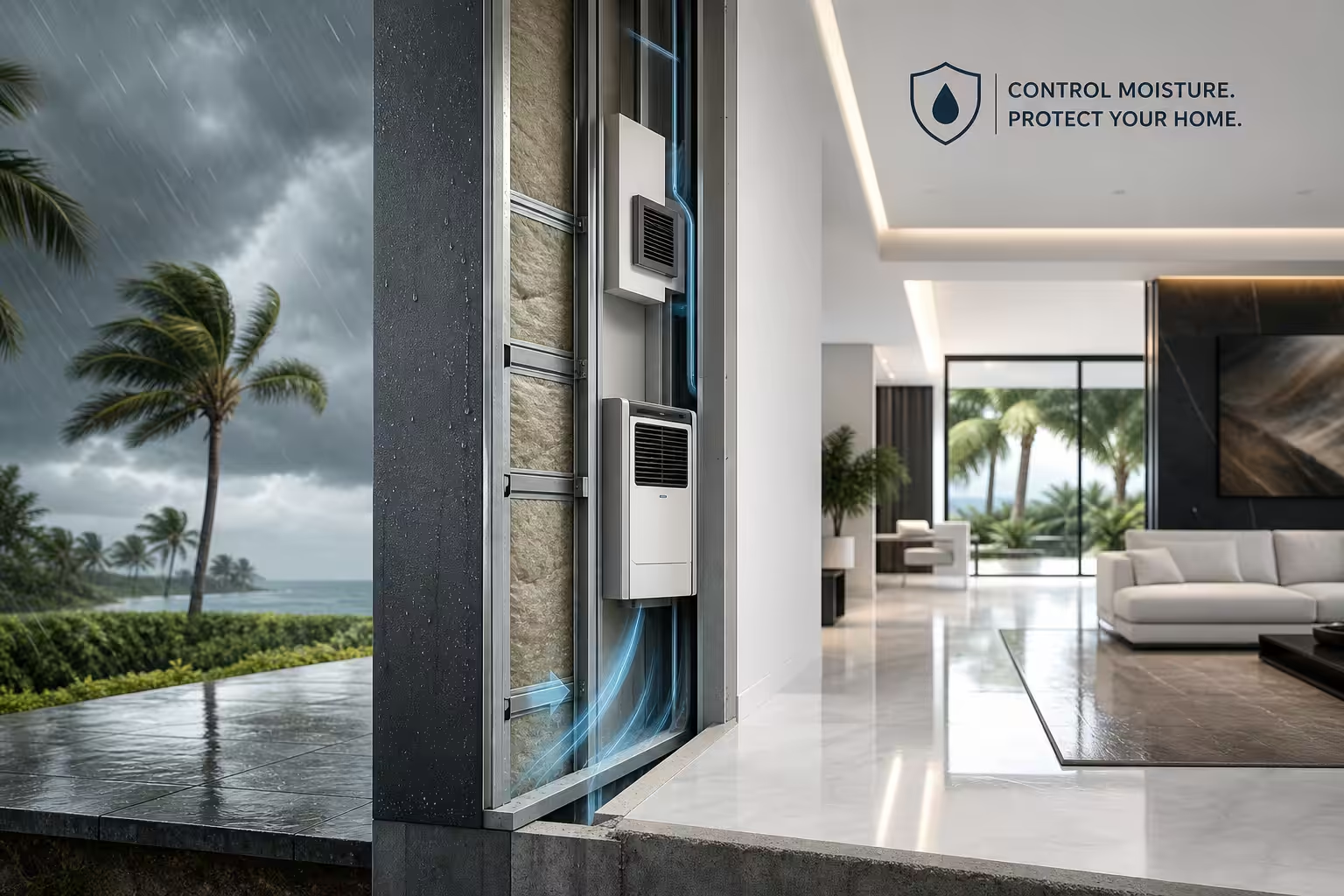
IECC Climate Zone 1A is defined by extreme heat, extreme humidity, and persistent vapor pressure conditions that virtually eliminate any inward-to-outward moisture drying potential for building assemblies during the summer months. In South Florida, the dominant moisture drive is inward: hot, humid outdoor air at high vapor pressure migrates toward the cooler, lower-vapor-pressure conditioned interior through every gap, penetration, and permeable material in the building envelope.
Unlike northern climates where moisture drive reverses seasonally and allows assemblies to dry, Zone 1A structures face nearly unidirectional inward vapor pressure for the majority of the calendar year.
Outdoor dew point temperatures in the Tri-County region routinely exceed 75°F between May and October, meaning any surface within the building assembly that falls below the outdoor dew point will accumulate condensation. This dynamic is particularly problematic at the slab perimeter, within wall cavities adjacent to conditioned spaces, and at the underside of roof decks in vented attic assemblies.
Without a continuous vapor control layer at the appropriate position within the assembly, condensation accumulates unseen until structural damage or mold colonization is already advanced.
How the Stack Effect and Air Infiltration Amplify the Problem
Slab-on-grade construction, which predominates in South Florida residential and commercial building, creates specific pressure dynamics during summer cooling operation. As conditioned air cools within the lower levels of the structure, a slight negative pressure develops that draws humid outdoor air inward through foundation perimeter joints, slab utility penetrations, and attic bypass pathways.
This pressure imbalance, driven by cooling, duct leakage, and mechanical ventilation, continuously introduces humid air into the building envelope through pathways with no obvious visible entry point.
The most common infiltration pathways identified in South Florida structures include recessed lighting assemblies at the ceiling plane, unsealed top plates at the attic floor, duct boot penetrations at supply and return registers, and attic access panels without air barrier gaskets.
Compounding these pathways is the elevated water table common throughout Broward and Miami-Dade counties, which drives vapor upward through slab assemblies by ground-source vapor transmission. A comprehensive moisture management strategy must address both atmospheric infiltration from above and ground-source vapor migration from below.
Moisture Control Florida: Vapor Barriers and Air Sealing
How Vapor Transmission Works in Slab and Crawlspace Homes
Vapor transmission operates on concentration differential: moisture migrates from zones of high vapor concentration to zones of lower vapor concentration regardless of the presence of visible liquid water. In South Florida slab-on-grade homes, the ground beneath the slab maintains a near-constant high-moisture vapor state driven by the regional water table.
Without a properly installed vapor retarder beneath the slab and at the slab perimeter, measurable moisture migration occurs through the concrete matrix into floor assemblies, wall base plates, and interior finish materials over time.
For crawlspace homes in South Florida, exposed soil emits continuous vapor at high concentration levels throughout the year. A heavy-duty polyethylene vapor barrier installed across the crawlspace floor and sealed against foundation walls is the first and most critical structural defense against ground-source moisture migration.
Barrier thickness varies by site conditions; contractors in South Florida commonly specify 10 to 20 mil or reinforced membranes depending on moisture loading, pest intrusion risk, and the durability demands of periodic service access. The right spec for your crawlspace depends on a site-level assessment, not a universal standard.
Air Sealing as the Second Layer of the Moisture Control System
Vapor retarders and air sealing serve distinct but complementary functions within the moisture control system. Vapor retarders limit vapor diffusion through building materials by reducing their permeance rating. Air sealing eliminates bulk air movement through gaps and penetrations, which carries far greater quantities of moisture per unit time than vapor diffusion alone.
In Climate Zone 1A, uncontrolled air infiltration is often a leading contributor to indoor humidity elevation, and in most existing South Florida structures, air sealing delivers the largest per-dollar reduction in latent load.
The highest-priority air sealing locations for South Florida homes are slab penetrations at utility entry points, top plates at the attic floor plane, duct boot connections at the ceiling and floor, electrical penetrations in exterior-facing assemblies, and recessed light fixtures without airtight-rated housings.
A properly executed air sealing program, combined with a code-compliant mechanical ventilation strategy as specified under [ASHRAE Standard 62.2](https://www.ashrae.org/technical-resources/bookstore/standards-62-1-62-2), establishes the baseline building envelope performance level required before any dehumidification system can operate at its rated capacity without compensating for continuous infiltration loading.
Attic Assembly Design and Closed-Cell Spray Foam in Humid Climates
Vented vs. Unvented Attic Assemblies in Climate Zone 1A
The conventional vented attic assembly was developed for cold-climate applications where outdoor air introduced through soffit and ridge vents carries low absolute moisture content and provides effective drying potential for roof deck assemblies. In Climate Zone 1A, this logic inverts entirely.
Ventilation air drawn from the South Florida outdoor environment carries high absolute humidity throughout the majority of the year, converting the attic cavity into a continuously replenished moisture reservoir. Research on hot-humid climate building performance consistently shows vented attics in this region become moisture accumulation zones that accelerate wood deterioration and create sustained conditions for mold colonization of structural framing members.
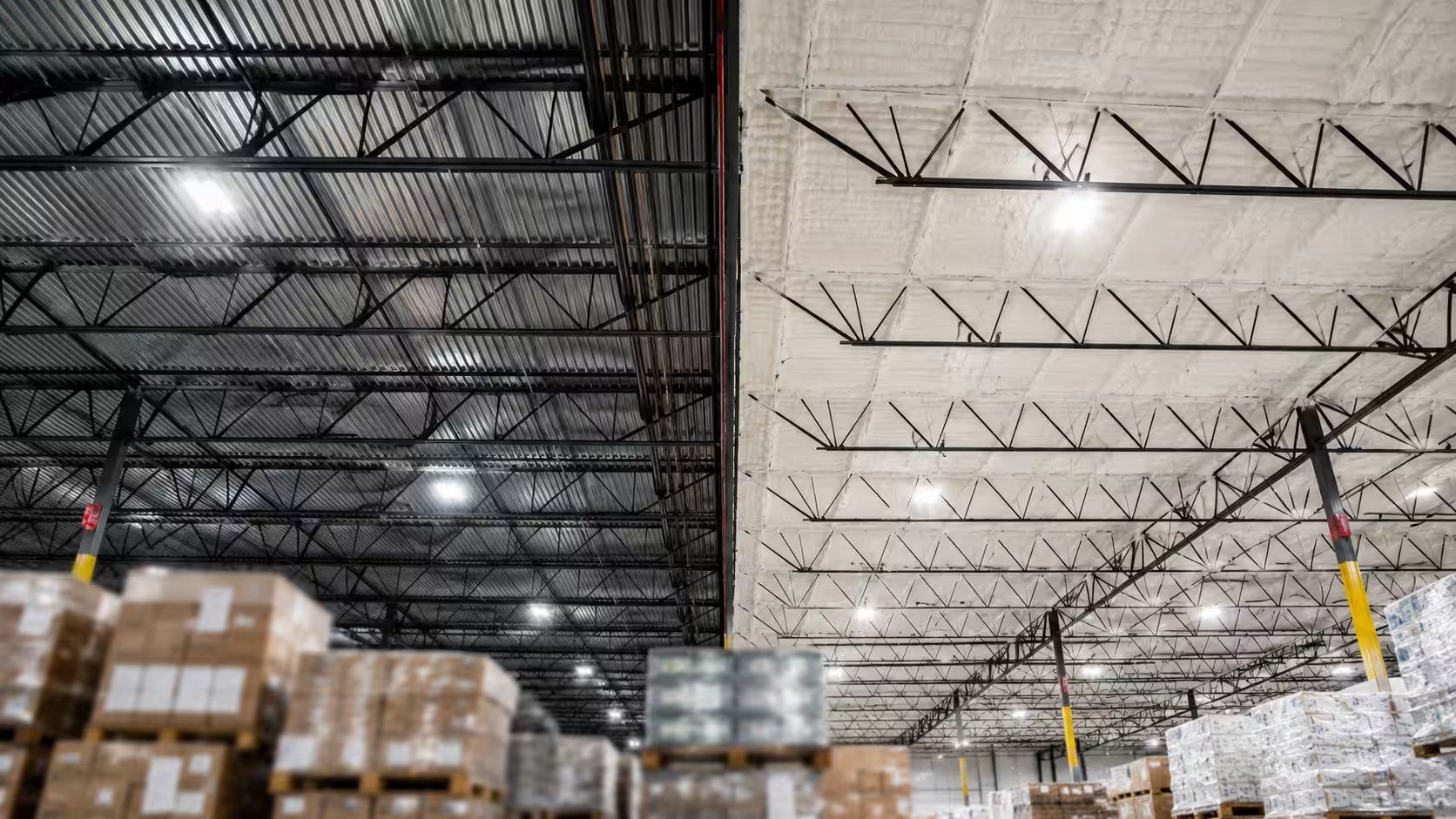
The unvented conditioned attic assembly resolves this deficiency by applying closed-cell spray foam to the underside of the roof deck, placing the attic cavity within the thermal and moisture boundary of the conditioned space. This design eliminates the attic as a moisture accumulation zone and brings the roof deck itself within the building’s vapor and air control layers.
The Florida Building Code permits unvented attic assemblies when closed-cell spray foam is applied to the roof deck underside at minimum thicknesses meeting the applicable energy code requirements for Climate Zone 1A, and when the assembly complies with the mechanical ventilation and air leakage criteria governing conditioned attic spaces. Review our completed implementations of this approach in our [Broward Insulation Projects Portfolio](https://browardinsulation.com/portfolio/).
Closed-Cell Spray Foam as a Class II Vapor Retarder
Closed-cell spray foam delivers two critical performance functions within a single application: thermal resistance at R-6.5 to R-7 per inch and vapor retarder performance at a permeance rating below 1.0 perm at standard application thicknesses, qualifying it as a Class II vapor retarder under IECC standards.
The practical minimum thickness for achieving Class II vapor retarder performance is approximately 1.5 inches, with 2 inches representing the conservative code-compliant target for most Climate Zone 1A applications. This dual function allows a single material to address thermal bridging through framing members, air infiltration at the deck and wall cavity level, and vapor diffusion—all in one continuous application—without the added assembly complexity of separately installed air barriers and vapor retarders.
Open-cell spray foam, by contrast, does not function as a vapor retarder. Its vapor permeance rating at standard thicknesses exceeds 10 perms, making it inappropriate as the sole moisture control layer in South Florida’s extreme humidity conditions.
Broward Insulation engineers closed-cell spray foam applications specifically for Climate Zone 1A performance parameters, specifying minimum thicknesses for vapor control compliance, verifying Florida High-Velocity Hurricane Zone code conformance, and confirming structural adhesion to roof deck substrates per applicable Florida Building Code and HVHZ wind-uplift testing standards. Learn more about our [Attic Insulation Florida Services](https://browardinsulation.com/services/attic-insulation/) and how we apply these materials in the field.
Moisture Control Florida: HVAC Capacity and Dedicated Dehumidification
Right-Sizing HVAC for Latent Load in South Florida
In Climate Zone 1A, the total cooling load on a residential or commercial HVAC system has two components: sensible load (temperature reduction) and latent load (moisture removal). South Florida’s outdoor conditions impose a disproportionately high latent fraction on the total cooling load relative to most other U.S. climate zones.
An oversized HVAC system reaches setpoint temperature quickly, short-cycles, and shuts off before the evaporator coil has removed sufficient moisture per operating hour. The result is a space that registers the correct temperature on the thermostat while sustaining relative humidity well above the 60% threshold for mold control; for guidance on recommended indoor humidity ranges see [Carrier Recommended Indoor Humidity Levels](https://www.carrier.com/residential/en/us/products/indoor-air-quality/humidifiers/what-humidity-should-my-house-be-at/).
Selecting equipment with a low sensible heat ratio (SHR) is a critical specification criterion for South Florida HVAC systems, as it indicates the proportion of total capacity dedicated to latent removal relative to sensible cooling. Variable-speed air handlers operating at reduced airflow settings substantially increase evaporator coil contact time per cubic foot of air processed, improving latent removal per operating cycle without requiring oversized equipment.
This mode is especially effective during low-sensible-load shoulder seasons when outdoor temperatures moderate but Florida humidity control remains a daily challenge.
Selecting the Right Dehumidification Approach for Your Home
Portable dehumidifiers are limited to single-room applications and are categorically insufficient as a whole-home moisture control strategy in South Florida’s persistent high-humidity conditions. Their capacity cannot address continuous infiltration loading across a conditioned floor plan, and they don’t integrate with the HVAC distribution system to provide uniform relative humidity control throughout the structure.
Crawlspace dehumidifiers, with a typical installed cost of $1,000 to $3,000 in 2026, are highly effective when ground-source moisture migration is the primary driver of elevated indoor humidity. They address the moisture load at its structural origin rather than compensating for it within the conditioned space.
[Whole-Home vs. Crawl-Space Dehumidifier Selection](https://aloraircrawlspace.com/blogs/news/whole-home-vs-crawl-space-dehumidifier-which-do-you-need) depends on the primary moisture source: when the building envelope and HVAC are otherwise sound, whole-house integration is often the most practical solution; when ground-source vapor is dominant, crawlspace dehumidification or encapsulation is the priority.
Whole-house dehumidifiers integrated with the HVAC duct system, typically $1,500 to $3,800 installed in 2026, represent the most effective solution for structures where conditioned space relative humidity chronically exceeds 60% despite correct HVAC sizing and envelope air sealing. These systems operate independently of the cooling system, allowing humidity control during mild outdoor temperature periods when the AC doesn’t activate.
One prerequisite applies to any dehumidifier installation: sealed return ductwork and completed building envelope air sealing. A system installed in a leaky envelope will run continuously without achieving sustained humidity reduction.
Investment Benchmarks and Cost-to-Value Analysis for 2026
Typical Cost Ranges for Moisture Control Systems in South Florida
The three primary moisture control investment tiers for South Florida residential and commercial properties carry the following 2026 installed cost ranges:
- Crawlspace dehumidifier installation: $1,000 to $3,000, depending on equipment capacity and site access conditions
- Whole-house dehumidifier with HVAC integration: $1,500 to $3,800, with complex duct configurations or larger floor plans reaching $4,000+
- Full crawlspace encapsulation (vapor barrier, penetration sealing, drainage correction): $5,000 to $15,000, with high-moisture or large-footprint applications reaching $20,000+
Closed-cell spray foam applications for unvented attic assemblies or wall cavity vapor control are evaluated as components of the broader thermal envelope scope. These applications may qualify for the FPL ceiling insulation rebate of $220 when installed by an FPL-approved contractor and when the project meets FPL program eligibility criteria; confirm current qualifying assemblies and installation requirements directly with your FPL-approved contractor by reviewing the [FPL Ceiling Insulation Rebate Guidance](https://www.fpl.com/save/resources/ceiling-insulation.html).
The HVAC load reduction achieved by a properly sealed and insulated attic assembly also generates measurable annual utility cost savings that factor into the total return on investment calculation. For additional market context on installed equipment pricing, see our reference [Whole-House Dehumidifier Cost Guide](https://thedryair.com/blogs/news/whole-house-dehumidifier-cost-guide).
Why Deferred Moisture Control Costs More in the Long Term
Unresolved moisture infiltration in South Florida structures generates downstream remediation costs that substantially exceed proactive system installation. Professional mold remediation ranges from $3,000 to $30,000+ depending on the extent of colonization and the building assemblies affected.
Structural wood replacement in roof framing or floor joists, driven by progressive moisture-related decay, typically begins at $5,000 and escalates with the scope of damaged framing. HVAC systems operating in chronically over-humidified environments experience accelerated component degradation, with compressor failure and coil corrosion adding thousands of dollars to the deferred-moisture cost calculation.
In the South Florida luxury residential and investment real estate market, documented moisture mitigation systems contribute measurably to appraised property value. Properties with verifiable building envelope integrity, controlled indoor relative humidity history, and compliant attic and crawlspace assemblies present reduced risk profiles, supporting stronger appraisal outcomes and shorter sale timelines for property owners and real estate professionals managing portfolio assets in Broward, Palm Beach, and Miami-Dade counties.
When to Engage a Climate Zone 1A Moisture Management Specialist
What Separates a Moisture Management System from a Collection of Fixes
Individual moisture control interventions consistently fail to deliver lasting results because they treat symptoms rather than the full moisture load pathway. A vapor barrier installed without coincident air sealing is a clear example: vapor simply reroutes through unsealed gaps while the barrier creates a false sense of resolution.
Vapor migrates through every available route; addressing one pathway while leaving others open redirects the load rather than reducing it. A permanent solution requires a systematic assessment of all vapor and air control layers within the building assembly, from below the slab through the roof deck, evaluated as an integrated system rather than a series of independent components.
A complete moisture management system for a South Florida structure is designed around its specific infiltration pathways, the vapor drive dynamics of Climate Zone 1A, the latent load capacity of the installed HVAC equipment, and the applicable requirements of the Florida Building Code and HVHZ wind-load provisions. No single product or installation addresses all of these variables simultaneously.
The distinction between a properly engineered moisture control system and a collection of incremental fixes is the difference between sustained humidity control at or below the 50% to 60% target range and a recurring remediation cycle that compounds cost over time.
How Broward Insulation Designs Moisture Systems for South Florida Structures
Broward Insulation is a licensed Florida insulation contractor with nearly five decades of continuous operation across IECC Climate Zone 1A, serving high-end residential, commercial, and multi-family properties throughout the Tri-County region. The company engineers closed-cell spray foam applications, vapor retarder systems, and building envelope air sealing programs that meet Florida Building Code requirements, HVHZ wind-uplift provisions, and IECC climate-specific vapor control standards.
Every assessment evaluates the full moisture control stack: below-slab and crawlspace vapor transmission, wall and attic assembly vapor and air control, duct system sealing, and HVAC latent capacity relative to the structure’s infiltration load.
As a vetted FPL-approved contractor, Broward Insulation provides eligible clients with direct access to the $220 FPL ceiling insulation rebate and navigates additional utility incentive programs to reduce the net cost of qualifying building envelope upgrades. The company serves Fort Lauderdale, Boca Raton, Weston, Parkland, Southwest Ranches, Lighthouse Point, Sunny Isles, and all priority municipalities within Broward, Palm Beach, and Miami-Dade counties.
Conclusion
Moisture control in South Florida is a building science discipline that requires coordinated intervention across the vapor, air, and thermal control layers of the building envelope. A vapor barrier or dehumidifier applied in isolation cannot resolve the full moisture load pathway in Climate Zone 1A conditions. The intervention hierarchy for South Florida structures follows a clear sequence:
- Identify all infiltration and vapor transmission pathways throughout the building assembly
- Seal the building envelope and install code-compliant vapor retarders at the slab, crawlspace, and wall assembly levels
- Address attic assembly design with appropriate closed-cell spray foam application
- Right-size HVAC equipment for the structure’s latent load
- Add dedicated whole-house or crawlspace dehumidification where conditioned space relative humidity cannot be sustained at or below 60% through envelope and HVAC improvements alone
Property owners and real estate professionals facing chronic indoor humidity above 60%, visible mold colonization, elevated energy costs, or post-storm moisture damage should engage a licensed contractor with documented Climate Zone 1A expertise before investing in dehumidification equipment or interior mold remediation.
Without resolving the underlying building envelope deficiency, those expenditures address symptoms rather than the structural cause. [Contact Broward Insulation](https://browardinsulation.com/contact-us/) for a professional assessment of your South Florida property’s moisture control system and to determine which building envelope upgrades qualify for FPL rebate programs in 2026.