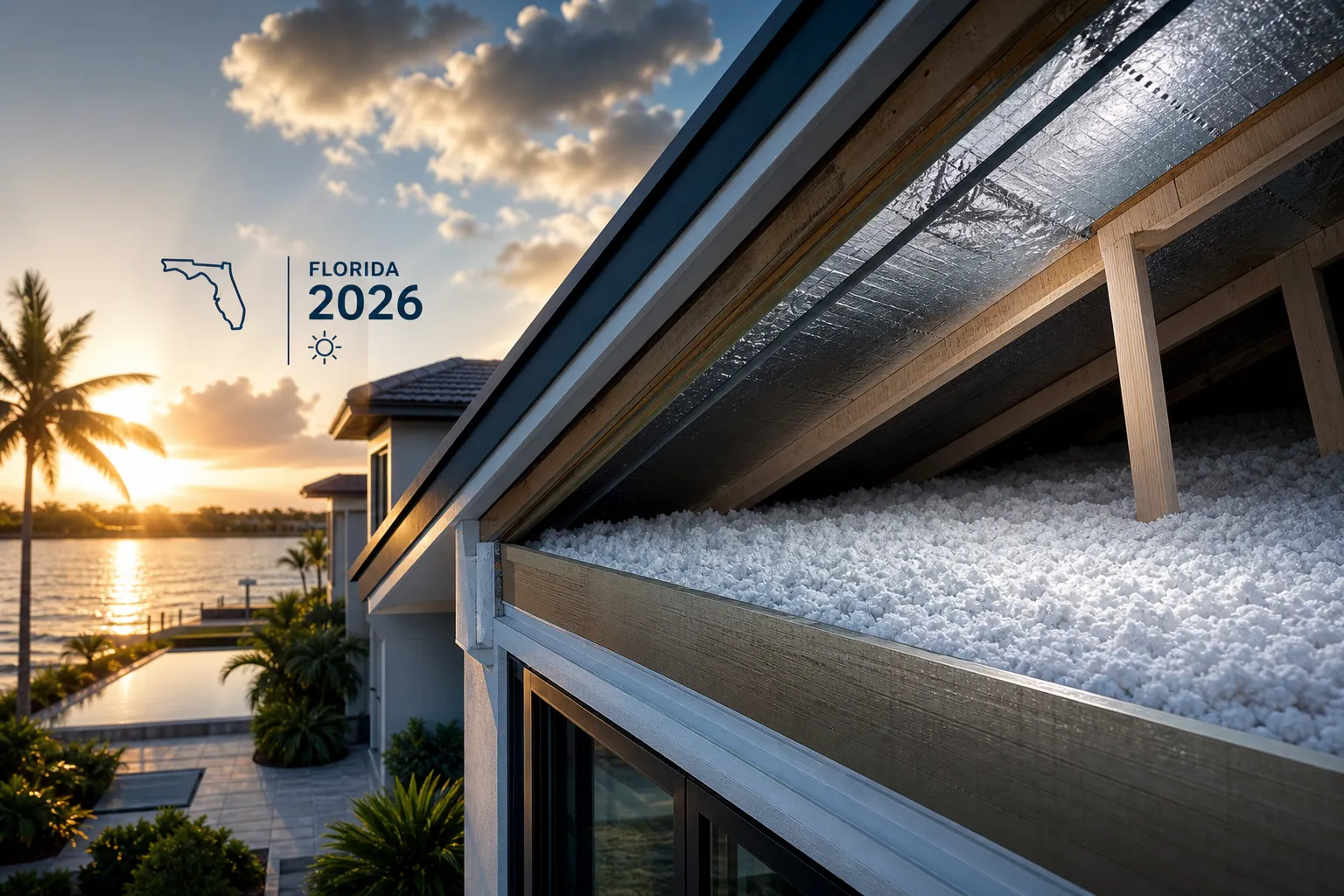
Attic Insulation in Florida: What Actually Works in 2026
Executive Summary: What Florida Homeowners Need to Know About Attic Insulation
Attic insulation in Florida must address extreme heat and humidity unlike almost anywhere else in the country. South Florida’s IECC Climate Zone 1A designation places Broward, Miami-Dade, and Palm Beach counties in one of the most thermally and hygroscopically demanding building environments in North America. Attic temperatures routinely exceed 140°F during summer months, and South Florida experiences high year-round humidity with summer dew points commonly in the mid-70s°F. Insulation assemblies engineered for temperate or cold climates are poorly suited to these conditions, leading to higher energy bills, increased HVAC wear, and chronic moisture problems.
The Florida Building Code (8th Edition, 2023) requires a minimum R-30 for Climate Zone 1 counties, including Broward, Miami-Dade, Palm Beach, Monroe, Lee, Collier, and Hendry. All remaining Florida counties fall under Climate Zone 2, which mandates an R-38 minimum. For high-performance applications, contractors such as Broward Insulation target R-38 to R-60 to maximize HVAC load reduction and improve long-term energy performance. The distinction between code minimum and performance-grade specification directly determines the financial return on any insulation upgrade. The FPL residential ceiling insulation rebate is a flat $220 instant invoice credit, the rebate amount does not increase with higher R-values, but exceeding minimum R-values does produce greater HVAC savings.
This guide addresses four performance areas specific to Climate Zone 1A: Florida Building Code compliance requirements, material performance and moisture risk, 2026 installed cost benchmarks, and projected energy savings with payback timelines. Each section synthesizes published research and industry benchmarks applicable to Broward, Palm Beach, and Miami-Dade County properties.
Florida Building Code R-Value Requirements for Attic Insulation
Climate Zone 1 vs. Climate Zone 2 Code Mandates
The Florida Building Code Energy Conservation chapter, 8th Edition, establishes R-30 as the governing minimum for attic insulation in Climate Zone 1 counties: Broward, Miami-Dade, Palm Beach, Monroe, Lee, Collier, and Hendry. All remaining Florida counties fall under Climate Zone 2, which mandates an R-38 minimum. The IECC recommends R-49 for Zone 2 applications in some national guidance documents, but the Florida Building Code Energy Conservation chapter maintains R-38 as the controlling standard. A reduction pathway to R-30 is permitted in Zone 2 when continuous insulation covers 100% of the ceiling area and all top plates at building eaves.
Permitted attic insulation projects in Broward County require two mandatory inspections under the 8th Edition: a rough-in inspection verifying R-values, air barrier continuity per FBC Table 402.4.2, and penetration sealing, followed by a final inspection confirming IC-rated, airtight recessed lighting and sealed electrical boxes. Unvented attic conversions additionally require blower door test documentation at or below 3 ACH50 before certificate of occupancy authorization. Projects permitted before December 31, 2026, remain governed by the 8th Edition; permits issued thereafter transition to the 9th Edition with incrementally higher R-value thresholds.
R-Value Compliance as a Financial and Legal Obligation
R-value compliance goes beyond a construction standard. The FPL residential ceiling insulation rebate is structured as a $220 flat instant invoice credit for qualifying Climate Zone 1 upgrades, with clear eligibility requirements: existing insulation must measure below R-8; the property must be a pre-1982 single-family home with whole-house central electric HVAC; and installation must be performed by an active FPL Participating Independent Contractor. Condominiums are categorically excluded. Homeowners who work with non-approved installers may forfeit rebate access and could face inspection or permit complications.
Attic Insulation Florida: Material Performance in Climate Zone 1A
Closed-Cell Spray Foam: The Benchmark for Roof-Deck Applications
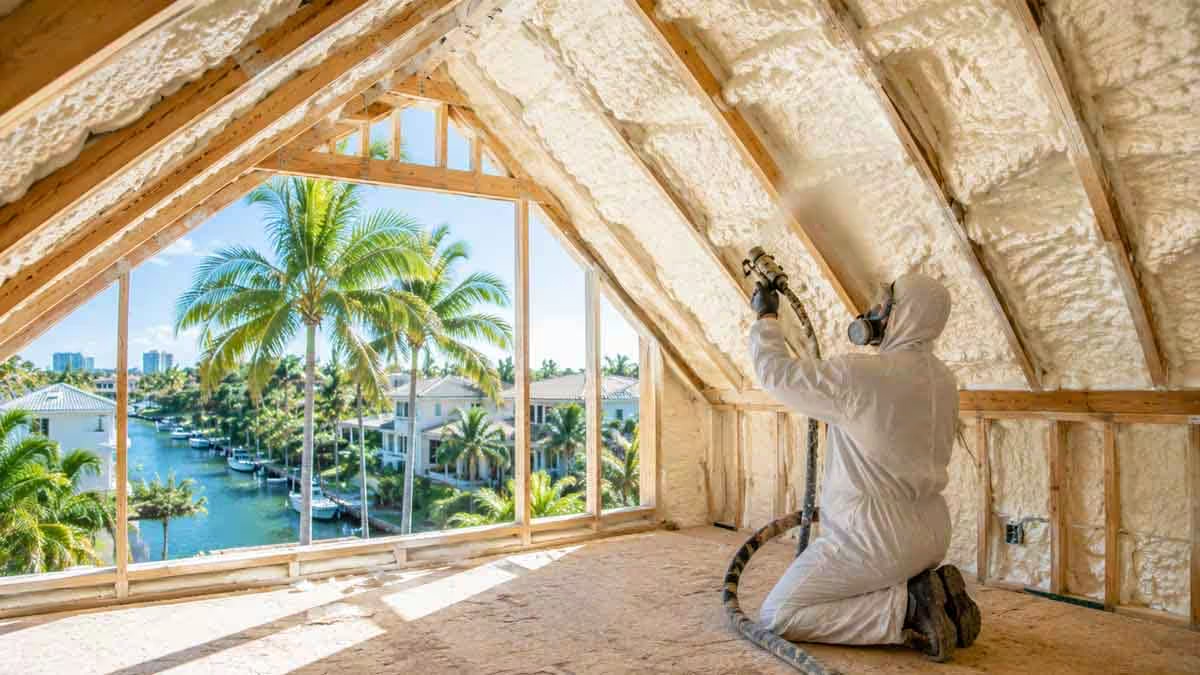
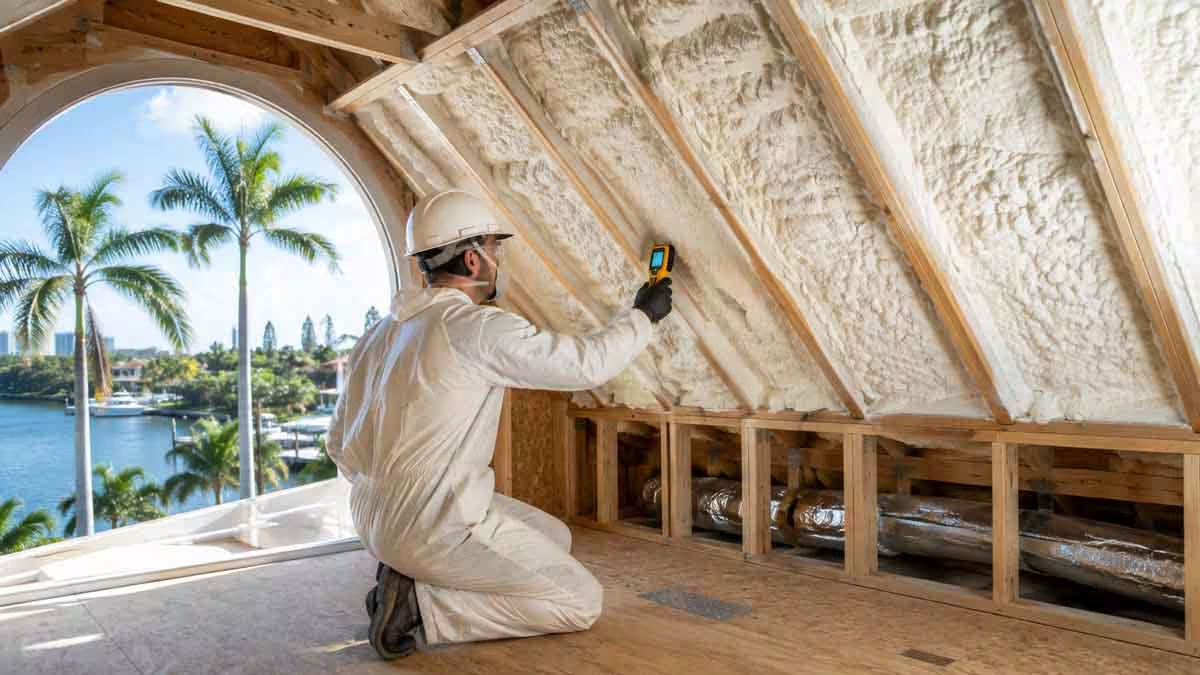
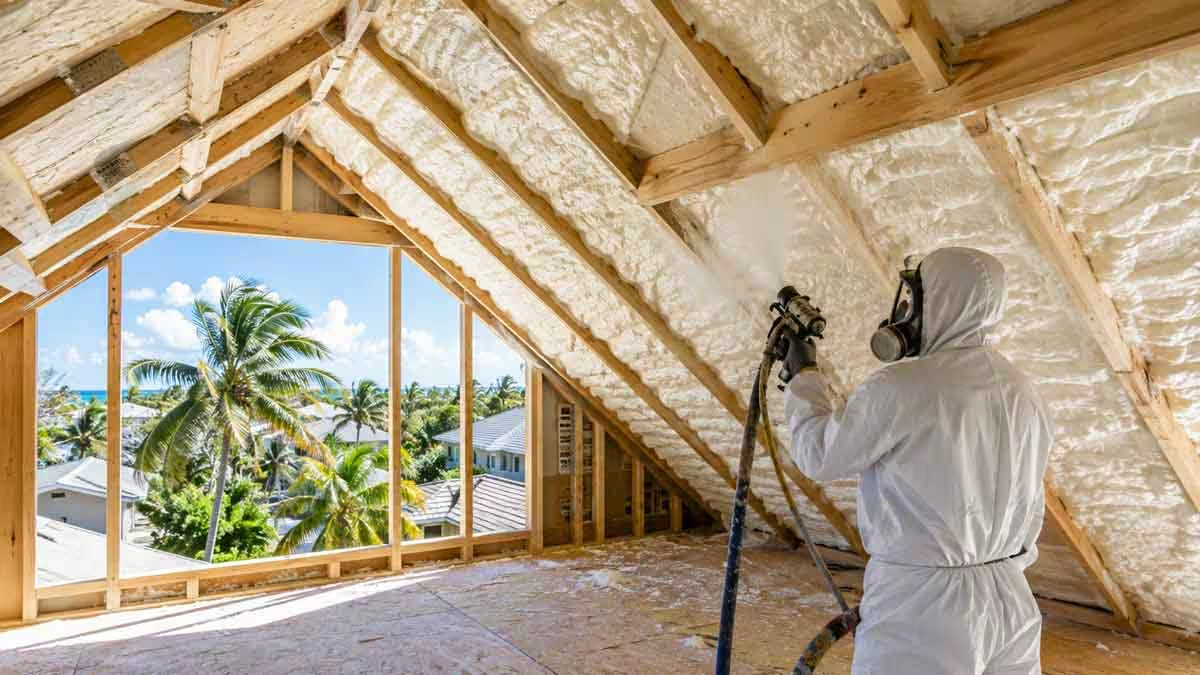
Closed-cell spray polyurethane foam delivers R-6 to R-7 per inch and achieves Class II vapor retarder status at 1.5 inches, with permeance at or below 1.0 perm. For South Florida roof-deck assemblies, application thickness of 2.5 to 4 inches is the professional standard. At this thickness, the foam creates an air-impermeable barrier at the underside of the roof deck that reduces attic temperatures from approximately 150°F to near-interior levels. That eliminates the thermal penalty on HVAC ductwork in unconditioned attic space and satisfies the moisture-control requirements for an unvented attic assembly under Florida Building Code Section R806.5.
In High-Velocity Hurricane Zone counties, Miami-Dade and Broward, spray foam applied to the roof deck must carry a current Miami-Dade County Notice of Acceptance (NOA). Statewide Florida Product Approval numbers are not sufficient for HVHZ compliance. Installation must conform to Roofing Application Standard (RAS) 109, which governs minimum foam thickness, ambient humidity limits at application (within 5 degrees of dew point prohibited), surface preparation, and the requirement for a Miami-Dade-approved coating over the foam. The assembly must be engineered to resist 170 mph ultimate design wind speeds in Broward County and 175 mph in Miami-Dade County. One critical limitation: a roof leak concealed beneath closed-cell foam can cause undetected wood rot, making pre-installation roof condition assessment a non-negotiable part of proper project scoping.
Blown-In Fiberglass and Cellulose: Performance Limitations in Humid Climates
Blown-in fiberglass and cellulose are cost-effective at $0.50 to $1.50 per square foot installed, but both materials are air-permeable. Without a separately installed, code-compliant air barrier, outdoor humid air passes through the insulation mass and contacts the cooler roof deck, where condensation initiates mold colonization on roof sheathing and framing. In existing South Florida homes, achieving a continuous, verified air barrier below blown-in insulation at the attic floor is often difficult at the quality level required for sustained Climate Zone 1A moisture performance. This material category is appropriate for attic-floor applications in properly vented assemblies with thorough air sealing at all penetrations, recessed fixtures, and HVAC chases.
Radiant Barriers: A Supplemental Tool, Not a Primary Solution
A radiant barrier reflects solar radiant heat, reducing roof deck temperature and supplementing primary insulation performance. It provides no measurable R-value, establishes no vapor retarder, and does not address humidity infiltration. Applied as a foil sheet stapled to rafters or as a spray-applied coating at $0.75 to $2.00 per square foot, it is a valid supplement in Climate Zone 1A assemblies but cannot serve as the sole thermal management strategy. Dust accumulation on the reflective surface degrades performance progressively over time.
Vented vs. Unvented Attic Configurations: Moisture Risk in South Florida
Why Vented Attics Underperform in Climate Zone 1A
Conventional guidance favoring attic ventilation was developed for temperate and cold climates, where interior moisture vapor must be driven outward through the roof assembly. In South Florida, the moisture threat operates in the opposite direction. During summer months, outdoor air with dew points averaging around 77°F enters a vented attic and contacts cool HVAC ductwork surfaces. That contact produces condensation that degrades ductwork insulation and promotes mold on roof sheathing, substantially increasing the latent cooling load the mechanical system must handle. Vented attic configurations in Climate Zone 1A consistently produce thermal and moisture management failures that compromise both energy performance and structural durability.
Unvented Attic Assemblies: The Preferred Configuration and Required Safeguards
The unvented, conditioned attic is the industry-preferred configuration for South Florida residential construction. Florida Building Code Section R806.5 permits unvented attic assemblies when at least one of the following moisture-control strategies is implemented: air-impermeable insulation applied to the roof deck underside at R-30 or greater; exterior rigid insulation above the deck raising sheathing temperature above the dew point; HVAC supply air conditioning the attic space; or a vapor diffusion port at the ridge permitting passive vapor egress without bulk airflow.
Mixing air-permeable blown-in insulation with an unvented design without one of these controls constitutes a code risk and a structural durability risk. Even in correctly designed unvented assemblies, a humidity sensor positioned near the roofline provides early detection of elevated relative humidity before condensation and biological growth begin. The attic space should be kept at low relative humidity, generally below problematic mold thresholds, through mechanical dehumidification or conditioned HVAC supply air. These findings align with independent research into attic thermal and moisture behavior in warm-humid climates, such as the Florida Solar Energy Center’s published analyses on attic performance and moisture control strategies FSEC publication.
Attic Insulation Florida: Installed Costs in South Florida for 2026
The following benchmarks reflect professionally installed costs, inclusive of materials and labor, for the South Florida market in 2026. South Florida’s humidity-resistant formulation requirements push closed-cell foam costs above published national averages.
- Closed-cell spray foam: $1.75 to $4.75 per square foot; $4,500 to $9,000 for a 1,000 to 1,500 square foot attic
- Open-cell spray foam: $1.50 to $3.00 per square foot; $2,500 to $5,000 for the same scope
- Blown-in fiberglass or cellulose: $0.50 to $1.50 per square foot; $1,000 to $2,500
- Radiant barrier: $0.75 to $2.00 per square foot; $1,500 to $3,500
Existing insulation removal adds an estimated $0.50 to $1.00 per square foot when degraded material requires extraction before new installation. Attic accessibility, framing configuration, required application thickness to reach code R-value, and air sealing at all penetrations are the primary variables affecting final project cost. A project scoped for insulation material alone, without comprehensive air sealing, will consistently fall short of the energy savings outlined in the following section.
The FPL $220 flat rebate is applied as an instant invoice deduction at installation. Qualifying upgrades may also be applied toward the federal Residential Energy Efficiency Tax Credit at 30% of project cost, capped at $1,200 for insulation improvements, claimed via IRS Form 5695. For homeowners seeking state-level guidance on weatherization and insulation best practices and available programs, the Florida weatherization and insulation library provides useful, practical resources on insulation types and installation considerations weatherization and insulation resources.
Energy Savings and Return on Investment for South Florida Property Owners
Cooling represents 40 to 60% of total annual energy consumption for South Florida residential properties, well above the national average. That concentration of energy expenditure in a single end use means attic insulation upgrades deliver more pronounced impacts on total utility cost in Climate Zone 1A than in most other U.S. climate regions. Properties with existing insulation measuring below R-19 consistently capture the largest percentage reductions.
Standard blown-in upgrades achieving R-38 produce 10 to 20% cooling cost reductions, translating to roughly $150 to $450 annually for a typical 1,500 to 2,000 square foot home. Closed-cell spray foam with comprehensive air sealing produces 20 to 40% cooling cost reductions, yielding $720 to $1,800 annually for the same property size. For properties exceeding 2,500 square feet with high cooling loads, documented annual savings of $1,800 or more are achievable with full spray foam upgrades. Payback periods fall in the 2 to 4 year range across upgrade scenarios when FPL rebate and federal tax credit values are factored in.
Duct sealing alone can improve HVAC system efficiency by more than 20%. Combined attic insulation and air sealing scopes consistently outperform insulation-only projects in independently measured energy savings, making the combined approach the strongest ROI pathway for property owners focused on reducing operating costs.
Engineering a Code-Compliant Attic Envelope: Broward Insulation’s Approach
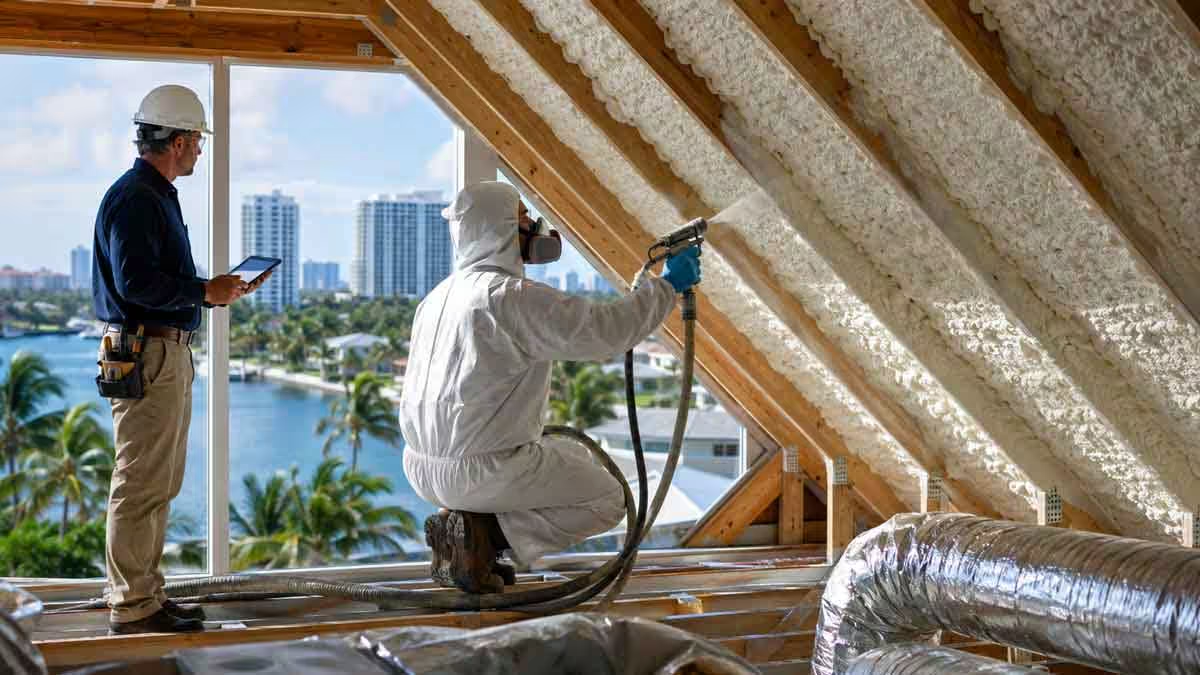
Broward Insulation has served the South Florida tri-county market since 1977, building deep familiarity with Climate Zone 1A conditions that national franchises applying generic cold-climate models simply cannot replicate. Every project engagement begins with a comprehensive building science assessment: existing R-value measurement, moisture and mold inspection, air leakage identification, ductwork condition evaluation, and attic ventilation configuration analysis. The specification document produced from that assessment supports a Broward County permit application, an FPL rebate submission, and a clear energy performance projection.
As an FPL Participating Independent Contractor, Broward Insulation manages the complete compliance pathway for each project, from Florida Building Code R-value verification and HVHZ NOA documentation through FPL rebate application processing. All closed-cell spray foam applications meet HVHZ standards, RAS 109 requirements, and the moisture-control provisions of the 8th Edition Florida Building Code. For contractors and homeowners seeking best-practice guidance on spray foam application, see the industry residential spray foam installation guidance residential spray foam guide. Contact Broward Insulation to schedule a professional attic insulation Florida assessment and receive a performance-grade specification for your property.
Recent project examples demonstrating typical outcomes and measured attic R-value improvements are available in our portfolio: