HVAC load reduction starts with your thermal envelope
Executive Summary: In South Florida’s IECC Climate Zone 1A, thermal envelope degradation is a major driver of elevated HVAC load reduction challenges in residential and commercial structures across Broward, Palm Beach, and Miami-Dade counties, and one of the most consistently documented causes in audited buildings throughout the region.
A compromised building envelope permits continuous radiant heat gain and air infiltration, forcing HVAC systems into near-continuous operation that inflates energy expenditure and accelerates mechanical wear.
Three insulation upgrades deliver measurable HVAC load reduction: attic air sealing, closed-cell spray foam, and blown-in insulation. A diagnostic thermal envelope assessment conducted prior to any material installation is the essential first step in any legitimate load reduction protocol.
Broward Insulation, a licensed building science-focused contractor with nearly 50 years of South Florida field experience, delivers that assessment and the code-compliant retrofit sequence it requires.
South Florida’s IECC Climate Zone 1A designation reflects conditions categorically distinct from those addressed by national insulation standards. Ambient temperatures regularly exceed 90°F for much of the year, dew points frequently climb above 70°F from June through October, and the effective cooling season stretches across most of the calendar year, conditions well-documented in NOAA regional climate normals for the tri-county area.
Under these conditions, residential HVAC systems in Broward, Palm Beach, and Miami-Dade counties experience extended run times and high duty cycles, consuming energy at rates most property owners underestimate when evaluating utility costs.
The common assumption among South Florida property owners is that a high electric bill or an underperforming HVAC system means aging mechanical equipment. In many of the audited cases we assess, the actual driver is a compromised thermal envelope that forces the system to compensate for continuous, unchecked heat gain and conditioned air loss.
Replacing the HVAC unit without correcting the envelope addresses the symptom while leaving the cause intact. This article details the mechanics of envelope-driven HVAC load, the three insulation upgrades that correct it in measurable terms, and the diagnostic process that determines which measures apply to a specific structure and in what sequence.
How a degraded thermal envelope forces continuous HVAC operation
Air infiltration and the stack effect in Climate Zone 1A
In South Florida’s near-year-round cooling season, attic bypasses, wind pressure, and mechanical pressure differentials work together as persistent infiltration drivers. Hot, humid exterior air enters through unsealed top-plate penetrations, attic bypasses, recessed lighting housings, and wall cavity discontinuities, continuously displacing conditioned interior air.
Each air change driven by infiltration is a direct HVAC load event: the system must condition an incoming volume of unconditioned air before thermal equilibrium is restored.
Pre-2000 South Florida single-family homes, which constitute a substantial portion of the tri-county residential inventory, typically test at 10 to 15 or more air changes per hour at 50 pascals (ACH50) prior to envelope retrofit, based on regional field data compiled across Zone 1A audits. That level of leakage places extraordinary demand on mechanical systems.
In Climate Zone 1A, the latent component of infiltration load compounds the sensible burden. Exterior dew points regularly above 70°F mean infiltrating air carries a heavy moisture load the HVAC system must remove as part of its operating cycle.
This latent demand, the energy required for moisture removal rather than temperature reduction, represents a significant share of total HVAC load in South Florida residential structures, a proportion often omitted from simplified load calculations. Reducing it is central to any effective heating load reduction or cooling load reduction strategy in this climate zone.
How attic heat gain translates into measurable HVAC tons
Uninsulated or under-insulated attic assemblies in South Florida present a direct conduction pathway from the exterior to the conditioned space below. Dark roofing surfaces under intense solar exposure reach very high surface temperatures during peak hours, field measurements in similar hot-climate environments have recorded roof-deck temperatures well above ambient, driving conductive heat gain through the attic floor assembly and into living areas.
Every BTU per hour entering through the attic boundary is a BTU the HVAC system must remove. When an attic assembly performs below Florida Building Code’s minimum R-30 threshold for Climate Zone 1A, that heat gain inflates the effective cooling load beyond the system’s original design intent and undermines its ability to maintain interior temperature and humidity setpoints.
The compounding effect of moisture infiltration on system runtime
A degraded vapor barrier or improperly specified insulation assembly amplifies latent infiltration beyond what the HVAC system was designed to manage. Loose-fill fiberglass insulation materials can test at permeance values well above 20 perms, highly vapor-open assemblies that offer no meaningful resistance to vapor diffusion (per ASTM E96 classifications).
Cellulose is less permeable, typically in the 2 to 5 perm range. When either material is applied without an air sealing sequence and without an appropriate vapor control layer, moisture-laden air passes through the assembly and enters the conditioned space.
The HVAC system then operates beyond its rated dehumidification capacity, extending runtime, increasing energy consumption, and accelerating mechanical wear in a climate with no seasonal recovery period.
The three insulation upgrades that measurably reduce HVAC load
Attic air sealing: the highest-impact entry point for South Florida homes
Attic air sealing is the first-priority measure in any envelope retrofit because the attic is the dominant infiltration zone in most South Florida single-family structures. The process requires identifying and sealing all bypass pathways at top plates, recessed lighting housings, plumbing stacks, HVAC chases, and electrical penetrations, before any insulation material goes in. Applying insulation without completing this step is a documented failure mode: the material masks the bypass without eliminating the infiltration it drives.
Properly executed attic air sealing, verified by pre- and post-intervention blower door testing, typically delivers peak cooling load reductions in the single-digit to low-double-digit percent range, depending on the baseline leakage rate of the structure. DOE Building America program guidance consistently cites air sealing as a top-priority measure before insulation upgrades, and our own field assessments across Broward County confirm that pattern. For recent code-level guidance on sealing practice and compliance, see the [air sealing requirements for IECC 2021](https://www.eeba.org/air-sealing-requirements-for-iecc-2021-with-building-code-expert-joe-nebbia).
Closed-cell spray foam: the dual thermal and moisture barrier
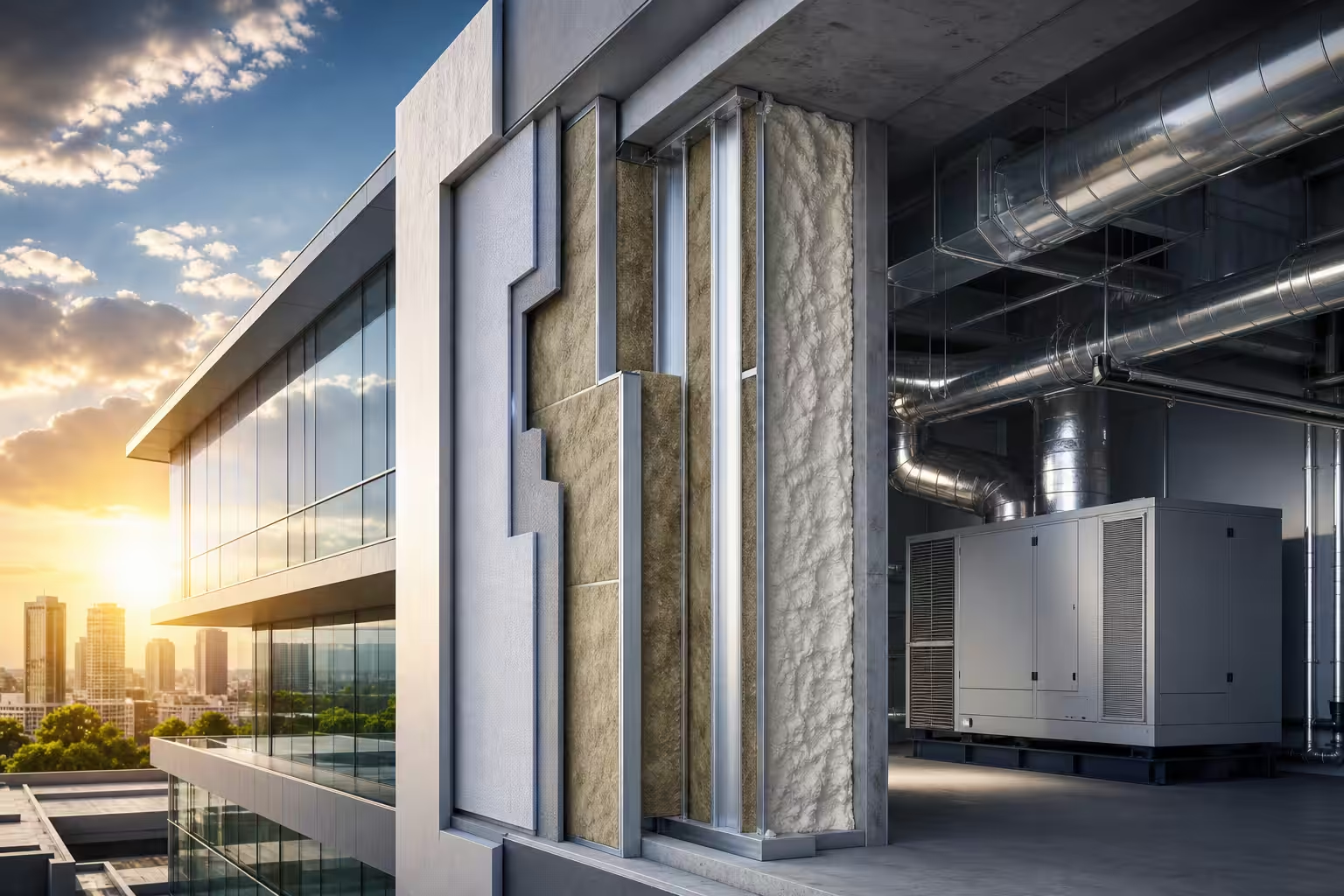
Closed-cell spray foam is the optimal specification for structures subject to Climate Zone 1A moisture exposure. At a sufficient application depth, typically two inches or more, with permeance decreasing as thickness increases, closed-cell foam functions as a Class II vapor retarder, blocking vapor diffusion in addition to conductive heat transfer.
Its R-value of 6 to 7 per inch makes it the highest thermal resistance per unit thickness available for residential and commercial applications in South Florida. Primary application zones include the underside of the roof decking in unvented attic assemblies, rim joists, wall cavities in legacy structures, and mechanical room penetrations where thermal bridging concentrates heat gain. For further detail on vapor control performance among spray foam options, see [which type of spray foam insulation offers better vapor barrier protection](https://prestigeinsulationsolutions.com/which-type-of-spray-foam-insulation-offers-better-vapor-barrier-protection/). See our [project portfolio](https://browardinsulation.com/portfolio/) for examples of mechanical-space work that includes targeted foam application.
When closed-cell spray foam is incorporated as part of a comprehensive envelope retrofit that includes air sealing and R-value correction, combined measures have produced aggregate peak cooling load reductions of 20 to 60 percent in deep-retrofit case studies, reductions attributable to the full package of air sealing, insulation, and vapor control working together. South Florida’s extreme baseline infiltration and heat gain rates tend to push results toward the higher end of that range relative to temperate climate applications.
Blown-in insulation: cost-effective thermal coverage for existing structures
Blown-in loose-fill insulation, applied as loose-fill fiberglass or cellulose to the attic floor assembly, is the practical mechanism for increasing attic R-value in occupied South Florida residences without structural disruption. Florida Building Code establishes a minimum R-30 threshold for attic assemblies in Climate Zone 1A, with R-38 cited as the recommended performance target for optimal energy efficiency in the tri-county market.
Many pre-2000 South Florida homes fall substantially below this threshold. Older structures commonly exhibit original attic insulation well below R-30, particularly those built before modern energy codes took effect. Blown-in insulation, applied after air sealing is complete, delivers the R-value correction the code mandate and the HVAC load calculation both require.
Why a thermal envelope assessment must precede any upgrade
What a building science assessment examines in a South Florida residence
A thermal envelope assessment deploys three primary diagnostic instruments: blower door depressurization testing, infrared thermography under differential temperature conditions, and duct leakage testing. [Blower-door testing for air leakage](https://flcea.com/blower-door-testing-for-air-leakage/) quantifies total building leakage in ACH50, establishing a measurable baseline against which post-retrofit performance can be verified.
Infrared imaging, conducted under the temperature differential conditions present in South Florida’s air-conditioned interiors, identifies specific locations of thermal bridging, moisture intrusion, and air movement pathways that a visual inspection cannot detect. Duct leakage testing isolates conditioned air loss through the distribution system, which frequently contributes to building load independent of the envelope assembly.
This diagnostic foundation also informs whether energy recovery ventilation (ERV) is appropriate for the structure. In tightly sealed buildings, ERV systems allow controlled fresh air exchange without sacrificing conditioned air, a critical ventilation and indoor air quality tradeoff that becomes especially relevant after aggressive air sealing.
Why generic upgrade recommendations without diagnostic data produce suboptimal results
Without a diagnostic baseline, contractors routinely apply insulation over unsealed bypasses, add R-value where conduction is not the primary load driver, or misidentify the dominant heat gain pathway. The consequence is not merely inefficiency.
The upgrade investment delivers a fraction of the theoretically achievable cooling load reduction, and the resulting energy savings fail to justify the capital outlay. A property owner who invests in blown-in insulation without prior air sealing has paid for a cosmetic improvement while the infiltration pathway remains fully intact beneath the new material.
How Broward Insulation’s assessment process determines the right upgrade sequence
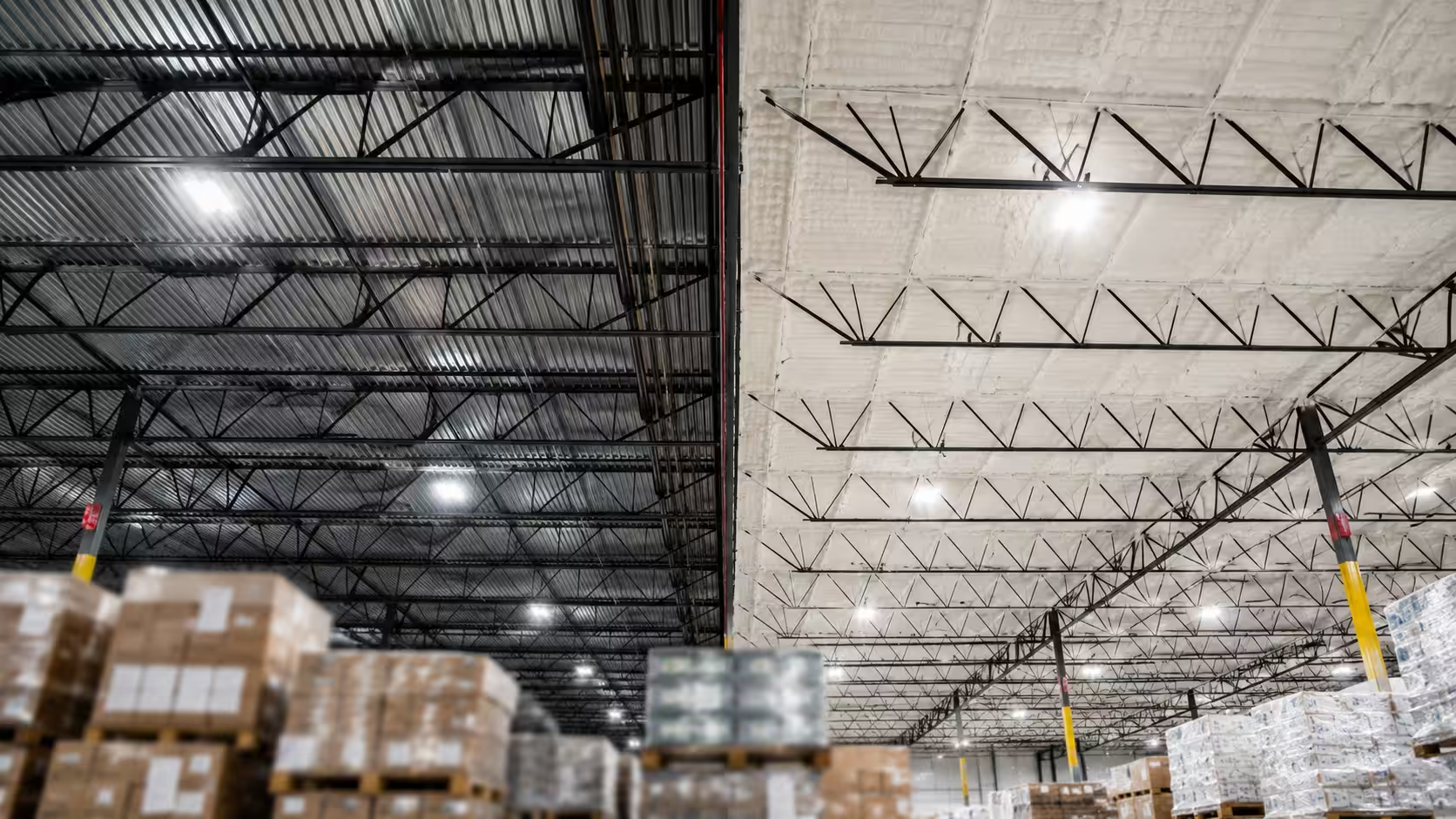
Broward Insulation, founded in 1977 and operating continuously in the South Florida tri-county market, conducts systematic thermal envelope assessments that map heat gain and infiltration pathways before any material recommendation is made.
The assessment output is a ranked priority list of insulation and air sealing measures, organized by projected HVAC load reduction per dollar invested. This prioritization allows property owners, real estate investors, and facility managers to sequence upgrades against their capital planning cycle, capturing the largest efficiency gains in the earliest phase and generating energy cost savings that offset subsequent investment. See our [completed projects portfolio](https://browardinsulation.com/portfolio/) for examples of assessment-driven retrofit sequencing.
Quantifying the load reductions: tonnage, percent savings, and right-sizing potential
Documented percent reductions by insulation upgrade type
Based on regional field assessments and published building science research, the following ranges reflect what South Florida residential assemblies typically achieve:
- Attic air sealing alone: Peak cooling load reductions typically in the single-digit to low-double-digit percent range, depending on baseline leakage
- Closed-cell spray foam at critical thermal junctions: An additional 10 to 20 percent contribution as part of a combined retrofit
- Combined envelope upgrades including blown-in R-value correction: Aggregate reductions of 20 to 60 percent documented in comprehensive [Before And After Insulation Work Case Studies](https://browardinsulation.com/portfolio/)
South Florida’s Climate Zone 1A conditions, extreme baseline heat gain and high latent infiltration, consistently push results toward the higher end of these ranges relative to temperate climate applications of the same measures. These are also the conditions where demand-response HVAC programs offer the most benefit, since a properly retrofitted envelope reduces peak electrical demand during high-grid-stress hours.
HVAC equipment right-sizing opportunities following envelope retrofit
When peak cooling load decreases following comprehensive envelope work, the replacement HVAC system is often specified at lower tonnage without compromising interior thermal comfort or humidity control.
Hot-climate retrofit studies and simulations show equipment capacity reductions in the 10 to 30 percent range following envelope upgrades, with significant HVAC energy savings documented across the post-retrofit operational period, though specific outcomes vary based on the depth of retrofit and baseline conditions.
Right-sizing eliminates the short-cycling inefficiency of an oversized unit operating against a corrected load. For property investors acquiring pre-2000 South Florida structures, that right-sizing opportunity is a direct capital cost reduction at the point of HVAC replacement, one that is traceable to the envelope investment that preceded it.
The latent load correction that tonnage calculations frequently omit
Reducing infiltration through air sealing and closed-cell spray foam decreases the moisture removal burden on the HVAC system. This reduction frequently eliminates the need for supplemental dehumidification in structures where the corrected envelope maintains interior relative humidity within acceptable bounds.
The latent load correction is routinely omitted from simplified tonnage calculations, yet it represents a material component of true cooling load reduction in South Florida assemblies. It must be incorporated into any replacement system specification to avoid undersizing the dehumidification capacity of the new unit.
Financing the retrofit: FPL rebates, ROI timelines, and implementation sequencing
FPL rebate programs available for qualifying insulation upgrades in Broward County
Broward Insulation participates in Florida Power and Light’s residential efficiency rebate programs, providing clients direct access to available incentives without additional administrative burden.
The current FPL residential rebate structure for Broward County includes a $220 instant rebate credited directly to the contractor invoice for qualifying attic insulation upgrades, applicable to structures where the existing ceiling R-value measures below R-8. The rebate is processed at installation and requires no separate application by the property owner.
At South Florida electricity rates, this incentive can reduce the simple payback period for a comprehensive attic insulation and air sealing retrofit, from typical national averages of 4 to 8 years down to a considerably shorter window for qualifying structures. See FPL’s resources on [ceiling insulation](https://www.fpl.com/save/resources/ceiling-insulation.html) for program details and installation guidance.
Building a phased implementation sequence based on ROI priority
The optimal sequencing logic for South Florida envelope retrofits follows the proportional relationship between installation cost and HVAC load impact.
Start with attic air sealing, the lowest-cost measure with the highest proportional load reduction per dollar invested. Move to blown-in insulation second, as the primary mechanism for R-value correction in existing structures. Apply targeted closed-cell spray foam third, at high-infiltration junctions and unvented attic assemblies where vapor control and thermal resistance both require a Class II or better performance specification.
This sequence aligns with FPL rebate program structures and positions the property owner to realize the largest energy cost reductions in the first phase, generating cash flow that can partially offset the capital requirement for subsequent phases. It also aligns with peak cooling and peak heating mitigation goals, reducing grid demand during the hours that matter most for both utility costs and system longevity. Property owners should also evaluate federal incentives such as the [Energy Efficient Home Improvement Credit for insulation and air sealing](https://www.energy.gov/cmei/buildings/articles/energy-efficient-home-improvement-credit-insulation-and-air-sealing) when calculating ROI and payback timelines.
Conclusion: the envelope precedes the equipment
HVAC load reduction in South Florida is not, in the first instance, an equipment problem. It is a building envelope problem. The path to measurably lower energy costs, reduced HVAC runtime, and justified equipment right-sizing runs through attic air sealing, closed-cell spray foam, and blown-in insulation correction, executed in sequence against a diagnostic baseline that identifies the precise locations and magnitudes of heat gain and infiltration.
An HVAC replacement made without this foundation does not reduce building load. It replaces equipment operating under an uncorrected load with newer equipment that will run under the same conditions.
Without a thermal envelope assessment establishing where conditioned air is escaping and where heat is entering the building assembly, upgrade investments are allocated without the data required to achieve maximum HVAC load reduction.
The assessment is not an optional preliminary step. It is the analytical instrument that determines which measures are warranted, in what sequence they should be executed, and what performance outcomes the property owner should expect to verify upon completion.
For South Florida property owners, real estate investors, and facility managers seeking a licensed, building science-focused contractor to conduct a thermal envelope assessment and engineer a code-compliant insulation retrofit, Broward Insulation brings nearly 50 years of South Florida field experience to that work. Contact us to schedule a diagnostic assessment and receive a ranked, ROI-sequenced upgrade recommendation with FPL rebate eligibility confirmed before any material commitment is made.