Commercial pipe insulation guide for South Florida facilities
Executive Summary: Commercial pipe insulation encompasses the thermal and vapor control systems applied to chilled water, condenser water, HVAC mechanical, and domestic hot water piping within commercial and multi-family facilities. In IECC Climate Zone 1A, which covers Broward, Miami-Dade, and Palm Beach counties, undersized or improperly installed mechanical pipe insulation allows surface condensation to form on below-ambient lines. That condensation can saturate structural assemblies rapidly under high dew point conditions, promote mold colonization, and initiate corrosion under insulation on carbon steel and galvanized systems. This guide addresses material selection across the principal insulation types, ASHRAE 90.1 thickness minimums, vapor retarder specifications, ASTM E84 plenum compliance, jacketing systems, and contractor qualification standards. The content reflects nearly five decades of large-scale mechanical insulation engineering across commercial and multi-family properties throughout the South Florida Tri-County region.
Why South Florida’s climate makes commercial pipe insulation a structural priority
The condensation failure mechanism in chilled water systems
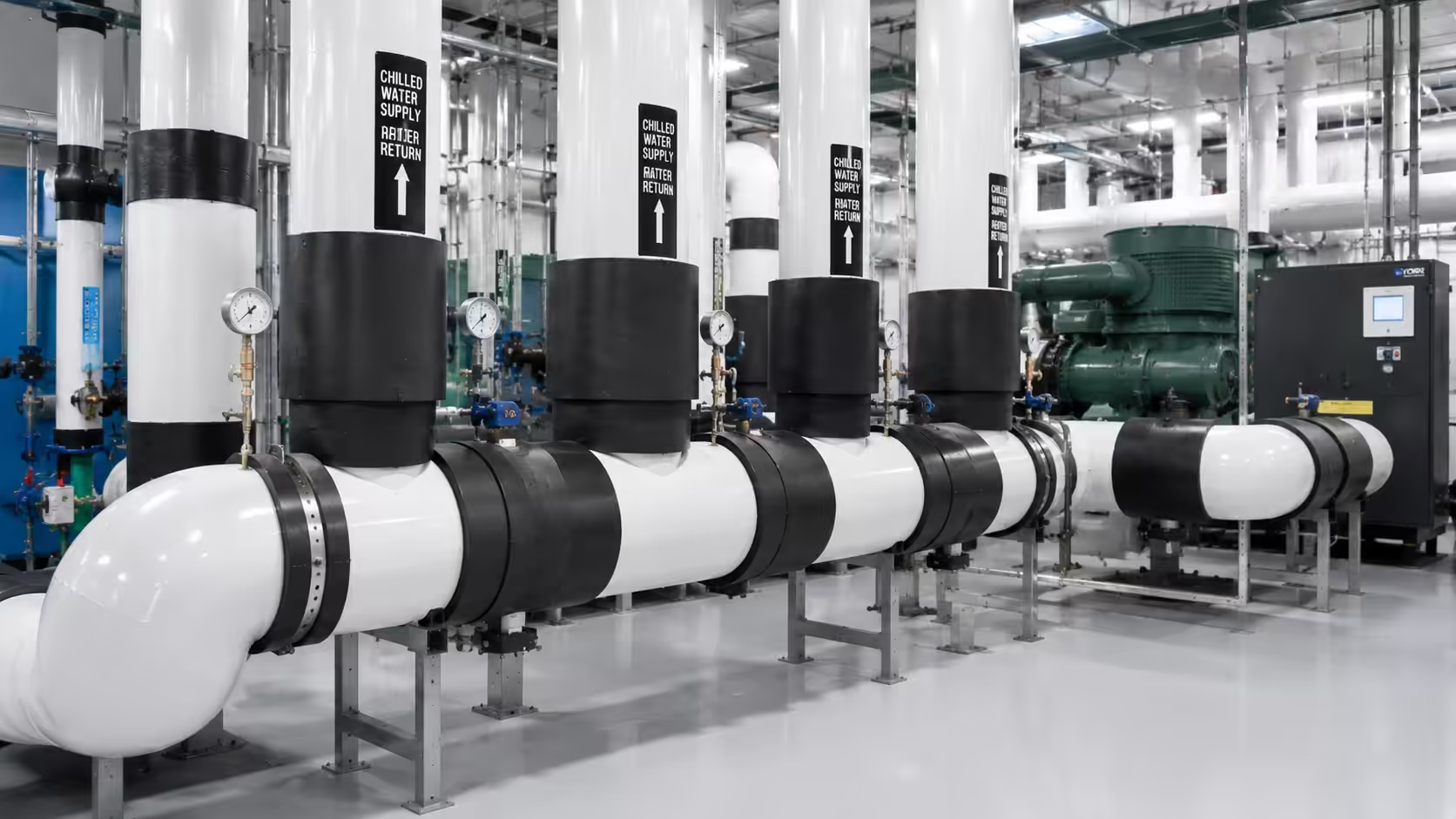
Chilled water systems in commercial facilities typically operate at supply temperatures between 42°F and 55°F. South Florida’s ambient dew points routinely exceed 75°F during summer months, and annual average dew points at Fort Lauderdale Executive Airport (KFLL) hold between 68°F and 72°F, with peak summer readings between 75°F and 78°F. The resulting differential between pipe surface temperature and ambient dew point is among the highest recorded for any IECC climate zone in the continental United States.
When insulation is undersized relative to this dew point differential, the outer surface of the insulation assembly drops below the ambient dew point and condensation forms continuously. That moisture saturates adjacent building materials, provides a substrate for mold colonization, and loads corrosive chloride-bearing moisture directly onto pipe supports and hangers. This is a mechanical and structural liability, not a comfort variable. Facility managers who treat commercial pipe insulation on chilled water lines as a commodity item consistently underestimate this failure mechanism until remediation costs materialize.
Energy loss and HVAC load penalties in Climate Zone 1A
Thermal bridging through undersized or degraded insulation on chilled water supply lines transfers heat gain directly into the chilled water loop. Each incremental degree of heat gain at the coil forces the chiller plant to generate additional cooling capacity to compensate, increasing electrical consumption measurably over the annual operating cycle. IECC Climate Zone 1A’s extreme heat index and sustained humidity produce among the highest annual heat gain values of any climate classification applicable to U.S. commercial construction, making insulation thickness a direct variable in energy expenditure calculations rather than a peripheral specification concern.
For large commercial facilities with central plant chilled water distribution spanning hundreds or thousands of linear feet, even modest improvements in commercial pipe insulation performance translate to quantifiable reductions in chiller runtime and utility cost. Qualifying energy-efficiency upgrades may be eligible for FPL rebate programs; confirm current program requirements directly with FPL before including rebate assumptions in project financial models.
Corrosion under insulation (CUI) and system longevity risk
Corrosion under insulation is an electrochemical degradation process that occurs when moisture infiltrates improperly sealed or physically degraded insulation systems, accumulates at the pipe surface, and initiates sustained oxidation on carbon steel and galvanized pipe. CUI requires three conditions to develop: moisture, oxygen, and a susceptible metal substrate. South Florida’s climate supplies all three in abundance. Carbon steel pipe operating between 32°F and 300°F resides precisely within the most aggressive CUI temperature range documented in industry literature.
Coastal salt-air exposure in Broward and Miami-Dade materially increases CUI risk. Airborne chlorides from Atlantic exposure deposit on jacket surfaces, and any breach in jacketing continuity delivers a concentrated chloride electrolyte solution directly to the pipe substrate. Galvanized pipe is particularly vulnerable: once chloride attack compromises the zinc coating, the underlying steel corrodes at rates substantially higher than standard atmospheric exposure. Stainless steel cladding and low-water-retention insulation materials are the correct specification response for coastal mechanical installations, not an optional upgrade. Industry guidance on identifying and managing CUI is available through educational resources such as the AMPP Corrosion Under Insulation course, which covers inspection, mitigation, and design strategies specific to insulated piping systems.
Pipe insulation materials: performance properties and HVAC applications
Elastomeric foam for chilled water and pipe insulation for HVAC refrigerant lines
Elastomeric and nitrile rubber insulation operates across a temperature range of -50°C to +125°C, with thermal conductivity values between 0.034 and 0.038 W/m·K at 24°C mean temperature. The closed-cell molecular structure provides inherent vapor diffusion resistance, eliminating the need for a separately applied vapor retarder in most below-ambient HVAC applications when the factory-faced assembly is correctly installed. This material is the standard specification for commercial pipe insulation on HVAC chilled water piping, refrigerant lines, and condensate drain systems throughout Climate Zone 1A. For quick reference on typical material temperature ranges and applicability, see common manufacturer guidance on temperature ranges for common insulation materials.
The flexible form factor accommodates the tight clearances common in commercial mechanical rooms, and field-fabricated fittings maintain continuous coverage at elbows, tees, and valve assemblies without the thermal bridging that results from improperly cut or loosely fitted sections. Specifiers should confirm that vapor retarder seam adhesive is compatible with the insulation manufacturer’s system to preserve composite assembly performance ratings.
Fiberglass and mineral wool for high-temperature piping
Fiberglass pipe insulation operates from -40°C to +540°C with a k-value range of 0.031 to 0.044 W/m·K. It is suited for domestic hot water, steam, and dual-temperature systems where operating temperatures exceed the upper limit of elastomeric materials. Mineral wool extends the operational ceiling to +650°C, with k-values between 0.032 and 0.050 W/m·K. Its inherent fire resistance, water-repellent treatment, and structural rigidity make it the preferred specification for industrial pipe insulation applications, high-temperature headers, and installations where non-combustibility per ASTM E136 or low surface-burning characteristics per ASTM E84 are governing requirements.
Both fiberglass and mineral wool are fibrous materials with open-cell structures that do not provide vapor diffusion resistance. A separately specified vapor retarder jacket rated at or below 0.1 perm (Class I per ASTM E96) is mandatory when either material is applied to below-ambient piping. Specifying fiberglass or mineral wool without an appropriate vapor retarder system on chilled water lines constitutes a non-compliant installation in Climate Zone 1A under both ASHRAE 90.1 and the Florida Building Code.
Polyethylene foam for domestic cold water and low-temperature lines
Closed-cell polyethylene foam insulation operates to approximately +80°C, with thermal conductivity between 0.029 and 0.040 W/m·K. It is a lightweight, cost-effective solution for domestic cold water distribution, condensate lines, and other low-temperature piping where the long-term vapor diffusion resistance demands of commercial HVAC chilled water systems do not apply. Its moisture resistance and ease of installation make it appropriate for these limited applications within conditioned interior spaces.
Polyethylene foam is not appropriate for HVAC chilled water systems in Climate Zone 1A. The material does not provide sufficient long-term vapor resistance for below-ambient commercial piping, and its lower operating temperature ceiling precludes use on high-temperature mechanical systems. Specifiers must confirm intended service conditions before selecting this material to avoid non-compliant installations.
ASHRAE 90.1 thickness requirements and R-value compliance
Chilled water and condenser water piping minimums
ASHRAE 90.1 Table 6.8.3-2 specifies minimum insulation thicknesses for below-ambient cooling systems, including chilled water piping operating between 40°F and 60°F. For nominal pipe sizes below 1.0 inch, the minimum thickness is 0.5 inches. From 1.0 to 1.25 inches NPS, the minimum is 0.75 inches. For all pipe sizes at 1.5 inches NPS and above, the minimum is 1.0 inch. These values apply uniformly across IECC climate zones and are not adjusted for the elevated dew point conditions specific to Climate Zone 1A.
Energy code minimums represent a compliance floor, not a condensation control specification. In Climate Zone 1A, condensation control calculations for chilled water piping at ambient summer conditions of 80°F and 85% relative humidity produce dew points approaching 75°F. These conditions frequently require insulation thickness and vapor retarder specifications that exceed ASHRAE 90.1 minimums to maintain surface temperatures above the dew point. Specifiers must perform project-specific condensation calculations, not simply replicate code minimum tables.
Domestic hot water and steam piping requirements
High-temperature steam piping operating above 350°F requires up to 5.0 inches of insulation on larger nominal pipe sizes per ASHRAE 90.1-2010 and subsequent editions, a significant increase from the 4.0-inch minimums of earlier code cycles. For additional context on the ASHRAE 90.1 thickness changes and their implications for design practice, see discussions of ASHRAE Standard 90.1 increases to minimum pipe insulation thicknesses. Domestic hot water piping thickness is determined by the intersection of operating temperature and nominal pipe diameter in ASHRAE 90.1 Table 6.8.3-1. The IECC-2024 edition introduced minimum R-values as an optional compliance path alongside the existing thickness tables, giving specifiers a second route to demonstrate energy code conformance. For piping serving Climate Zone 1A facilities, the R-value path can be particularly useful when non-standard insulation materials or composite assemblies are being evaluated.
Energy codes govern performance minimums only. Material selection remains the specifier’s decision, informed by operating temperature range, code classification for the installation environment, vapor control requirements, and long-term durability in the specific mechanical room or field condition where the system will operate.
Vapor retarder specification for below-ambient systems
All below-ambient commercial piping systems in IECC Climate Zone 1A require a vapor retarder rated at or below 0.1 perm (Class I per ASTM E96) to prevent moisture migration through the insulation toward the cold pipe surface. Interstitial condensation occurring within the insulation body degrades thermal resistance, saturates the insulation matrix, and establishes the moisture accumulation conditions that initiate CUI at the pipe surface. The vapor retarder must function as a continuous, unbroken membrane across the full installed length of the system.
Every joint, seam, end cap, and penetration through the vapor retarder represents a potential condensation pathway. Field splices at fittings, valve bodies, and flanges must be sealed with system-compatible adhesive and tape to maintain the composite assembly’s vapor resistance rating. Any breach in this continuity degrades the performance of the entire insulated section and cannot be corrected through re-inspection alone, physical remediation is required.
Preformed sizes, large-diameter options, and jacketing specifications
Standard preformed pipe insulation sizes and large-diameter availability
Preformed pipe insulation sections are manufactured as standard commercial inventory for nominal pipe sizes (NPS) ranging from 1/8 inch through 12 inches, conforming to the outside diameters defined by ASME B36.10M for carbon steel and B36.19M for stainless steel pipe. Specifiers must confirm nominal pipe size and pipe schedule when ordering preformed sections, as the insulation bore diameter is sized to the pipe outside diameter. Schedule changes within the same NPS can affect fit and continuous coverage.
For large-diameter applications common in central plant chilled water distribution systems, process cooling headers, and mechanical room main distribution lines, preformed fiberglass molded sections are available from major manufacturers up to 36 inches outside diameter. Large-diameter pipe insulation must be specified by NPS, insulation thickness, material type, and jacket type on project mechanical drawings. Specifiers should confirm OD compatibility with the installed pipe schedule and coordinate with the engineer of record on any project-specific jacket or fastener requirements for installations subject to HVHZ provisions or coastal salt-air exposure.
Jacketing and cladding options for commercial applications
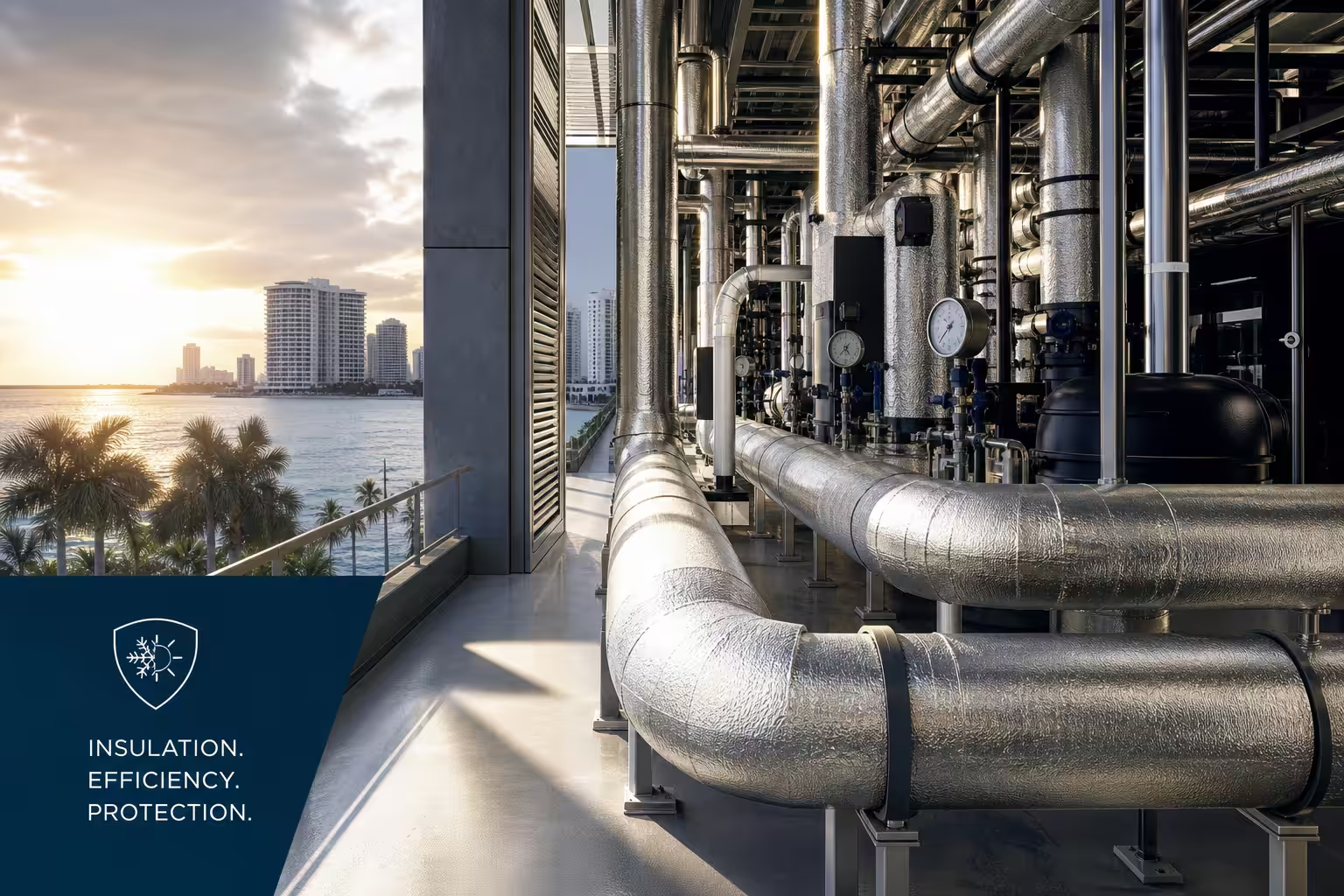
Aluminum jacketing is the standard weatherproofing system for outdoor installations and mechanical room pipe insulation throughout most commercial applications. Where coastal salt-air exposure presents an accelerated corrosion risk to standard aluminum, stainless steel cladding is the appropriate specification. It is also required for food-service and pharmaceutical mechanical room applications where surface hygiene standards apply. PVC jacketing is appropriate for interior conditioned spaces and is specified at banding intervals of 12 inches on center with a minimum joint overlap per manufacturer requirements.
Standard project drawing notation for jacketed commercial pipe insulation should follow this format: “NPS [size], [insulation material], [thickness] thick, [jacket material], bands at 12 inches O.C.” All mechanical insulation jacketing specifications must be reviewed and confirmed by the mechanical engineer of record to ensure compliance with project-specific performance requirements, applicable building codes, and any HVHZ fastener standards enforced by the local Authority Having Jurisdiction. Confirm applicable NOA product approvals through the Miami-Dade Notice of Acceptance system for all assemblies installed in HVHZ-designated areas. For examples of related commercial construction work, see our section on Construction | Broward Insulation.
Fire, smoke, and Florida Building Code compliance
ASTM E84 requirements for plenum-located pipe insulation
All pipe insulation installed within plenum return air spaces in commercial buildings must achieve a Flame Spread Index (FSI) of 25 or less and a Smoke Developed Index (SDI) of 50 or less under ASTM E84 testing, as required by International Mechanical Code Section 602.2.1.8. The insulation assembly must also demonstrate no flaming, glowing, smoldering, or smoking behavior at a minimum test temperature of 250°F (121°C) throughout the test exposure period. Non-combustible materials per ASTM E136 satisfy this requirement as an alternative compliance path.
The 25/50 rating requirement applies to the tested composite assembly, encompassing the pipe insulation, jacketing material, adhesive, and any applied coverings as a unified system. Individual component ratings are not a substitute for composite assembly testing. Specifiers must verify that the manufacturer provides composite ASTM E84 test data for the specific insulation, jacket, and adhesive combination specified for the project. For practical guidance on composite ASTM E84 25/50 testing and manufacturer interpretation, reference manufacturer guidance on ASTM E84 25/50 guidance. Non-compliant insulation in plenum spaces creates a code violation, a life-safety liability in the event of fire, and a basis for occupancy denial at code inspection.
NFPA, IBC, and High-Velocity Hurricane Zone (HVHZ) considerations
NFPA 13 requires that water-filled fire sprinkler piping be insulated to maintain pipe temperatures at or above 40°F in unheated spaces. Tenting assemblies used to isolate sprinkler piping from cold conditions must be structurally secure for long-term service and must not compromise the insulation assembly’s fire performance ratings. The Florida Building Code incorporates HVHZ provisions that affect mechanical room envelope integrity, vapor control assembly continuity, and fastener specifications for jacketed insulation systems exposed to wind-driven rain infiltration. Designers should consult the local AHJ and the NOA process to confirm which provisions apply to specific pipe insulation assemblies, as prescriptive fastener requirements vary by assembly type and installation condition.
Facility managers operating commercial properties in Broward County and Miami-Dade County are subject to local AHJ amendments to the base IBC and IMC that may impose requirements more stringent than the national standard editions. Confirming applicable local amendments before finalizing mechanical insulation specifications is a non-negotiable step in the design process for South Florida commercial projects.
Inspection and maintenance obligations
Post-installation inspection of commercial pipe insulation systems must verify continuous vapor retarder sealing across all joints and penetrations, structural integrity of jacketing and cladding, and the presence of ASTM E84 25/50 compliance labeling on all plenum-located insulation assemblies. Documentation of material certifications and composite assembly test reports must be available for the authority having jurisdiction at occupancy inspection.
Scheduled maintenance intervals for commercial mechanical insulation systems should include annual visual inspection of all plenum-located and mechanical room insulation, with assessment focused on jacket damage, vapor retarder seam integrity, and evidence of moisture infiltration or CUI initiation at pipe supports. NFPA 25 guidance provides the baseline inspection framework for water-filled sprinkler system insulation. Facility managers should apply equivalent rigor to chilled water and condenser water systems given the condensation failure risks specific to Climate Zone 1A operating conditions.
Selecting a licensed commercial pipe insulation contractor in South Florida
What spec-compliant mechanical insulation installation requires
Florida Statute Chapter 489 and the applicable provisions of the Florida Building Code govern commercial pipe insulation on chilled water systems, large-diameter mechanical room headers, and HVAC distribution piping as a licensed contractor scope of work. Proper installation requires field measurement of every fitting configuration, continuous vapor retarder sealing at each joint and penetration, correct jacket application with code-appropriate fasteners and banding intervals, and documentation confirming material certifications for code inspection submission. Confirm the specific licensing and scope provisions that apply to your project with the Florida Department of Business and Professional Regulation or the local AHJ. For specialized local services, see our Pipe Insulation Florida | Hot, Cold & Refrigerant Line Lagging | Broward Insulation offering, which details available commercial insulation services in the Tri-County region.
Installers without specialized mechanical insulation training are more likely to produce installations with discontinuous vapor retarder sealing, improperly fitted preformed sections at fittings, and inadequate jacket fastening. Verify contractor qualifications, licensure, and project references before award. Each of these deficiencies creates a condensation pathway or CUI initiation point that compromises the entire system’s performance and longevity, often without visible indication until remediation-level damage has occurred.
Why facility-scale experience in Broward and Miami-Dade matters
Climate Zone 1A presents condensation failure modes and CUI risk profiles that contractors without regional facility experience consistently underestimate. Ambient dew points regularly exceed 75°F, coastal chloride exposure is sustained, and the local specification environment includes HVHZ provisions and Miami-Dade NOA product approval obligations that require familiarity with Florida Building Code requirements and AHJ expectations. Contractors whose experience is limited to temperate climate regions are more likely to produce non-compliant or inadequately performing installations. The margin between code-minimum and condensation-controlled insulation thickness in South Florida is substantial, it requires site-specific psychrometric calculation, not table-transfer from national code documents.
Broward Insulation has provided commercial pipe insulation systems across the South Florida Tri-County region for nearly five decades, covering HVAC mechanical rooms, chilled water distribution, and large-scale plumbing projects in Broward, Miami-Dade, and Palm Beach counties. The firm’s project portfolio spans large-scale commercial and multi-family properties where condensation control, ASHRAE 90.1 energy code compliance, and HVHZ structural requirements are non-negotiable components of the installation specification. For an example of project work and detailing considerations, see Concrete Design | Broward Insulation. Pipe insulation contractors with this depth of regional experience bring direct knowledge of local code amendments, AHJ expectations, and the psychrometric conditions that determine whether an installation performs for decades or fails within the first operating season.
What to prepare before engaging pipe insulation contractors
A complete project specification should document the following before contractor engagement begins:
- Pipe system type (chilled water, condenser water, steam, domestic hot water, or refrigerant)
- Design operating temperature range
- Nominal pipe sizes and schedules for all runs and branches
- Installation location classification (plenum, conditioned mechanical room, or exterior)
- All governing codes or engineer-of-record performance specifications
Without this information, a contractor cannot provide an accurate scope of work or confirm that material selections satisfy both energy code minimums and the project-specific thermal and vapor control demands of Climate Zone 1A.
Providing access to current mechanical drawing sets and equipment schedules allows the contractor to quantify linear footage, fitting counts, and large-diameter sections that require factory-fabricated or field-insulated treatment. This baseline documentation also establishes the project record against which post-installation inspection and ongoing maintenance can be verified, protecting the facility owner’s compliance status through the service life of the system.
Specifying commercial pipe insulation as a precision engineering decision
In South Florida’s IECC Climate Zone 1A environment, the selection, specification, and installation of commercial pipe insulation systems carries direct consequences for condensation control, chiller plant efficiency, code compliance, and long-term asset integrity. It is not a commodity procurement decision. The specification hierarchy is sequential: material selection is governed by operating temperature and vapor diffusion resistance requirements; insulation thickness is determined by ASHRAE 90.1 minimums and project-specific condensation control calculations; jacketing selection is driven by installation environment and code classification; and installation is performed by a licensed contractor with demonstrated experience in the regional mechanical insulation environment.
Facility managers and property owners responsible for chilled water systems, mechanical rooms, or large-scale domestic plumbing in Broward, Palm Beach, or Miami-Dade County should not defer mechanical insulation specification to the close-out phase of a construction or renovation project. Code deficiencies identified at occupancy inspection, condensation failures discovered during initial commissioning, and CUI damage identified during the first scheduled maintenance cycle all carry remediation costs that substantially exceed the cost of correct specification at the outset. Getting the specification right before work begins costs a fraction of what correction costs after the fact.
Broward Insulation provides formal project assessments for commercial facilities across the South Florida Tri-County region, ensuring that all mechanical pipe insulation is specified, installed, and documented to code before occupancy inspection or the next scheduled maintenance cycle. Schedule a technical site review to discuss your facility’s commercial pipe insulation requirements with an experienced South Florida contractor.
Frequently asked questions: commercial pipe insulation in South Florida
Why does South Florida require thicker pipe insulation than national code minimums?
ASHRAE 90.1 minimum thicknesses are set for energy code compliance across all IECC climate zones and are not adjusted for local dew point conditions. In Climate Zone 1A, ambient dew points regularly approach or exceed 75°F during summer months. At those conditions, code-minimum insulation thickness on chilled water lines is often insufficient to keep the outer surface of the insulation assembly above the dew point. Project-specific condensation control calculations are required to determine the thickness that actually prevents surface condensation under local design conditions.
What vapor retarder rating is required for below-ambient piping in Climate Zone 1A?
Below-ambient commercial piping systems in Climate Zone 1A require a vapor retarder rated at or below 0.1 perm (Class I per ASTM E96). This level of vapor resistance is necessary to prevent moisture migration through the insulation body toward the cold pipe surface. Elastomeric closed-cell foam provides inherent vapor resistance when correctly installed; open-cell materials such as fiberglass and mineral wool require a separately specified Class I vapor retarder jacket applied as a continuous membrane.
What does corrosion under insulation (CUI) mean for commercial pipe systems?
CUI is an electrochemical degradation process that occurs when moisture infiltrates improperly sealed insulation and accumulates at the pipe surface. In South Florida, coastal chloride exposure amplifies the risk: any breach in jacketing continuity can deliver a chloride-bearing electrolyte solution directly to the pipe substrate. Carbon steel and galvanized pipe in the 32°F to 300°F operating range are most susceptible. Preventing CUI requires correct insulation selection, continuous vapor retarder sealing, stainless steel or appropriate cladding in coastal exposures, and scheduled inspection for jacket and seam integrity.
What are the HVHZ requirements for pipe insulation jacketing in Broward and Miami-Dade?
The Florida Building Code’s High-Velocity Hurricane Zone provisions affect mechanical room envelope integrity, vapor control assembly continuity, and fastener specifications for jacketed insulation systems exposed to wind-driven rain infiltration. Specific requirements vary by assembly type and installation condition. Product approvals through the Miami-Dade Notice of Acceptance (NOA) system govern certain insulation assemblies in HVHZ-designated areas. Designers and contractors should confirm applicable provisions with the local Authority Having Jurisdiction before finalizing specifications.
Does pipe insulation in plenum spaces require special fire ratings?
Yes. All pipe insulation installed in plenum return air spaces must achieve a Flame Spread Index of 25 or less and a Smoke Developed Index of 50 or less under ASTM E84 testing, per International Mechanical Code Section 602.2.1.8. This rating applies to the tested composite assembly, insulation, jacket, adhesive, and coverings, not to individual components. Non-combustible materials per ASTM E136 satisfy the requirement as an alternative. Non-compliant insulation in plenum spaces creates a life-safety liability and can result in occupancy denial at code inspection.
How do I choose between elastomeric foam, fiberglass, and mineral wool for my HVAC system?
The primary selection driver is operating temperature. Elastomeric and nitrile rubber foam is standard for HVAC chilled water piping, refrigerant lines, and condensate systems in Climate Zone 1A because its closed-cell structure provides inherent vapor resistance in the below-ambient range. Fiberglass is appropriate for domestic hot water, steam, and dual-temperature systems above the elastomeric temperature ceiling. Mineral wool is specified where non-combustibility or high-temperature performance above 540°C is required. In all cases, the installation environment, plenum, mechanical room, exterior, or coastal, affects jacketing and vapor retarder requirements independently of the base insulation selection.
How do I find qualified pipe insulation contractors in South Florida?
Look for licensed contractors under Florida Statute Chapter 489 with documented experience on commercial and industrial pipe insulation projects in Broward County, Miami-Dade County, and the broader South Florida region. Request project references from comparable facility types, confirm familiarity with HVHZ provisions and Miami-Dade NOA requirements, and verify that the contractor can provide material certifications and composite assembly test documentation for code inspection. Broward Insulation has served commercial and multi-family facilities across the Tri-County region for nearly five decades and is available to assess your project’s mechanical insulation requirements.