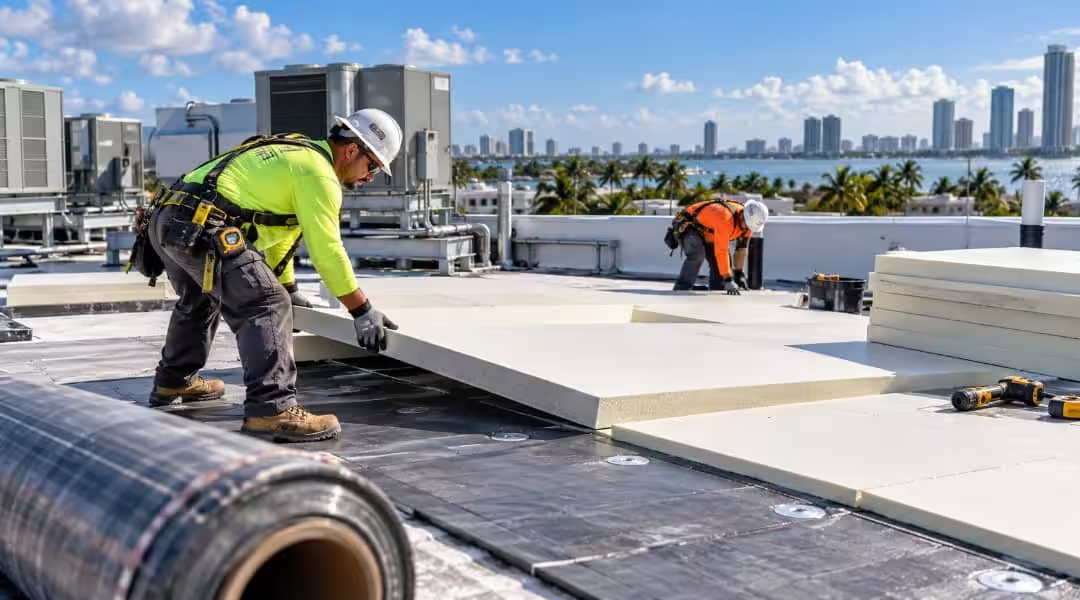
Commercial Insulation Options in South Florida: Which Material Is Best for Your Building?
Choosing insulation well means looking past product names. The best fit usually depends on the assembly, moisture risk, air leakage, code needs, and budget tradeoffs. In South Florida, those decisions also need to account for heat, humidity, and the way insulation interacts with the building envelope.
That is the real scope behind insulation options for commercial contractors: where each material works best, when air sealing matters more, and why the lowest bid or highest R-value can still be the wrong call.
What “Contractor Insulation Options” Really Includes
“Contractor insulation options” is broader than a list of products. It usually includes the full scope of decisions that shape building performance. That starts with where insulation goes, how it is installed, and whether air leaks or moisture issues need attention first.
It also includes project type, code requirements, access, schedule, and the condition of existing materials. In practice, insulation options for commercial contractors may cover new construction, retrofits, partial replacements, removal, and air sealing as part of one plan.
Some jobs call for one material across the whole building. Others need a mix of systems to match different assemblies and performance goals. That is why the right choice is rarely just “pick a product.”
Broward Insulation Service frames the decision the same way many experienced contractors do: as a system choice, not a single-item purchase. That helps set up the next step clearly, because the best option often changes once each area of the building is evaluated.
How Insulation Choices Change by Attic, Walls, Crawl Space, and Other Areas
Assembly matters because insulation decisions shift with the space, not just the product name.
Attics often drive the first big choice. The roof assembly takes substantial heat exposure, and insulation that is thin, uneven, or interrupted around framing and penetrations can allow heat to move inward faster and increase HVAC demand.
Walls usually call for a steadier target. Gaps around windows, service entries, joints, and connection points can reduce the effectiveness of an otherwise adequate insulated cavity.
Crawl spaces change the risk profile. Ducts, pipes, and floor transitions in these areas can affect comfort and moisture conditions when they sit outside a well-controlled boundary.
Other enclosed or difficult-to-access areas may require a different approach. The insulation system needs to account for available space, existing conditions, access, and how the area connects to the rest of the building envelope.
Fiberglass, Spray Foam, and Blown-In Insulation: What Each Does Best
Material choice works best when the product matches the job that matters most. Fiberglass is often the straightforward pick for broad cavity coverage. Blown-in insulation can fit areas that need material to fill irregular spaces more evenly than standard batts.
Spray foam tends to stand out when the scope calls for insulation plus tighter air control in one step. It can be particularly useful around difficult transitions, penetrations, rooflines, and other areas where maintaining continuity is challenging.
That does not make one material best in every part of a building. Each option solves a different problem, and each can lose value when it is forced into the wrong assembly. Cost, access, thickness limits, moisture exposure, and the need to coordinate with other trades can all shift the better choice.
For insulation options for commercial contractors, the practical takeaway is simple: choose by function first, then by product, so the material supports the assembly instead of fighting it.
Which Insulation Options Help Most With Comfort, Noise, and Energy Loss
Instead, the best fit usually depends on which problem the assembly needs to solve most.
Comfort and energy loss: These often improve most when the insulation type matches the project, not when one product is treated as a universal winner. The right approach depends on the area being insulated and the conditions affecting that assembly.
Installation quality: Insulation performance depends heavily on how well it is installed. A strong product choice can still fall short if gaps, compression, or poor coverage reduce real-world performance.
Noise control: Acoustic results need a narrower review than comfort or energy savings alone. The material, assembly design, density, and installation method can all influence sound performance, so sound reduction should be checked as a separate performance goal.
Project fit: For commercial insulation projects, the clearer tie-breakers are project conditions, installation quality, and the intended performance rather than label claims alone.
How Climate and Moisture Risk Affect the Right Insulation Choice
Climate and moisture exposure can change the right insulation choice even before price does. A product that fits one region or assembly may be a weaker fit elsewhere. In South Florida, the key issue is not only thermal resistance.
It is also how the insulation will behave if humid air, condensation, or bulk water shows up. In higher-moisture conditions, the safer choice is often the one that better matches that risk. That does not make one product universally best.
It means project conditions should narrow the field early. Heat, humidity, and where the insulation sits in the enclosure can change which tradeoffs matter most.
For insulation options for commercial contractors, that usually means checking the exposure profile before comparing labels alone. A strong thermal specification can still be the wrong call if moisture risk is underestimated.
The practical takeaway is simple: choose for the building’s climate and wetting risk first, then compare product strengths inside that narrower set.
Where Air Sealing Matters More Than Insulation Alone
Air leaks can undo a good insulation plan because moving air carries heat and moisture through gaps that insulation alone does not stop. In many commercial insulation projects, that makes air sealing the first performance check, not a finishing detail.
Large gaps at penetrations, framing transitions, access points, and other openings often deserve attention before adding more insulation. If those paths stay open, a higher labeled thermal value may still leave uneven temperatures and harder HVAC control.
Air sealing matters most when the main problem is uncontrolled movement, not just heat flow through materials. That is why some projects improve more from closing leakage paths than from upgrading an already adequate insulation layer.
The tradeoff is that air sealing does not replace insulation everywhere. It works best as a priority step when drafts, humid air movement, or leakage between conditioned and unconditioned spaces are driving the performance problem. Insulation can then do its share more reliably.
What R-Value Can Tell You and What It Can’t
Higher R-value can narrow a material list, but it is not a full performance verdict on its own.
Heat flow: R-value is useful for comparing resistance to conductive heat moving through insulation. That makes it a solid screening tool when thickness, assembly, and installation conditions are otherwise similar.
Whole-assembly limits: The label does not describe every factor that affects real results in a building. Framing, gaps, compression, moisture exposure, and uneven coverage can all change how much the installed system actually delivers.
Different jobs: A strong thermal number does not automatically answer needs like sound control, durability, drying potential, or space constraints. In insulation options for commercial contractors, those job-site limits often decide between materials with similar label values.
Decision use: The better role for R-value is as one checkpoint inside a broader scope review. If two products look close on paper, the more reliable choice is often the one that fits the assembly cleanly and leaves fewer performance compromises after installation.
When the Lowest-Cost Insulation Option Ends Up Costing More
Price can mislead when one bid looks smaller on paper. The real question is which choice avoids hidden cost once performance, thickness, and assembly limits are counted.
Upfront price is only one lens. A lower-priced material may not remain the better value if the project requires additional preparation, more installation work, or a different approach to achieve the required performance.
Thickness changes value, too. Available space can limit how much insulation can be installed, making the material’s performance characteristics and the assembly design important parts of the decision.
Material fit can protect or waste the budget. A lower-priced product may stop looking economical if the assembly needs a different thickness, a different material behavior, or tighter moisture control than that product can support well.
That is why insulation options for commercial contractors should be judged by installed outcome, not tag price alone. The lower bid can cost more when it creates additional work, reduced flexibility, or a weaker fit for the building conditions.
Questions to Ask a Contractor Before You Choose a Material
Start with questions that test fit, not sales language. Ask which material matches the exact assembly, what thickness it needs, and what tradeoffs come with that choice. Ask whether the proposal accounts for space limits, moisture exposure, and areas where air leakage could reduce real performance.
Ask what parts of the job need separate air sealing, and which parts rely on insulation alone. Next, ask how the installer will handle gaps, penetrations, edges, and transitions between materials. Those details often decide whether a product performs as expected.
It also helps to ask what could make a lower bid less durable or less effective after installation. One more check matters. Ask the contractor to explain why one option was ruled out, not just why another was recommended.
Clear answers usually reveal whether the recommendation is tied to the building conditions or to a standard sales preference. For insulation options for commercial contractors, that distinction can prevent an expensive mismatch.
Ultimately, the best insulation choice is usually a matched system, not a single winning product. The stronger path is to judge each area by assembly, moisture exposure, air leakage, thickness limits, and budget tradeoffs.
That is why insulation options for commercial contractors often work best when materials are chosen by function first. R-value still helps, but it cannot settle the decision alone. Installation quality matters, too.
Even a solid product can underperform when gaps, compression, or poor coverage are left in place. The practical advantage is a specification that fits the building more cleanly and avoids costly mismatches.