Closed-Cell Spray Foam: Performance Guide for South Florida
Executive Summary: Closed cell spray foam Florida is a two-component polyurethane system that combines isocyanate and polyol resin under high pressure to produce a rigid cellular matrix with a thermal resistance of R-6.5 to R-7.0 per inch and a Class II vapor retarder classification at approximately 1.5 inches of applied thickness. For construction within IECC Climate Zone 1A and the High-Velocity Hurricane Zone (HVHZ), closed-cell SPF uniquely combines high R-value per inch, low vapor permeability, and measurable structural rigidity in ways that make it a strong choice for South Florida assemblies where no other single material addresses all three performance demands simultaneously. Broward Insulation, a licensed FPL-approved insulation contractor established in 1977, has engineered closed-cell spray foam insulation systems for luxury estates and commercial facilities across Broward, Palm Beach, and Miami-Dade counties for nearly five decades, the technical foundation from which this performance guide is written.
What closed-cell spray foam is and how it performs structurally
Closed-cell spray foam Florida provides an exceptional barrier against humidity, making it ideal for the unique climate conditions of the region.
When isocyanate (the “A” side) and polyol resin (the “B” side) meet under high pressure, the resulting exothermic reaction drives rapid foam expansion before the material cures into a rigid, dense matrix of fully enclosed cells. Expansion factor varies by product and formulation; the medium-density standard for commercial and residential applications is 2 lb/ft³, the specification that defines both structural and vapor performance characteristics. Higher-density formulations at approximately 3 lb/ft³ are also available and used in select commercial assemblies.
The thermal performance differential between closed-cell and alternative insulation types is significant. Closed-cell foam achieves R-6.5 to R-7.0 per inch, while open-cell foam achieves only R-3.5 to R-3.8 per inch and fiberglass batts fall within a comparable R-3.2 to R-3.8 range. At two inches of applied thickness, closed-cell foam delivers R-13 to R-14, a threshold open-cell foam cannot approach at equivalent depth. This distinction carries direct prescriptive relevance under the 2023 Florida Building Code, which requires a minimum R-13 for exterior wall assemblies in Climate Zone 1A.
The rigidity of cured closed-cell foam constitutes a structural asset beyond its thermal properties. When applied to wall cavities or roof decking, the foam bonds to substrate surfaces and contributes measurable racking resistance. A study by the National Association of Home Builders (NAHB Research Center, “Structural Contribution of Spray Polyurethane Foam Insulation in Wood-Frame Assemblies”) documented racking strength increases of up to 300 percent in wood-frame wall assemblies treated with closed-cell spray polyurethane foam, with vinyl-clad wall configurations showing increases from 913 lbs to 2,800 lbs. For structures within HVHZ jurisdictions, this mechanical reinforcement directly supports compliance with wind uplift requirements under the Florida Building Code, a performance dimension that neither fiberglass batts nor open-cell foam can provide.
Why Class II vapor retarder classification defines South Florida’s insulation standard
Vapor retarder classifications are defined per ASTM E96 permeance testing. A Class II vapor retarder achieves a permeance rating of 0.1 to 1.0 perms. At 1.5 inches of applied thickness, 2 lb/ft³ closed-cell spray foam achieves approximately 0.61 perms per manufacturer product data sheets (e.g., JM Corbond III PDS), though permeance varies by formulation and applied thickness, so specifiers should confirm product-specific ASTM E96 results. Open-cell foam remains vapor-permeable regardless of applied thickness and cannot function as a primary moisture control layer in high-humidity assemblies. That distinction is not incidental; it is the foundational reason closed-cell spray foam insulation is the technically appropriate specification for South Florida building envelopes.
IECC Climate Zone 1A encompasses the South Florida Tri-County region and represents conditions not replicated anywhere else in the continental United States at scale. Regional climate data (NOAA Southeast Regional Climate Center) reflects high seasonal humidity regularly exceeding 70 percent and elevated summer dew points that drive persistent vapor pressure across building assemblies. Where vapor-permeable insulation systems allow moisture accumulation inside wall and roof cavities, consequences range from mold colonization to fastener corrosion and progressive framing degradation. Closed-cell foam’s Class II classification substantially reduces vapor infiltration at the building envelope before these mechanisms can take hold.
The HVHZ designation adds further complexity: wind-driven rain during tropical weather events creates pressure differentials across building envelopes that force moisture through conventional assembly gaps. Closed-cell spray foam’s air-impermeable nature simultaneously seals air infiltration pathways and resists vapor transmission. Among commonly specified insulation types, it is the only one that addresses both thermal and moisture failure modes inherent to HVHZ construction conditions within a single applied material.
Closed cell spray foam applications and building assembly types
The unvented roofline assembly represents the highest-value application of closed-cell spray foam in South Florida’s Climate Zone 1A. A conventional vented attic introduces exterior humid air directly above the thermal envelope, elevating HVAC loads and creating a persistent moisture infiltration pathway. When closed-cell foam is applied to the underside of roof decking at the minimum thickness required to achieve Class II vapor retarder status, the attic becomes a conditioned space. Mechanical equipment and ductwork located within this conditioned envelope operate within the thermal boundary rather than against it, producing measurable reductions in HVAC system load and extending equipment service life.
Wall cavity and foundation applications
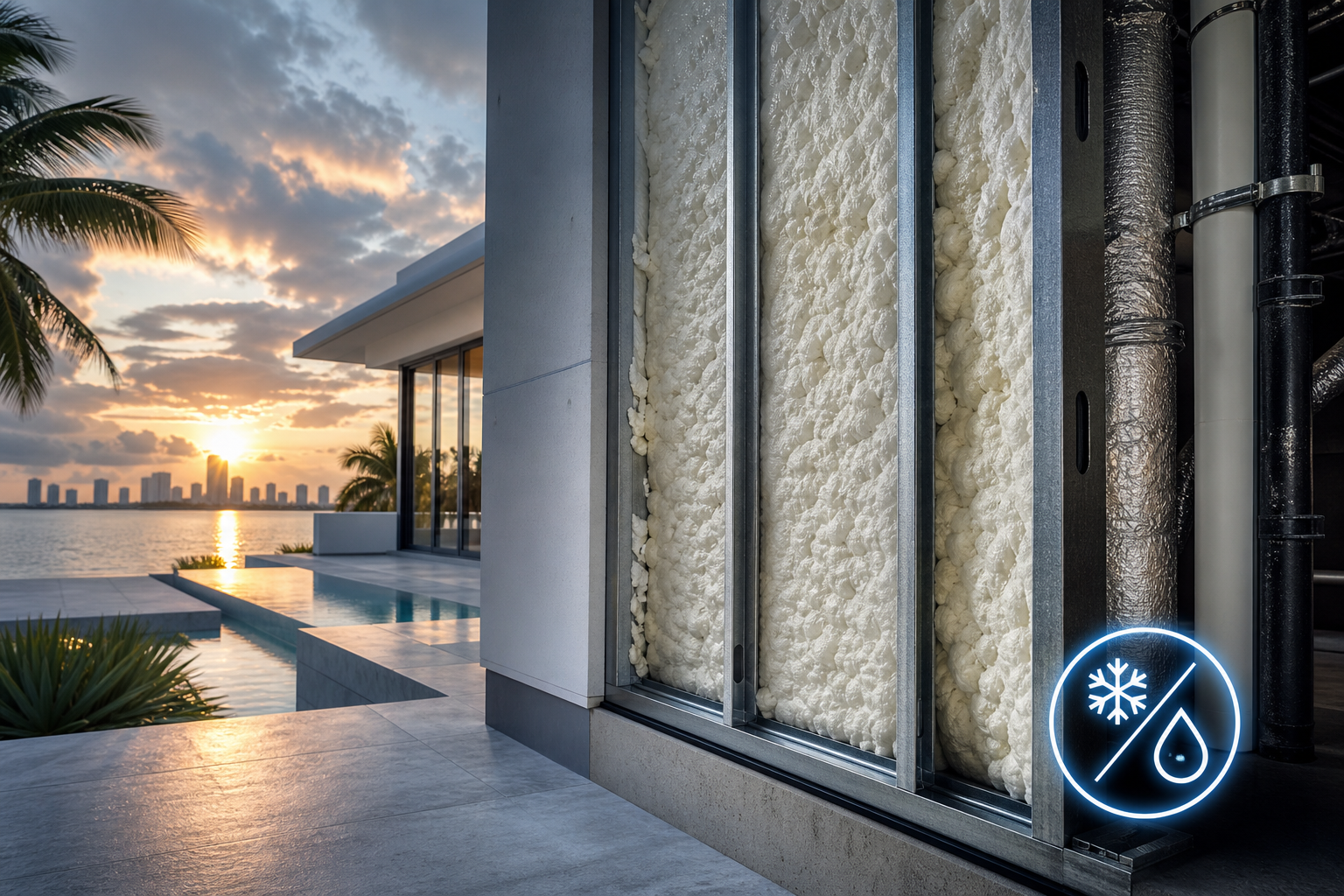
Wall cavity and foundation applications extend the material’s utility to the full building perimeter. A closed-cell application within a standard 2×4 wall cavity at approximately 2 to 2.5 inches of applied thickness achieves roughly R-14 to R-16, exceeding the IECC Climate Zone 1A prescriptive minimum of R-13 for exterior walls. At foundation walls and crawlspace perimeters, where coastal water tables and ground moisture create persistent vapor drive, closed-cell foam applied to interior foundation surfaces provides both thermal resistance and a continuous Class II vapor barrier in a single material, eliminating the need for separate polyethylene vapor retarder membranes.
Commercial and specialty applications
Commercial applications present additional performance requirements that closed-cell foam addresses with equivalent technical precision. Mechanical rooms and chilled water pipe assemblies in South Florida’s high-humidity environment accumulate condensation rapidly on unprotected cold surfaces, creating both efficiency losses and water damage risk. Commercial warehouse rooflines and tilt-wall construction benefit from the foam’s ability to span irregular substrates while maintaining uniform thermal and vapor performance across large surface areas. FM Global testing has confirmed adhesion values of 990 psf to concrete substrates and 220 psf to metal deck assemblies, performance data directly relevant to HVHZ uplift requirements.
Closed cell spray foam costs and South Florida project benchmarks
Professional installation of closed-cell spray foam is priced per board foot, defined as one square foot of coverage at one inch of applied thickness. The national professional installation range is $1.20 to $1.50 per board foot, inclusive of materials and labor. A project requiring three inches of foam across 1,000 square feet requires 3,000 board feet; scaling cost calculations from this foundation provides accurate project budgeting before contractor quotations are solicited. South Florida’s HVHZ compliance requirements, permitting complexity, and coastal material specifications typically position local projects at the upper end of national ranges, with some premium projects exceeding them.
For the major assembly types common in Tri-County residential and commercial work, representative installed ranges are:
- Attic assembly at 8 to 10 inches (1,000 ft²): $9,600 to $15,000 installed, reflecting the high board-foot volume required for full thermal compliance at roofline depth and the HVHZ regulatory premium applied to South Florida projects.
- Exterior wall cavity at 3 to 4 inches (1,000 ft²): $3,500 to $6,000 installed, consistent with standard residential framing depth applications.
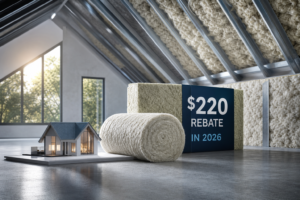
- FPL ceiling insulation rebate (2026): $220 instant rebate applied as an invoice credit through a qualifying FPL-approved Participating Independent Contractor, applicable to closed-cell spray foam installations in Broward County residential properties with existing attic insulation below R-8.
Consumer two-component spray foam kits present a cost comparison that warrants objective analysis. The largest consumer kits cover 600 board feet at a material cost of $500 to $1,000. A standard attic application requires 5,000 to 10,000 board feet, ten or more kits, repeated setup cycles, and no mechanism for the pressure control and heated hose delivery that professional proportioner systems provide. At any scale beyond minor gap-sealing, professional installation delivers equivalent or lower cost per board foot with superior cell structure consistency, code-compliance documentation, and transferable warranty coverage. For an independent comparison of DIY kits versus hiring a professional, see a practical discussion of DIY spray foam vs hiring a contractor.
Building code, fire-rating, and thermal barrier requirements under Florida law
Closed-cell spray foam installations in Florida must comply with IBC Section 2603 and its Florida Building Code equivalent, which mandates a 15-minute thermal barrier separating all foam plastic insulation from occupied interior spaces. One-half inch gypsum wallboard is the standard acceptable thermal barrier. AC377 exceptions exist for attic and crawlspace applications, but the local building authority must approve supporting documentation before work begins. Proceeding without that approval constitutes a code violation.
Flame spread and smoke development requirements
All foam plastic insulation must meet an ASTM E84 flame spread index below 25 and a smoke development index below 450 before the thermal barrier requirement is applied. In exposed locations, mechanical rooms or unconditioned crawlspaces where no thermal barrier is installed, intumescent coatings are required to bring uncovered foam into code compliance. This requirement adds material and labor cost to commercial projects and must be incorporated into project scope from the design phase, not addressed as a post-installation correction.
HVHZ code considerations and NOA documentation
Permitting requirements within HVHZ jurisdictions add a layer of documentation that distinguishes South Florida projects from installations elsewhere in the state. Closed-cell spray foam installation in Miami-Dade and Broward County HVHZ jurisdictions requires a licensed contractor permit, Miami-Dade Notice of Acceptance (NOA) product documentation for all system components, and mandatory special inspector verification at multiple installation stages. Florida Product Approval numbers are insufficient in HVHZ jurisdictions; only Miami-Dade NOA documentation satisfies the product approval requirement. Unpermitted spray foam installation creates title, appraisal, and insurance complications on both residential and commercial properties that significantly exceed any material cost savings from circumventing the process.
Why South Florida’s engineering demands require a licensed specialist
Professional-grade closed-cell spray foam application requires proportioner units maintaining 1,000 to 1,500 PSI pressure and 120 to 140 degrees Fahrenheit heated hose temperatures. These parameters ensure precise A/B component mixing ratios and consistent cellular structure throughout the applied thickness. South Florida’s ambient conditions, particularly substrate surface temperatures on sun-exposed rooflines and exterior walls, require equipment capable of compensating for thermal variation in real time. Off-ratio application, the most common consequence of inadequate equipment or consumer kit limitations, produces foam with degraded R-value, compromised vapor retarder performance, and a structural tendency toward shrinkage and delamination.
Certified contractor installations carry 20 to 25-year transferable warranties, a significant financial asset for luxury estate owners and commercial property investors who require long-term building performance documentation for appraisal and insurance purposes. FPL rebate eligibility requires installation by an FPL-approved contractor and supporting documentation that consumer kit installations cannot provide. The $220 rebate, combined with HVAC load reductions that utility program evaluations and building science research attribute to a range of 20 to 50 percent over the life of a well-executed assembly, represents a documentable return on the installation investment.
Broward Insulation has specialized in HVHZ-compliant insulation systems since 1977. The firm engineers closed-cell spray foam assemblies for luxury custom estates in Weston, Parkland, and Boca Raton, as well as commercial facilities and multi-family properties throughout the Tri-County area. That continuous focus on IECC Climate Zone 1A building science means every application is engineered to the structural and moisture demands specific to South Florida construction, not adapted from cold-climate models developed for conditions that bear no resemblance to this region.
Specifying the correct insulation system requires local engineering authority
Closed-cell spray foam’s combination of R-6.5 to R-7.0 per inch thermal resistance, Class II vapor retarder classification at approximately 1.5 inches of applied thickness, and documented structural reinforcement properties positions it as the technically superior insulation specification for South Florida’s climate and regulatory environment. The vapor retarder performance is not a secondary benefit. It is the primary mechanism by which closed-cell SPF addresses the moisture infiltration failure mode endemic to IECC Climate Zone 1A building envelopes.
Property owners, architects, and facility managers specifying insulation systems for Tri-County residential and commercial projects should engage a licensed South Florida insulation specialist before finalizing material selections or accepting contractor bids that do not account for HVHZ permitting requirements, NOA product compliance, and FPL rebate qualification criteria. These variables affect both project cost and long-term building performance in ways that generic national specifications do not capture.
Broward Insulation provides closed-cell spray foam assessment, system engineering, and licensed installation across Broward, Palm Beach, and Miami-Dade counties. With nearly five decades of HVHZ specialty work and active FPL contractor status, the firm brings regional expertise that generalist contractors cannot replicate. Contact Broward Insulation directly to schedule a free technical consultation for any residential, commercial, or multi-family project requiring precision building envelope performance under South Florida’s specific climatic and regulatory demands.