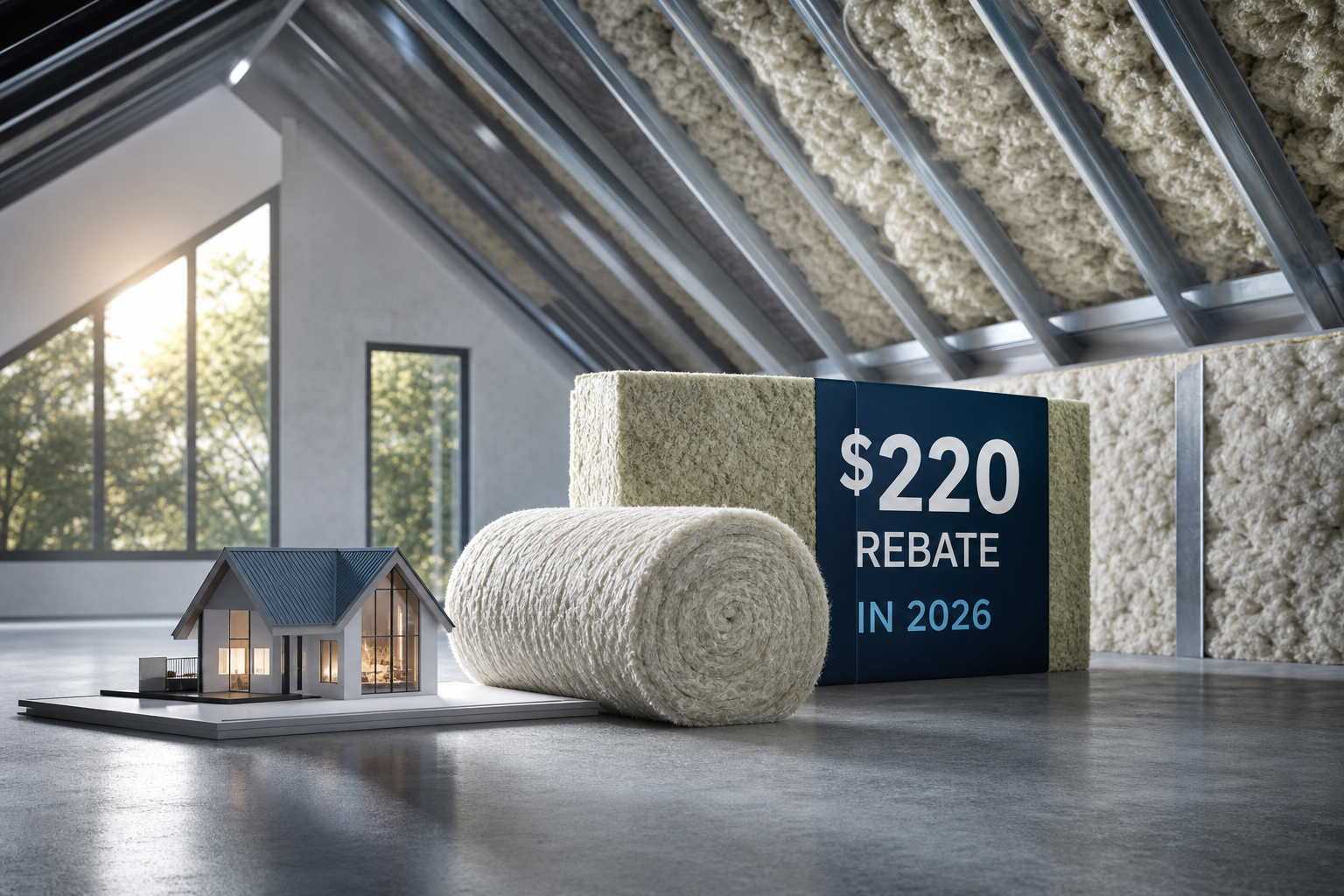
How to claim FPL’s $220 ceiling insulation rebate in 2026
Executive Summary: This guide explains how to claim FPL insulation rebates in 2026, covering eligibility requirements, R-value thresholds, required documentation, and the instant contractor credit process. Florida Power & Light’s residential ceiling insulation rebate program delivers a direct financial incentive to qualifying South Florida homeowners through FPL’s demand-side management (DSM) initiative. The rebate applies exclusively as an instant credit deducted from the installing contractor’s invoice at the time of service. No post-installation reimbursement pathway exists. Eligibility requires a verified pre-1982 construction date, a documented existing ceiling R-value below R-8, an active FPL residential account, whole-house central electric HVAC, and installation by an FPL-approved Participating Independent Contractor (PIC). Consumer-facing FPL materials reference a $220 figure; FPL’s DSM program standards specify a tiered structure, $190 for existing R-values between R0 and R2, and $95 for R3 to R8. Broward Insulation is a licensed, FPL-approved PIC serving Broward, Palm Beach, and Miami-Dade counties, and manages the complete rebate submission process for qualifying clients.
For South Florida homeowners whose properties meet these criteria, this rebate represents immediate, measurable ROI on a code-compliant building envelope upgrade. The program is not open-ended: the once-per-20-years frequency restriction and the pre-1982 construction threshold mean many property owners who haven’t yet acted still have a qualifying window in 2026, but only while their home remains within those parameters.
Who qualifies for FPL insulation rebates in 2026
FPL insulation rebates operate under a strict set of program-defined criteria established in FPL’s DSM Program Standards. Meeting each requirement independently is not enough, the program mandates simultaneous compliance across all eligibility categories. Failing any single criterion will typically make the project ineligible; remediation may require rework or re-submission through the PIC before approval can proceed.
Account, property, and mechanical system requirements
The baseline qualifications require an active FPL residential account associated with the installation address. Based on FPL’s published program standards, the property must be a single-family primary residence occupied by the account holder. Commercial structures and non-residential properties are excluded; homeowners with multi-family or rental properties should contact FPL directly to confirm occupancy eligibility for their specific situation. The HVAC system must be a whole-house central electric air conditioning and heating configuration. Window units and non-electric supplemental systems do not satisfy this requirement, and the FPL billing address must correspond exactly to the installation address.
The R-value threshold that determines rebate eligibility
To qualify for FPL insulation rebates, your existing ceiling R-value must be below R-8 before installation begins. FPL’s program standards apply a tiered rebate structure based on this pre-installation measurement: existing R-values between R0 and R2 qualify for a $190 rebate; R3 to R8 qualifies for $95. Consumer-facing FPL materials advertise $220 as the rebate figure, this appears to reflect a combined or program-cap amount rather than a single flat rebate tier. Request explicit confirmation of your expected rebate tier from your selected PIC during the pre-installation assessment to avoid surprises on your invoice.
The pre-1982 construction requirement and 20-year frequency rule
Only residential properties built before 1982 qualify for this rebate, reflecting the program’s focus on modernizing older South Florida housing stock. FPL reserves the authority to verify construction date through permit records and county property data. The program also imposes a 20-year rebate frequency restriction: no qualifying property may receive the ceiling insulation rebate more than once within any 20-year period. FPL maintains rebate history records and conducts audits to enforce this restriction against duplicate claims.
Which insulation types and R-values meet FPL’s program standards
Qualifying for FPL insulation rebates requires not only program eligibility but also installation of materials that satisfy Florida Building Code minimums for IECC Climate Zone 1A, the designation governing Broward, Palm Beach, and Miami-Dade counties. For ceiling assemblies in Climate Zone 1A, the Florida Building Code prescribes a minimum R-30 for new and substantially renovated residential construction. For additional state-level weatherization guidance, see the Florida Energy weatherization guidance on insulation.
Approved insulation materials under the FPL program
FPL’s program standards recognize blown-in (loose-fill), batt, and spray foam insulation as qualifying installation types, provided each product meets or exceeds applicable Florida Building Code and local county code minimums for the installation assembly. All installed materials must be new; previously used or recycled product does not qualify. Per program requirements, product specification sheets must remain on-site after installation, they form a mandatory part of the documentation package the PIC submits to FPL, and their absence is grounds for submission rejection. FPL also publishes a concise ceiling insulation technical PDF that outlines common program specifications and documentation expectations.
How FPL and PICs verify your existing R-value
Pre-installation R-value verification is a formal program requirement, not an optional diagnostic step. The FPL-approved PIC or an FPL Energy Expert must physically access all attic spaces to confirm the existing ceiling insulation falls below R-8 before work begins. This on-site inspection directly triggers rebate eligibility and cannot be self-reported or estimated by the homeowner. Obstructed attic access or incomplete verification of any attic zone will disqualify the project. Make sure every attic space is fully accessible before scheduling your installation.
How FPL insulation rebates are verified and claimed: the step-by-step process
FPL insulation rebates follow a defined three-step process administered exclusively through the PIC network. Steps must be completed in sequence, skipping or reordering them typically results in a non-compliant submission. There is no homeowner-submitted application portal and no post-installation reimbursement route.
Step 1: Schedule a free home energy analysis with FPL
Contact FPL at 800-DIAL-FPL (800-342-5375) or visit fpl.com/save to initiate a complimentary Home Energy Analysis. This assessment establishes documented baseline conditions, including existing ceiling R-value, that provide verified support for the PIC’s rebate submission to FPL. While skipping this step doesn’t automatically disqualify a claim, it removes an important layer of documented eligibility verification that can be critical during an FPL audit or disputed submission.
Step 2: Select an FPL-approved participating independent contractor
Access FPL’s PIC Search tool and filter by county: Broward, Palm Beach, or Miami-Dade. Only PICs listed in FPL’s active database are authorized to issue the instant rebate credit. State-licensed contractors who are not enrolled in the FPL PIC network cannot process this rebate, no exceptions apply. Using a non-PIC contractor forfeits the rebate entirely, and FPL does not provide retroactive processing for installations completed outside the PIC network.
Step 3: Installation and the instant invoice credit
On installation day, the PIC completes the ceiling insulation upgrade, documents pre- and post-installation attic conditions with mandatory photographs, and deducts the applicable rebate amount directly from your invoice as an itemized line credit. You pay only the net invoice amount. The PIC then compiles the complete documentation package and submits it to FPL for contractor reimbursement, which FPL processes within 45 days per program standards, and the homeowner’s obligation ends with payment of the net invoice amount.
Documentation and access requirements FPL mandates for approval
The rebate approval process is entirely documentation-driven. Incomplete submissions can trigger processing delays or denial. Homeowners and PICs should confirm FPL’s current resubmission procedures directly, as program standards govern how non-compliant packages are handled.
The documentation package your contractor submits to FPL
The PIC’s rebate submission must include each of the following components:
- A pre-installation attic photograph confirming existing R-value below R-8
- A post-installation photograph documenting insulation depth and full coverage area
- A photograph of the home’s exterior address number confirming the installation site
- The product specification sheet left on-site following installation
- The customer invoice presenting the rebate as an itemized deduction from the gross project cost
Any omission from this package produces a non-compliant submission. FPL processes PIC reimbursement within 45 days of receiving a complete, conforming package. Incomplete submissions reset this timeline and may result in denial, at which point the homeowner may not receive the rebate unless the PIC corrects and resubmits in accordance with FPL’s procedures.
Permit obligations and FPL’s verification authority
All ceiling insulation installations must be permitted in accordance with applicable county and municipal building codes before work begins. FPL disqualifies unpermitted installations from the rebate program. Both Broward County and Miami-Dade County require building permits for attic insulation work. Miami-Dade’s High-Velocity Hurricane Zone (HVHZ) designation imposes additional compliance requirements for construction projects, including specific fastening and wind-load standards that can affect insulation installations. Consult your county building department or the Florida Building Code for guidance on HVHZ obligations specific to your project. FPL retains sole authority over all eligibility determinations and reserves the right to conduct on-site verification at any point during or after installation, requiring homeowners to provide unobstructed attic access upon request.
Why working with Broward Insulation reduces rebate risk
Selecting an FPL-approved PIC with a proven documentation process is the most effective risk-reduction strategy available to homeowners pursuing FPL insulation rebates. The documentation and compliance requirements are precise, and contractor errors are a leading cause of denied claims.
What FPL-approved PIC status means for your rebate outcome
Broward Insulation operates as a licensed, FPL-approved PIC with an established documentation process covering every component of the rebate submission: pre-installation R-value documentation, permit coordination across Broward, Palm Beach, and Miami-Dade counties, FPL-compliant attic photography, product specification sheet placement, and invoice formatting that isolates the rebate as a distinct itemized credit. This systematic approach is designed to avoid the documentation errors that commonly lead to denied rebate claims in the South Florida market. For real-world examples, see our Before And After Insulation Work | Broward Insulation Case Studies.
Common approval errors that non-PIC or inexperienced contractors cause
Frequent sources of rebate denial in FPL’s submission review include:
- Missing or improperly labeled pre- and post-installation attic photographs
- Product specification sheets not left on-site as program standards require
- Invoice formatting that does not present the rebate as a discrete itemized line deduction
- Unpermitted installations in jurisdictions requiring permits for this scope of work
- Incomplete attic access during the pre-installation R-value verification
Each of these errors can cause processing delays or denial. The financial consequence is direct: without the rebate credit, the homeowner absorbs the full gross project cost with no mechanism to recover the forfeited amount.
Additional energy incentive opportunities available through the same project
A properly executed ceiling insulation upgrade can support eligibility for financial incentives beyond FPL insulation rebates. Homeowners who completed qualifying insulation installations through December 31, 2025, may be able to claim the IRS Section 25C Energy Efficient Home Improvement Credit on their 2025 tax return, covering 30 percent of qualifying material costs up to an annual cap of $1,200, consult IRS Section 25C guidance and a qualified tax professional for material vs. labor treatment and applicable limits. For 2026 installations, the 2026 credit status depends on current IRS program continuation; verify eligibility with a tax professional before filing. The HVAC load reduction documentation generated by a licensed, FPL-approved contractor also positions the property for future FPL rebate programs tied to cooling system performance metrics. Working with a contractor fluent in both Florida Building Code requirements and FPL’s DSM program infrastructure gives homeowners the best opportunity to realize compounded ROI from a single, well-executed project. For an example project that illustrates the scope and outcome of a typical upgrade, see the Oakland Park, R-11 To R-38 Blown-In Upgrade | Broward Insulation.
Secure your rebate with a single compliant installation
FPL insulation rebates deliver a direct, immediate financial return for qualifying South Florida homeowners, but only when every eligibility condition is satisfied and the installation is executed through an FPL-approved PIC using the program’s prescribed documentation protocol. The core eligibility requirements are clear:
- Pre-1982 construction
- Existing ceiling R-value below R-8
- Active FPL residential account at the installation address
- Whole-house central electric HVAC
- Single-family residential occupancy
- No prior ceiling insulation rebate received within the preceding 20 years
Homeowners who engage a non-PIC contractor, proceed without proper permitting, or allow incomplete attic access during pre-installation verification put the rebate at risk. The instant invoice credit mechanism exists exclusively within the PIC-administered process, and there is no alternative pathway to recover this incentive after an installation has been completed outside program standards.
Secure FPL insulation rebates in 2026 by working with an FPL-approved PIC like Broward Insulation, a licensed insulation contractor providing ceiling insulation assessments and compliant installations across Broward, Palm Beach, and Miami-Dade counties. Contact Broward Insulation to schedule a rebate-eligibility assessment and receive a fully documented installation proposal aligned with FPL’s DSM program standards, Florida Building Code requirements, and applicable permit obligations.