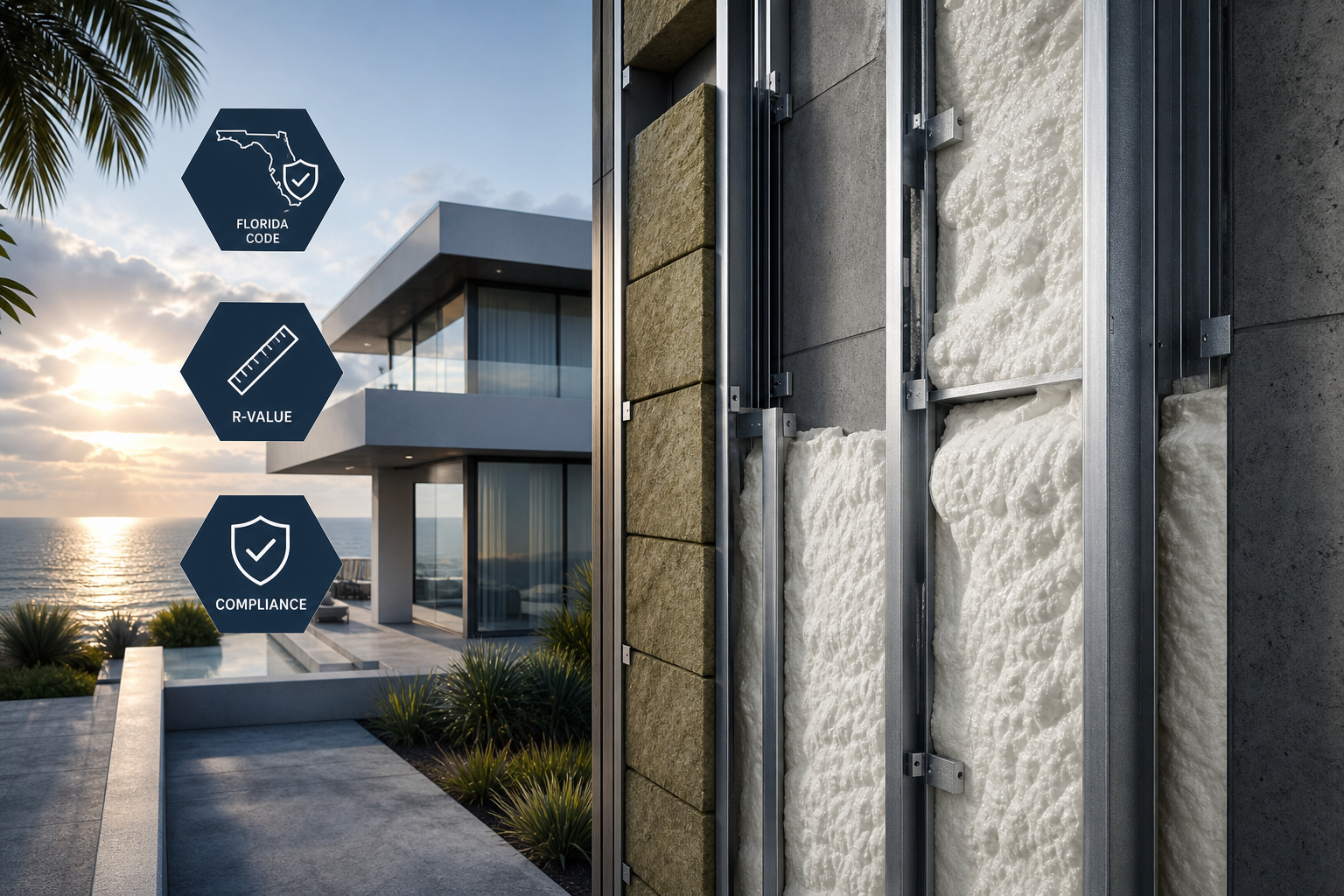
Florida Building Code Insulation: R-Values and Compliance
Executive Summary: The 8th Edition Florida Building Code (FBC), effective December 31, 2023, establishes the governing energy conservation standards for all permitted insulation work across South Florida’s Tri-County region. This guide to Florida Building Code insulation requirements covers Climate Zone 1, which encompasses Broward, Miami-Dade, and Palm Beach counties, where prescriptive minimums include R-30 for vented attic floors, R-20 for unvented conditioned attic assemblies, R-13 for exterior wall cavities, and R-13 for floor joists under the 8th Edition’s expanded requirements. Contractors may demonstrate compliance through the Form 402 prescriptive path or the Form 405 simulated performance alternative, with the Energy Rating Index (ERI) approach available as a residential third option. High-Velocity Hurricane Zone (HVHZ) classifications layered over standard FBC energy provisions create dual-compliance obligations requiring precision from permit application through final inspection. This is a framework Broward Insulation applies to every project phase, backed by nearly five decades of Tri-County operational history as a licensed, FPL-approved contractor.
Florida Building Code Insulation: R-Value Minimums for South Florida
Vented attic floor requirements for Climate Zone 1
Florida is divided into two climate zones under the FBC: Climate Zone 1, covering Broward, Miami-Dade, Palm Beach, Monroe, Collier, Lee, and Hendry counties, and Climate Zone 2, which encompasses all remaining Florida counties. The prescriptive minimum for vented attic floors in Climate Zone 1 is R-30, compared to the R-38 threshold applicable in Zone 2. A reduction provision does apply: R-38 may be reduced to R-30 where insulation maintains full continuity over the entire ceiling area and extends over top plates at the eaves. Some performance-path projects target R-38 or higher in Zone 1 installations to pursue Energy Rating Index compliance even when the prescriptive floor remains R-30.
Unvented conditioned attic assemblies
Where the attic is converted to a conditioned space, the applicable minimum is R-20 of spray foam insulation applied directly to the underside of the roof deck per FBC R806.5. This assembly type carries an important air-tightness condition: any building achieving a blower door result below 3 ACH50 (air changes per hour at 50 pascals) triggers mandatory mechanical ventilation compliance under the same code section. The conditioned attic configuration is particularly relevant in South Florida’s IECC Climate Zone 1A moisture environment, where eliminating the unconditioned attic air volume reduces humidity infiltration risk and the likelihood of condensation forming at the deck assembly.
Exterior wall and floor minimums
The FBC prescribes an R-13 cavity minimum for exterior walls in both Climate Zone 1 and Zone 2, typically satisfied through standard 2×4 framing with fiberglass batt insulation. The 8th Edition introduced a new R-13 floor joist requirement for Zone 1, a departure from the 7th Edition, which imposed no floor insulation obligation in that zone. Slab-on-grade perimeter insulation requirements under Table R402.1.2 apply to new construction where applicable, and above-deck commercial roof assemblies follow a separate prescriptive table, C402.1.3, which governs rigid insulation thickness for commercial occupancies.
HVHZ-Specific Florida Building Code Insulation Obligations in Broward and Miami-Dade
How the High-Velocity Hurricane Zone designation layers onto FBC energy requirements
The HVHZ designation covers all of Miami-Dade and Broward counties and introduces structural and moisture-resistance installation requirements that operate independently of, and in addition to, the FBC Energy Conservation provisions applicable statewide. Product approvals, fastening schedules, and water-managed wall assembly specifications must be verified in parallel with R-value compliance. This creates a dual-compliance obligation that does not apply to non-HVHZ jurisdictions such as Palm Beach County. Where roof insulation forms part of the building envelope or structural assembly, a Florida Product Approval (FPA) or Miami-Dade Notice of Acceptance (NOA) issued to HVHZ standards is required. Interior cavity insulation not forming part of the primary envelope generally falls outside this product approval mandate but must still conform to FBC energy code minimums.
Moisture barrier and air barrier obligations under HVHZ conditions
IECC Climate Zone 1A’s extreme humidity demands continuous air barrier assemblies in substantial contact with wall systems per Table 402.4.2. Closed-cell spray foam, classified as a Class II vapor retarder under the FBC, satisfies both the thermal performance and moisture control requirements that HVHZ installations demand. Vapor retarder class selection must align with the specific assembly type: Class I (sheet polyethylene or aluminum foil), Class II (kraft-faced batts or closed-cell foam), and Class III (latex or enamel paint) each carry distinct applicability thresholds that the licensed contractor of record must verify against the approved assembly design. Continuous insulation Florida installations in HVHZ assemblies must also satisfy FPA requirements, adding a layer of documentation beyond standard energy code submittals.
Permit Triggers and What Inspectors Verify On-Site
When a permit is required for insulation work in the Tri-County region
Permit obligations are triggered in Broward County and the broader Tri-County region under the following conditions: new construction, unvented attic conversions, any insulation work tied to mechanical system upgrades, and alterations affecting the thermal envelope assembly. A straightforward top-off of existing blown-in insulation may fall below the permit threshold where the scope does not alter the assembly or exceed Broward County’s $1,500 minor repair exemption threshold, provided no structural components are disturbed, a determination made by the local permit office or the licensed contractor of record. Any work that replaces, reconfigures, or alters the thermal envelope, including re-insulation tied to re-roofing or HVAC replacement, requires plan review and permit issuance. Licensed contractors are responsible for pulling permits under Florida Statute Chapter 489; property owners engaging unlicensed parties assume the associated code and liability exposure directly.
Inspection checkpoints and Table 402.4.2 verification
At rough-in and final inspection stages, the inspector verifies that installed R-values match the approved permit drawings, that air barrier continuity conforms to Table 402.4.2, and that recessed lighting fixtures are IC-rated, air-tight, and sealed to drywall. Utility penetrations, knee walls, and flue shafts must be sealed. Air-sealed electrical and communication boxes are now a mandatory inspection item per FBC R402.4.6, introduced in the 8th Edition. Unvented attic assemblies require submitted blower door test documentation at the final inspection stage before the building official will authorize the certificate of occupancy.
Approved Compliance Paths Under Florida Building Code Insulation Requirements
Form 402 prescriptive path
The prescriptive path requires documentation of all prescribed R-values, window U-factors at a maximum of 0.65, and Solar Heat Gain Coefficient (SHGC) values at a maximum of 0.30, along with verification of all mandatory air-sealing measures. Form 402 is submitted at permit application and cross-referenced against installation at inspection. This path provides the least scheduling flexibility but the most straightforward documentation trail. It is standard practice for residential retrofits and additions where the existing framing configuration aligns with prescriptive assembly requirements, for example, a homeowner adding blown-in insulation to an existing vented attic without altering the roof assembly or mechanical systems.
Form 405 performance path and the 5% efficiency mandate
Section R405’s simulated performance alternative permits trade-offs between building envelope components, allowing higher-performance glazing to offset insulation levels that would otherwise fall short of prescriptive thresholds. The 8th Edition mandates a 5% efficiency improvement over the standard reference design, a threshold verified through Florida Building Commission-approved software such as EnergyGauge USA, Ekotrope RATER, or Wrightsoft Right-Energy Florida. This path is often used when architectural features or high-performance glazing limit prescriptive compliance, a common scenario in projects with expansive window walls or non-standard roof geometries.
Energy Rating Index approach and Total UA alternative
Section R406 establishes the ERI compliance path, with a maximum ERI of 58 for Climate Zone 1 per Table R406.4. The Total UA alternative permits U-value trade-offs across the entire building envelope and can be modeled in REScheck for straightforward residential projects where component-level flexibility is required without engaging full simulation software. Both the ERI and Total UA paths require documentation submitted at permit application, with approved software-generated reports retained for inspector review at final.
Code-Permitted Exceptions and Alternative Insulation Methods
Continuous insulation provisions and steel-framing reductions
The FBC permits continuous insulation Florida requirements to be reduced to R-3 in certain steel framing configurations where standard cavity insulation cannot achieve the code minimum due to thermal bridging through the steel framing members. Continuous insulation (ci) is defined as insulation installed without thermal bridges other than fasteners and service openings. Above-deck rigid insulation on commercial roof assemblies follows Table C402.1.3, which specifies R-value and U-factor thresholds by occupancy and roof type, separate from the residential envelope tables applicable to single-family and low-rise multifamily construction. For an overview of recent Florida code developments related to insulation, see the Insulation Institute Florida energy code brief.
Reduced attic R-values and thermal isolation exceptions
The FBC allows R-30 in lieu of R-38 for ceilings without attic spaces where the insulation covers the entire ceiling area continuously and extends over the top plates at the eaves. Section R402.2.13 establishes thermal isolation exceptions for sunrooms and heated garages, permitting these conditioned spaces to be thermally separated from the primary building envelope rather than insulated to full envelope standards. These exceptions require precise documentation at permit application to prevent inspector non-conformance findings at final inspection.
Preparing Documentation for Permit Submittal and Final Inspection
Required plan notes and labeling for insulation assemblies
Permit drawings must annotate R-values for every envelope assembly, including attic, walls, and floors, and must identify the selected compliance path. Window schedules must include certified U-factor and SHGC labels from NFRC-rated products. Insulation product labels referencing applicable ASTM testing standards must remain on-site and available to the inspector through the final inspection stage. Removal of product packaging prior to inspection constitutes a documentation deficiency that can delay certificate of occupancy issuance. Maintaining a complete insulation compliance checklist through each phase of the project is the most reliable way to prevent last-minute inspection holds. State resources such as Florida weatherization and insulation guidance explain common labeling and inspection expectations for homeowners.
Blower door and duct leakage test documentation
Blower door testing must be conducted in accordance with ANSI/RESNET/ICC 380 and results reported at 50 pascals. The 3 ACH50 threshold governs unvented attic assemblies and simultaneously triggers mandatory mechanical ventilation compliance; the 5 ACH50 threshold applies to standard prescriptive paths. A written test report signed by the qualified tester, including the tester’s license or certification number and the issuing authority, must be submitted to the code official. Duct leakage testing documentation under FBC R403.3.3 is required when performance-path efficiency credits are claimed.
Why partnering with a long-tenured licensed contractor matters at every phase
Code compliance failures in the Tri-County region most frequently occur at the intersection of permit documentation, installation sequencing, and inspection readiness, not in R-value specification alone. Broward Insulation has operated continuously in Broward, Miami-Dade, and Palm Beach counties for nearly five decades, building direct institutional knowledge of local building department enforcement practices and HVHZ product approval requirements. That tenure also means familiarity with the specific documentation standards individual inspectors verify at final; see our project portfolio for representative work (for example, our Climate-controlled Data Suite). As an FPL-approved contractor, Broward Insulation navigates utility rebate qualifications in parallel with code compliance, delivering measurable financial value alongside a certificate of occupancy.
Conclusion
The 8th Edition Florida Building Code, currently in force, establishes a multi-layered compliance framework for Florida Building Code insulation installations across South Florida’s Tri-County market: Climate Zone 1 R-value minimums, HVHZ structural and moisture-resistance layering, two primary compliance paths with distinct documentation requirements, and air-sealing provisions that are materially more stringent than those imposed by the prior 7th Edition. Proposals for the 9th Edition, targeted for a December 31, 2026 effective date, would introduce additional envelope stringency, including potential energy heel mandates and tighter performance-path efficiency thresholds. Contractors and building owners should monitor Florida Building Commission stringency comparisons and anticipate possible documentation and assembly changes before that date.
Broward Insulation has served the Tri-County region for nearly five decades as a licensed, FPL-approved contractor, handling every Florida Building Code insulation requirement from permit pull through certificate of occupancy. To start a consultation on Climate Zone 1 compliance, HVHZ product approval requirements, or FPL utility rebate qualification for a residential or commercial project in Broward, Miami-Dade, or Palm Beach County, contact Broward Insulation directly and view projects like Concrete Design.