The Complete Guide to Spray Foam Insulation for Florida Homes
Executive Summary
Spray foam insulation (spray polyurethane foam) is a two-component system where Part A is isocyanate and Part B is a polyol blend. The two react in place to form an air-impermeable, high-R building envelope. Two categories dominate: open-cell foams at approximately R-3.5 to R-3.8 per inch, which are vapor-permeable, and closed-cell foams at approximately R-6.0 to R-7.0 per inch that function as a Class II vapor retarder at sufficient thickness. For South Florida’s IECC Climate Zone 1A and HVHZ jurisdictions, closed-cell is the commonly specified roof-deck solution given the region’s moisture and structural demands. National 2026 installed costs average $1.50 to $2.50 per square foot for open-cell and $3.00 to $4.50 per square foot for closed-cell, with regional premiums across Broward, Palm Beach, and Miami-Dade. Retail spray foam kits generally do not meet requirements for permitted, code-compliant installations in occupied structures. Broward Insulation has nearly five decades of continuous operation in the tri-county market, delivering code-documented, FPL-approved, climate-specialized SPF assemblies. When considering insulation options, spray foam insulation Florida offers exceptional benefits for energy efficiency.
Ready to find out which spray foam insulation system is right for your home? Schedule a technical consultation with Broward Insulation for a property-specific design and investment case.
For residents looking to enhance their home’s energy efficiency, exploring spray foam insulation Florida is a smart choice.
How Spray Foam Insulation Works as a Building Envelope System
The Polyurethane Chemistry Behind the Expansion
Spray polyurethane foam is produced on site by proportioning two liquid components under pressure and heat at the spray gun. The isocyanate and the polyol resin react exothermically, expanding many times their liquid volume, then curing into a rigid or semi-rigid cellular matrix.
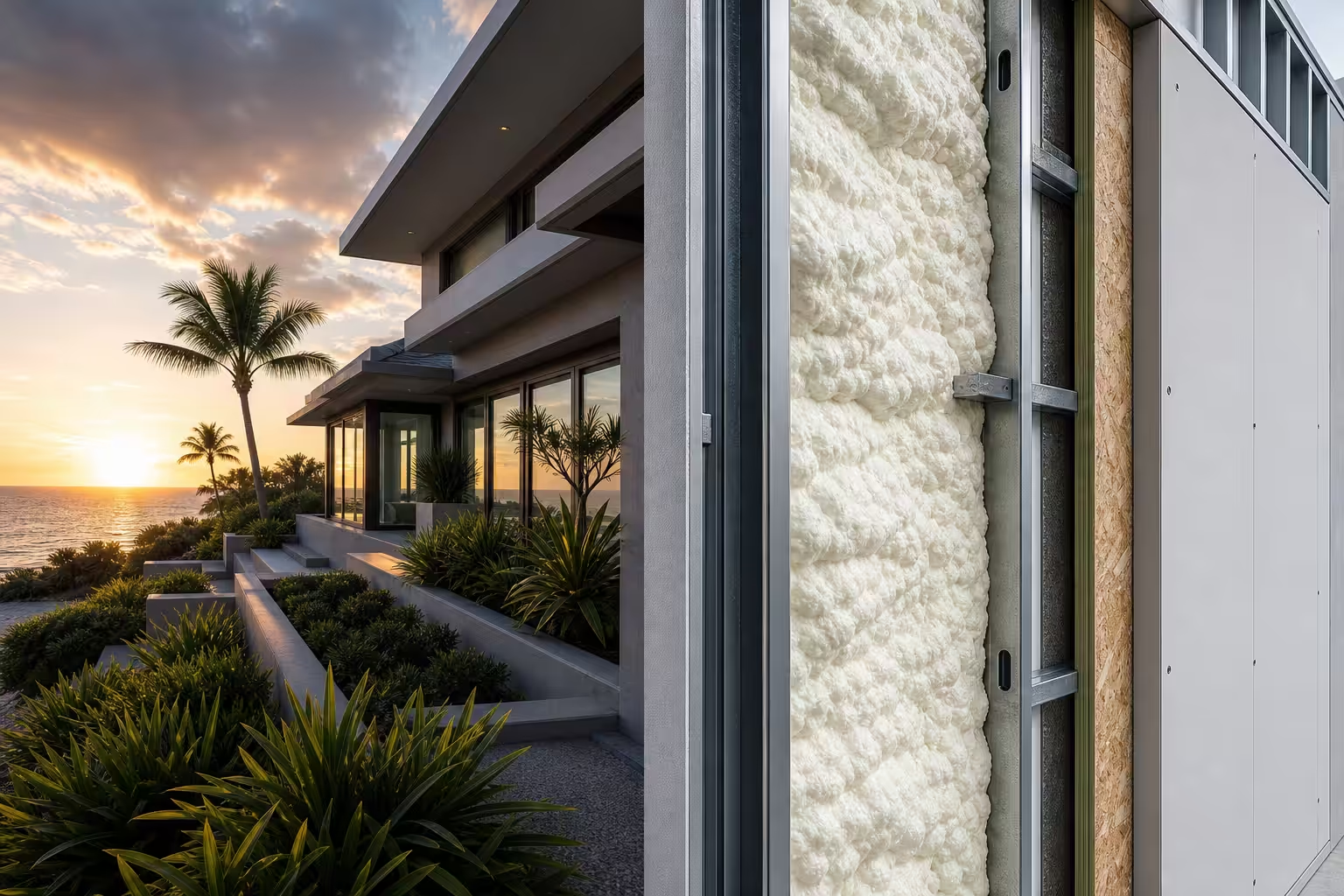
The resulting foam adheres to wood framing, roof sheathing, masonry, and concrete, limiting the bypasses that traditional materials leave at interfaces. That combination of bonding and volumetric expansion creates a continuous layer that integrates insulation and air barrier in a single application, something batts and loose-fill products simply cannot replicate on their own.
In South Florida, this dual function matters more than anywhere else. The foam does not merely occupy a cavity; it seals the pressure boundary while delivering R-value at the same time. Standard batts and loose-fill products cannot achieve that without a separate, fully sealed air barrier, which is rarely installed correctly in retrofits.
Air Sealing as the Primary Thermal Performance Mechanism
In IECC Climate Zone 1A, latent and sensible loads are driven primarily by uncontrolled air exchange, not conductive heat transfer alone. Infiltration carries moisture and heat directly into attics and walls, taxing HVAC systems around the clock.
By eliminating the gap between the insulation layer and the air barrier, spray foam stops the dominant transport mechanism. Fiberglass batts and blown-in cellulose are air-permeable and require a separate, perfectly sealed air barrier to perform to their labeled R-value, a standard that is rarely met in retrofits.
Industry research indicates that air movement can transport vastly more moisture through an assembly than vapor diffusion alone. Air-impermeability is the critical performance variable in South Florida assemblies, and that is the core property that gives spray foam insulation its advantage over fiber products.
Open-Cell vs. Closed-Cell Spray Foam: Technical Specifications Compared
R-Value, Density, and Vapor Permeance Differences
Open-cell foams typically provide R-3.5 to R-3.8 per inch at approximately 0.4 to 1.6 pounds per cubic foot. They are intentionally vapor-permeable, with permeance values commonly ranging from 16 to 35 perms depending on thickness.
Closed-cell foams typically provide R-6.0 to R-7.0 per inch at approximately 1.7 to 3.0 pounds per cubic foot. At roughly 2.5 inches and above, they function as a Class II vapor retarder, a key requirement in hot-humid roof and wall assemblies.
Closed-cell foam also adds structural contribution and resists bulk water, making it well suited for HVHZ applications at roof decks and exterior-facing walls. Open-cell foam is frequently specified for interior partitions where sound absorption is the priority and moisture exposure is low.
Thickness Requirements and Application Context for Florida Assemblies
In sealed, unvented attic and roof-deck assemblies in Zone 1A, closed-cell spray foam at approximately 3 to 4 inches creates an air-impermeable, Class II vapor-retarding layer at the deck. That thickness range is widely used in South Florida to control solar-driven moisture and to stabilize dew-point location within the assembly.
Prescriptive R-value targets under the Florida Building Code may be met through the performance path or UA trade-offs rather than nominal cavity R alone, a flexibility described in IECC and FBC compliance guidance. Broward Insulation documents project compliance including blower-door results, duct location within the conditioned envelope, and modeled load reduction as part of the permitted-project process.
Open-cell requires significantly greater thickness to achieve equivalent thermal resistance and does not provide vapor control in hot-humid roof assemblies. In South Florida, it is reserved for interior applications such as theater rooms or bedroom partitions where acoustic performance is the priority and moisture load is modest.
For exterior walls and crawlspaces subject to wind-driven rain, periodic wetting, or high vapor drive, closed-cell remains the right choice. It is the only foam type that simultaneously delivers high R per inch, air control, and vapor control in these assemblies.
Why Spray Foam Insulation Outperforms Traditional Insulation in South Florida’s Climate
IECC Climate Zone 1A Thermal and Moisture Demands
Zone 1A is defined by year-round cooling loads, high ambient relative humidity, elevated outdoor dew points, and intense solar exposure of roof decks. These conditions create strong moisture drives into building assemblies, particularly at south and west exposures.
The stack effect in this region draws humid exterior air through voids at soffits, top plates, penetrations, and sheathing seams when a building is not air-sealed. That uncontrolled air movement elevates interior latent loads, destabilizes interior humidity, increases energy use, and risks condensation at cold surfaces.
Spray foam forms a monolithic air and thermal boundary that shuts down this mechanism. Fiberglass and cellulose remain gap-sensitive and vapor-open, a real disadvantage in subtropical roof and wall assemblies unless paired with continuous, fully sealed air barriers and dedicated vapor control layers.
Structural and Hurricane-Resilience Advantages in HVHZ Construction
Closed-cell foam adheres to roof decking and framing, adding measurable racking resistance and uplift resistance based on post-storm engineering observations. It is not a substitute for structural connectors or a roofing system, but it does contribute to the overall resilience of the assembly in HVHZ jurisdictions.
HVHZ code enforcement in Broward and Miami-Dade requires documented compliance for wind, moisture, and fire performance. Generic fiberglass systems typically need additional components to address air and vapor control, introducing complexity and field variability that a spray foam insulation system resolves with a single integrated layer.
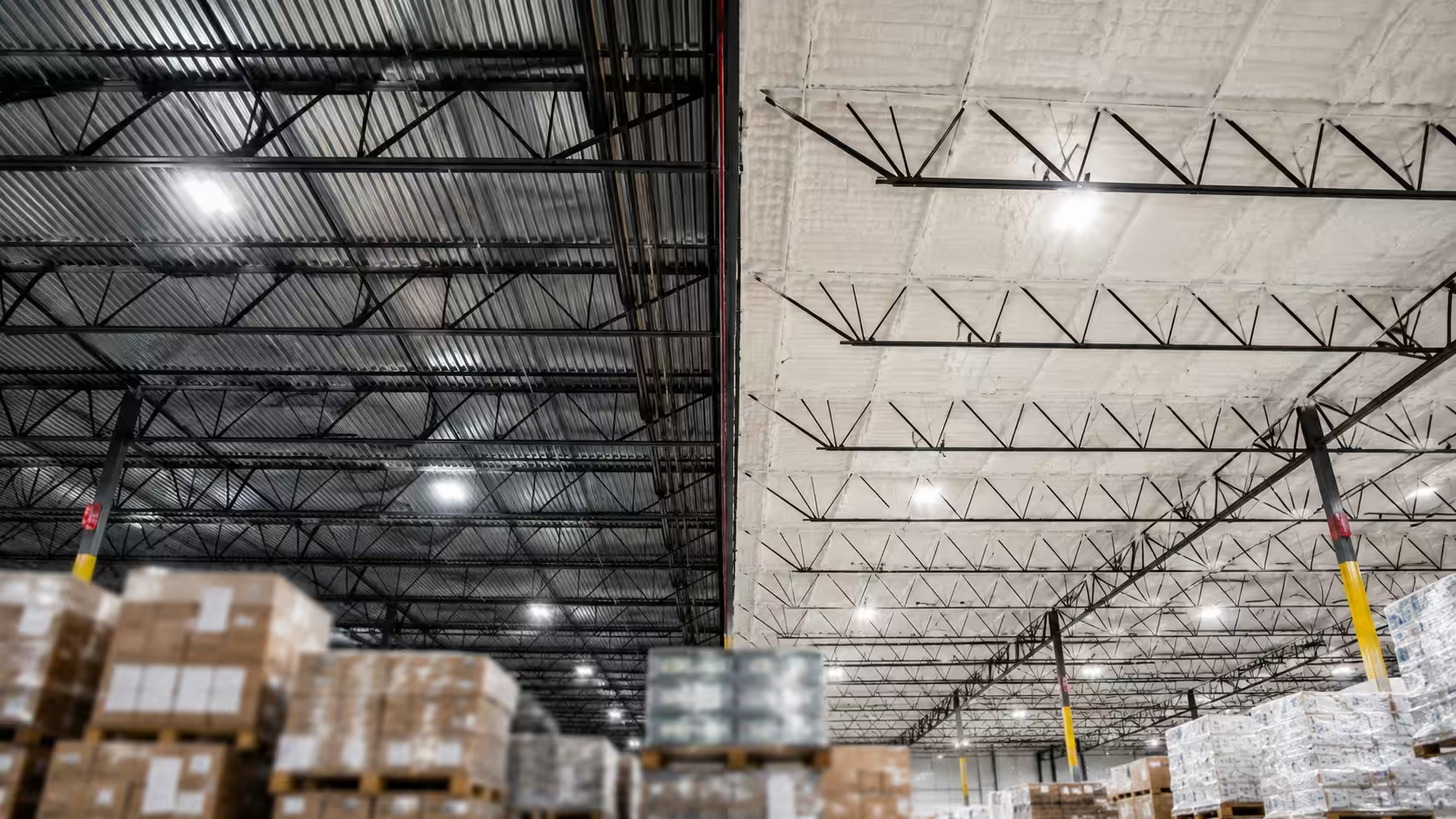
When the roof deck is insulated with closed-cell spray foam, the attic becomes semi-conditioned, and HVAC equipment and ducts within that volume operate in a more stable environment. Field observations and building-performance modeling commonly show that this configuration reduces sensible and latent loads on the equipment, supports right-sizing, and lowers operating hours over the cooling season.
Installed Cost and Coverage for Spray Foam Insulation in 2026
National Cost Benchmarks and South Florida Cost Factors
For 2026, national averages for professional installation range from approximately $1.50 to $2.50 per square foot for open-cell and $3.00 to $4.50 per square foot for closed-cell, reflecting a broader market range that includes higher regional bids. Typical whole-home projects covering 2,000 to 2,500 square feet of surface area fall between $6,000 and $30,000 depending on foam type, thickness, and scope.
South Florida projects often carry a regional premium because of HVHZ compliance documentation, licensed labor, confined attic working conditions, and project logistics. Some quotes are presented in board feet, one board foot equals one square foot at one inch of thickness, so always convert to total installed thickness for accurate comparisons.
- Material volume: Closed-cell is higher density and costs more per unit volume than open-cell.
- Access and prep: Tight attics, existing ductwork, and substrate conditioning extend labor time.
- Compliance: FBC permitting, thermal or ignition barriers, and documentation add scope that retail kits do not include.
Why Consumer-Grade Kits Do Not Satisfy Florida Building Code Requirements
Retail spray foam kits are typically sold in the 105 to 650 board-foot range per set and are designed for small gap sealing, rim joists, or incidental repairs. Even at ideal yields, a 600 board-foot kit covers only 300 square feet at 2 inches, far short of what whole-assembly compliance in a residence requires. DIY spray foam kits from big-box stores, including Icynene and other polyurethane foam products marketed for homeowners, are similarly limited in scope and output.
The Florida Building Code and the 2021 IECC require minimum R-values, air-impermeable insulation at unvented roofs, and fire protection. Thermal barrier provisions generally require 0.5-inch gypsum or an approved intumescent coating over foam surfaces adjacent to occupied areas, with ignition barriers permitted only in service-only attics or crawlspaces per NFPA 286 listings.
Licensed contractors must install permitted work and certify materials, installation conditions, and code compliance. FPL rebates are accessed through Participating Independent Contractors; as of 2026, FPL offers an instant $220 ceiling insulation rebate for qualifying homes, which Broward Insulation applies directly on eligible projects in Broward, Palm Beach, and Miami-Dade. For information about our licensing and construction services, see Construction Insulation Contractors Florida.
Moisture, Health, and Installation Risks in South Florida Retrofit Assemblies
Trapped Moisture and Mold Risk in Subtropical Retrofit Conditions
Spray foam will lock in pre-existing moisture if applied to wet substrates, which can lead to plywood delamination, concealed rot, or mold growth. This risk is elevated in Climate Zone 1A, where ambient humidity routinely exceeds 70 percent and wood moisture content in legacy construction can surpass safe thresholds.
Best practice puts bulk water control first. Flashings, the water-resistive barrier, and any leak remediation must all be verified before foam is applied. Spray foam insulation is a secondary air and vapor control layer, not a fix for active moisture sources.
Broward Insulation tests substrates for moisture content and sequences work to maintain drying potential throughout the assembly. That process discipline is what separates durable outcomes from callbacks in unvented attics and wall retrofits across the tri-county market.
Off-Gassing, Cure Time, and Occupant Protection Protocols
During application and initial cure, MDI isocyanate aerosols and vapors present occupational respiratory hazards. Industry safety guidance for spray polyurethane foam users recommends complete evacuation of occupants and pets before work begins, with a minimum 24-hour re-entry delay after the area has been ventilated and work is complete.
- Environmental control: Maintain substrate temperatures above 60°F, observe manufacturer ambient limits, and provide continuous isolated ventilation during application and purge.
- PPE and training: Applicators use supplied-air respirators, full body protection, and SPFA-aligned procedures to control mix ratios, lift thickness, and cure.
- Fire protection: Post no hot-work signage until approved thermal or ignition barriers are installed and foam has fully cured.
Improper mix ratios or application to cold or damp surfaces can result in incomplete curing, extended odors, and poor adhesion. Licensed installers trained in SPFA protocols manage these variables with documented quality control, which translates directly to code compliance and long-term performance.
Conclusion: The Case for Licensed, Climate-Specialized Spray Foam Installation
For IECC Climate Zone 1A, professional spray foam insulation installation is the most effective approach to controlling heat and moisture at the roof deck and exterior walls. Closed-cell formulations deliver high R per inch, air impermeability, Class II vapor-retarding behavior, and structural contribution at the deck, a combination that is especially valuable in HVHZ jurisdictions.
The performance gap between open-cell and closed-cell is material in South Florida, where vapor drive, humidity, and solar loading define envelope risk. Installed costs exceed commodity fiber products, but access to FPL rebates, HVAC load reduction from sealed attics, and the avoidance of moisture failures produce measurable returns over the building’s service life.
Broward Insulation brings nearly five decades of continuous operation in Broward, Palm Beach, and Miami-Dade, delivering permitted, documented, and FPL-approved spray foam insulation assemblies engineered for Zone 1A. If Florida Building Code compliance, performance modeling, and occupant safety are non-negotiable, schedule a technical consultation with our team to get a property-specific spray foam design and investment case built around your home.