Luxury condo soundproofing: STC, IIC, and retrofit guide
Executive Summary: Luxury condo soundproofing is a fundamental expectation in South Florida high-rise living, yet many owners discover after closing that noise transmission from adjacent and overhead units falls well short of what was promised. Marketing materials often emphasize privacy as a premium feature, but the acoustic performance described in sales materials frequently bears limited relationship to lived experience.
The core issue is measurement: genuine acoustic isolation is quantified through two independent, standardized metrics. Sound Transmission Class (STC) governs airborne noise, speech, music, television. Impact Insulation Class (IIC) governs structure-borne impact noise: footsteps, chair movement, dropped objects.
Achieving the thresholds required by Broward County and Miami-Dade HOA review boards demands engineered assemblies specified at the system level, not off-the-shelf products selected on the basis of marketing claims.
This guide establishes the technical framework necessary to evaluate a luxury unit’s acoustic performance, specify retrofit upgrades with documented noise reduction targets, and navigate the HOA approval process that governs all interior assembly modifications in South Florida high-rises. Broward Insulation, founded in 1977, has spent nearly five decades engineering structural decoupling assemblies for acoustically demanding luxury properties across the Tri-County region. The cost tiers, assembly data, and documentation frameworks presented here reflect that operational record.
Luxury condo soundproofing: what STC and IIC ratings actually mean for a high-rise
The distinction between airborne and impact noise transmission
STC and IIC measure fundamentally different transmission pathways, and each requires a distinct engineering response. STC governs airborne sound: acoustic energy that travels through the air, excites a wall or floor assembly, and re-radiates on the far side.
IIC governs impact sound: mechanical energy introduced directly into a floor structure through physical contact, which propagates through the building substrate before radiating downward as audible noise. Under ASTM standards, STC measures airborne transmission only and is not a reliable predictor of footfall performance; any incidental attenuation of impact noise should never be assumed from an STC rating alone.
Both metrics must be addressed independently, and a specification that optimizes one while neglecting the other will not deliver the acoustic privacy expected in a premium residential environment.
Rating benchmarks: minimum acceptable vs. luxury grade
Florida Building Code Section 1207.2 establishes STC 50 as the laboratory minimum for airborne sound separation in multi-family residential assemblies, with STC 45 as the field-tested equivalent. Section 1207.3 establishes IIC 50 as the laboratory minimum for impact sound. These are code floors, not luxury performance targets.
For wall assemblies in a genuine luxury specification, STC 57 represents very good performance and STC 60 or above is the accepted benchmark for premium units. For floor-ceiling assemblies, IIC 55 is acceptable, IIC 60 is strong, and IIC 65 or above is the standard for acoustically sensitive occupants in high-end residences.
Why field performance consistently falls below laboratory ratings
Laboratory ratings are established under controlled conditions using ASTM E90 for STC and ASTM E492 for IIC. Field conditions introduce flanking transmission paths, construction penetrations, imprecise perimeter sealing, and installation variability that consistently reduce real-world performance.
The differential between laboratory and field results typically ranges from 3 to 10 points on either metric. A unit specified at IIC 60 in construction documents may perform at IIC 53 to 55 under actual occupancy conditions.
This gap is the primary reason HOA boards in South Florida luxury buildings require documented assembly-level test data rather than product-level performance claims, and why installation precision determines whether a specified assembly achieves its rated performance.
How top luxury developers engineer near-silent units from the structural slab outward
The four foundational principles of acoustic isolation
High-performance acoustic isolation is not a product category; it is a system discipline built on four interdependent principles. Mass provides the fundamental barrier to airborne sound transmission: concrete slab density and multi-layer drywall assemblies increase the energy required to excite a partition into re-radiation.
Decoupling interrupts the structural path through which vibration travels between assemblies, preventing the direct transfer of mechanical energy. Damping materials dissipate acoustic energy within the assembly before it can re-radiate. Airtight construction eliminates the penetrations, gaps, and perimeter leaks through which sound bypasses every other measure.
No single element achieves luxury-grade isolation. A high-STC drywall assembly is defeated by an unsealed conduit penetration; a premium acoustic underlayment underperforms if the floor assembly is not properly isolated at the perimeter.
High-performance glazing specifications for exterior and inter-unit noise
Glazing represents a critical acoustic vulnerability in South Florida high-rises, where exterior ambient noise levels and cross-unit corridor transmission both require engineered mitigation. Laminated sound-control glass and asymmetrical insulated glass units (IGUs), which pair panes of intentionally different thicknesses to disrupt coincident resonance frequencies, deliver meaningful performance above standard double glazing.
Standard double glazing achieves 30 to 40 dB of reduction; high-performance acoustic assemblies reach 40 to 50 dB. Frame sealing and perimeter gaskets are load-bearing acoustic details, not secondary concerns: field degradations of up to 10 dB have been reported in some cases where perimeter sealing or installation quality falls short of the laboratory configuration.
In South Florida, glazing specifications must additionally satisfy High-Velocity Hurricane Zone (HVHZ) impact requirements, which creates a dual performance mandate that necessitates careful product selection.
Floating floors, slab thickness, and resilient structural connections
Concrete slab mass is the primary driver of low-frequency airborne sound isolation in high-rise construction. Greater slab mass directly improves STC performance, particularly in the low-frequency bands most difficult to attenuate. Floating floor assemblies address IIC requirements by interrupting the direct mechanical path through which impact energy transfers.
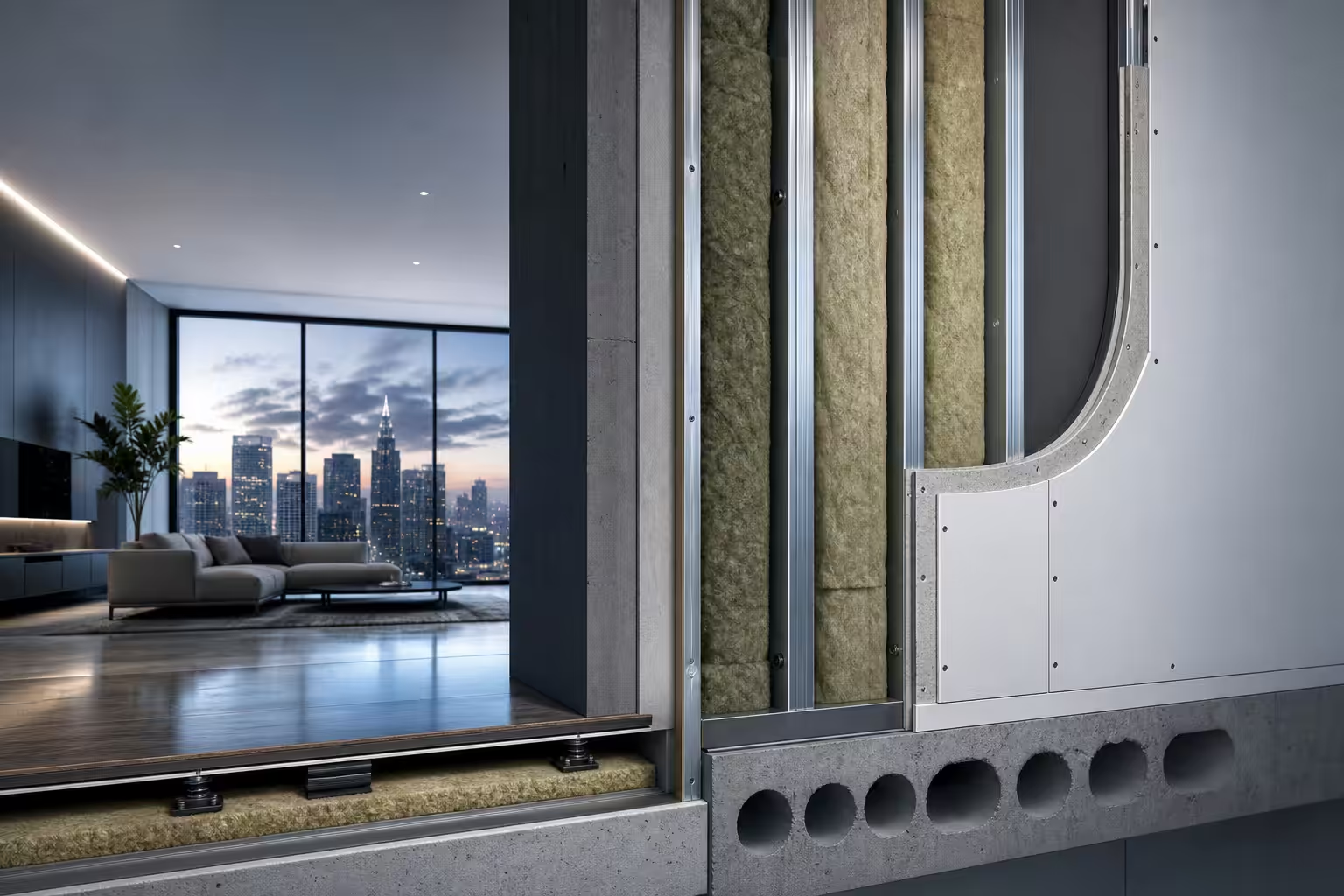
In these assemblies, finish flooring is installed over an acoustic underlayment system physically separated from the structural slab. Resilient channels, sound isolation clips, and isolated furring systems for ceiling assemblies provide decoupling for airborne sound at the wall and ceiling plane.
These details are the definitive differentiator between a code-minimum multi-family specification and a luxury acoustic build: the hardware is commercially available, but its performance depends entirely on installation precision and the integrity of every connection point in the assembly.
Retrofit guide: luxury condo soundproofing for floors, walls, and glazing
Acoustic floor underlayment: IIC performance gains and installation cost ranges
Acoustic underlayment represents the highest-ROI retrofit pathway for IIC improvement because it addresses the primary impact transmission path without structural modification. Three performance tiers exist. Basic foam or cork underlayment installed at $1 to $3 per square foot delivers minimal IIC improvement and is not appropriate for HOA submission in luxury buildings.
Mid-grade rubber and cork blend assemblies at $3 to $6 per square foot provide meaningful IIC gains suitable for hard floor installations and standard HOA approval processes. High-density acoustic mats and specialty tested assemblies at $6 to $10 or more per square foot provide documented IIC performance at the assembly level and are the appropriate specification for HOA boards requiring third-party test data.
Installation typically requires 1 to 3 days per area; flooring removal adds 1 to 2 days. All underlayment specifications submitted for HOA approval must reference tested assembly configurations, not product specifications in isolation. For deeper technical context on floor acoustics in multi-unit dwellings, see this technical review of [the acoustics of floors in condominiums](https://acousticstoday.org/wp-content/uploads/2019/10/THE-ACOUSTICS-OF-FLOORS-IN-CONDOMINIUMS-Marshall-Long.pdf).
Drywall decoupling and multi-layer wall assemblies for shared-wall retrofits
Shared-wall STC deficits are addressed through progressive levels of decoupling and mass addition. Resilient channel installation at $4 to $8 per square foot provides basic decoupling and measurable STC improvement for budget-constrained retrofits, but performance gains are limited by the channel’s susceptibility to short-circuiting, meaning the channel makes rigid contact with the substrate it is meant to isolate, if fastening is imprecise.
Sound isolation clips with hat channel and dual drywall layers at $8 to $15 per square foot deliver significant airborne STC improvement and represent the standard specification for addressing HOA violation notices related to shared walls. Full multi-layer assemblies incorporating acoustic insulation, damping compound, and airtight perimeter sealing at $15 to $25 or more per square foot achieve luxury-grade STC performance and are appropriate for the most stringent acoustic compliance requirements. Project timelines run 2 to 5 days per room and 1 to 3 weeks for full-unit scope.
Acoustic window upgrades: inserts vs. full replacement performance and pricing
Window retrofit options span a wide performance and cost range. Acoustic insert systems providing secondary glazing cost $150 to $500 per opening and deliver meaningful improvement in specific frequency bands, though they do not satisfy HVHZ impact requirements and are therefore limited to interior-facing applications in South Florida high-rises.
Mid-grade replacement windows at $500 to $1,500 per opening represent a practical upgrade for units with aging or poorly sealed frames. High-performance laminated custom acoustic units at $1,500 to $3,500 or more per opening deliver 40 to 50 dB of noise reduction and, when specified with HVHZ-compliant impact ratings, satisfy both the acoustic and hurricane-resistance requirements that govern glazing replacement in Broward and Miami-Dade jurisdictions. For guidance on window replacement costs and options, readers may consult an industry overview of [soundproof window costs and considerations](https://homeguide.com/costs/soundproof-window-cost).
Navigating HOA approval and building code compliance for acoustic retrofits in South Florida
What governing documents and review boards typically require before approval
Most Broward and Miami-Dade condo associations require written board approval before any flooring replacement, wall modification, or ceiling assembly change is initiated. Minimum acoustic thresholds are commonly incorporated into CC&Rs or architectural guidelines, with IIC 50 representing a common baseline and luxury buildings frequently specifying IIC 60 or above as the minimum for approved assemblies.
Installation method restrictions are also common: many associations prohibit direct fastening into structural slabs and require floating assembly configurations. Proceeding without written approval before work commences is the most frequent cause of HOA enforcement action, and the most difficult condition to remediate once installation is complete. For common legal questions about upstairs-neighbor rules and floor covering restrictions, see this discussion on [upstairs neighbor noisy floor covering restrictions](https://communityassociations.law/2024/04/01/upstairs-neighbor-noisy-floor-covering-restrictions/).
Assembling a documentation package that clears HOA review
A complete HOA submission for an acoustic retrofit includes several required elements: a defined scope of work with a marked floor plan, manufacturer product data sheets, assembly-level IIC and STC test reports sourced from independent laboratories, and contractor license documentation with a certificate of insurance.
Permit records where required by the Florida Building Code and a written work-hours compliance statement round out a submission-ready package. HOA boards at many South Florida luxury buildings also require field verification or post-installation acoustic testing as a condition of final approval. Submissions that rely on marketing literature rather than laboratory test reports are the single most common cause of HOA rejection in the region.
Regulatory compliance factors specific to Broward and Miami-Dade jurisdictions
Luxury condo soundproofing retrofits in South Florida are subject to regulatory requirements beyond HOA governing documents. Materials used in floor-ceiling and wall assemblies must satisfy flame-spread and smoke-toxicity requirements under Florida Building Code life-safety provisions.
Wall and ceiling assembly modifications that alter structural or fire-rated assemblies trigger permit requirements under the Florida Building Code, and retrofits involving penetration of or attachment to structural slabs require approvals that extend beyond the HOA level to the building’s structural engineer of record.
Window replacement in HVHZ jurisdictions, which encompass the entire South Florida Tri-County market, requires product approval under Florida Building Code Chapter 24 for both structural and acoustic performance. For the specific acoustical requirements related to ceiling and floor-ceiling assemblies, see the technical guidance from the [AWCI on acoustical requirements](https://www.awci.org/media/codes-standards/acoustical-requirements-for-ceilings-and-floor-ceiling-assemblies/), and for Florida-focused floor soundproofing considerations consult this [Florida building code floor soundproofing](https://acousticalsolutions.com/florida-building-code-floor-soundproofing) overview.
How Broward Insulation engineers acoustic assemblies that pass South Florida’s most rigorous HOA review
Tested assembly specifications proven in Broward and Miami-Dade luxury buildings
Broward Insulation has operated continuously in South Florida since 1977, developing an operational record in IECC Climate Zone 1A acoustic and thermal performance that no national franchise can replicate. The firm’s acoustic work spans [luxury condominiums](https://browardinsulation.com/what-is-the-best-insulation-for-a-florida-condo-unit/), high-rise commercial properties, and premium multi-family developments across Broward, Palm Beach, and Miami-Dade counties.
All assemblies specified by Broward Insulation are documented using tested build-up configurations with independent laboratory IIC and STC ratings, providing the exact evidentiary standard that HOA review boards in the South Florida luxury market require. The firm does not substitute product-level performance claims for assembly-level test documentation. Representative HOA-focused projects and community work are available in the firm’s [project gallery](https://browardinsulation.com/portfolio/), including multi-unit insulation scopes and [attic re-insulation](https://browardinsulation.com/services/attic-insulation/) projects.
The specification process from acoustic assessment to installation and post-verification
Broward Insulation’s luxury condo soundproofing process begins with an assessment of existing assemblies against the HOA-mandated minimums applicable to the specific property. A gap analysis identifies which elements require upgrade and at what performance tier. Assembly specifications are developed using tested build-up configurations appropriate for the building’s structural substrate, with full documentation prepared for HOA submission.
Licensed installation is performed by Broward Insulation’s field crews under direct supervision, and post-installation support includes preparation of the complete HOA submission package and coordination of field verification testing where required as a condition of approval. This end-to-end process eliminates the documentation failures that most commonly cause HOA rejection in the South Florida luxury market.
Why the contractor specification matters as much as the material selection
Acoustic compliance in a luxury high-rise is an engineering discipline, and its outcome is determined as much by installation precision as by material specification. The same acoustic underlayment installed with perimeter gaps or inadequate substrate preparation fails to deliver its rated IIC.
Resilient channels short-circuited by improper fastening into the structural member they are designed to isolate provide no decoupling benefit. Damping compound applied at insufficient coverage cannot dissipate acoustic energy within the assembly. Broward Insulation’s value proposition is the precision installation of proven, tested assemblies by a licensed contractor with an established record across South Florida’s most acoustically exacting compliance environments.
Conclusion: specifying acoustic performance that holds up under HOA review
Genuine luxury condo soundproofing is quantified by STC and IIC ratings. Achieving luxury-grade thresholds—STC 60 or above for walls, IIC 65 or above for floor-ceiling assemblies—requires a system integrating mass, decoupling, damping, and airtight detailing at every joint and penetration. Retrofit upgrades deliver measurable, documentable performance gains when specified at the assembly level, with costs ranging from $1 to $25 or more per square foot depending on assembly type and target performance. HOA compliance in Broward and Miami-Dade luxury buildings requires assembly-level test documentation, independently verified, not product specifications presented as a substitute.
Owners and HOA boards pursuing acoustic performance upgrades, specification review, or compliance documentation for pending retrofit applications should engage Broward Insulation for an initial acoustic assessment. Broward Insulation will evaluate the existing assembly condition, identify the specific gap between current and required performance, specify the appropriate tested assembly upgrade, and deliver the complete documentation package required to satisfy even the most exacting HOA submission standards in the region.
To schedule a luxury condo soundproofing assessment for your Broward, Palm Beach, or Miami-Dade property, contact Broward Insulation directly. Most assessments identify correctable deficiencies before HOA enforcement action or resale due diligence surfaces them. Inquiries from HOA boards, property managers, and licensed general contractors are welcome.
FAQ: luxury condo soundproofing in South Florida
What STC and IIC ratings should a luxury condo target?
For luxury-grade performance, target STC 60 or above for shared walls and IIC 65 or above for floor-ceiling assemblies. Florida Building Code minimums (STC 50 / IIC 50 in the lab) are code floors, not quality benchmarks. Many South Florida HOAs require IIC 60 as a minimum for approved flooring assemblies.
Do I need HOA approval before starting an acoustic retrofit?
Yes. Most Broward and Miami-Dade condo associations require written board approval before any flooring, wall, or ceiling modification. Submitting assembly-level test reports, not just product data sheets, is typically required and is the most common point of failure in HOA submissions.
How much does luxury condo soundproofing cost per square foot?
Cost depends on assembly type and performance target. Acoustic floor underlayment ranges from $1 to $10 or more per square foot. Wall decoupling assemblies range from $4 to $25 or more per square foot. Window upgrades range from $150 to $3,500 or more per opening. Broward Insulation provides assembly-specific pricing following an initial acoustic assessment.
Why does field acoustic performance differ from the laboratory rating?
Laboratory ratings are measured under controlled ASTM test conditions. In the field, flanking transmission paths, imprecise perimeter sealing, and installation variability reduce real-world performance by 3 to 10 points on either metric. This is why installation quality and contractor expertise directly determine whether a specified assembly achieves its rated performance.