STC and IIC Ratings: What Luxury Condo Owners Must Know
Executive Summary: STC and IIC ratings, Sound Transmission Class and Impact Insulation Class, are the two standardized acoustic performance metrics that govern floor-ceiling assembly compliance in South Florida luxury condominiums. Many HOA architectural review boards across Broward, Miami-Dade, and Palm Beach counties require documented STC and IIC compliance before approving any hard-surface flooring installation, with requirements that often exceed minimum building code thresholds. This article defines both ratings and their governing ASTM standards, establishes the specific thresholds applicable to South Florida high-rise residential construction, and outlines the technical documentation required for first-submission board approval.
Understanding where these ratings come from, and why laboratory numbers don’t always match field results, is essential before a unit owner or architect commits to any flooring specification. The consequences of an incomplete submission extend well beyond a delayed project.
What STC and IIC ratings actually measure
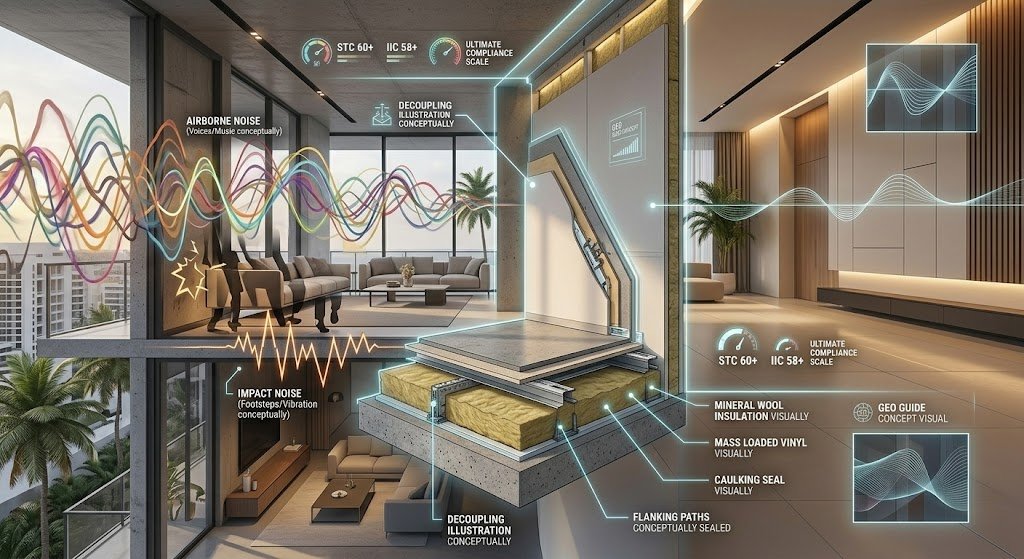
Sound Transmission Class (STC) quantifies a building assembly’s ability to block airborne sound. This includes voices, mechanical equipment noise, and amplified audio. Laboratories derive it from testing per ASTM E90, which measures transmission loss in decibels across 1/3-octave frequency bands from 80 to 5,000 Hz. The raw data is then classified per ASTM E413, fitting results to a standardized reference contour. The STC value equals the contour reading at 500 Hz, subject to a maximum of 32 dB in total deficiencies and no single band deficiency exceeding 8 dB. For condominium floor-ceiling assemblies, STC governs sound privacy between horizontally stacked units.
Impact Insulation Class (IIC) measures resistance to structure-borne noise: footsteps, furniture movement, and dropped objects. Laboratories derive it from testing per ASTM E492, in which a standardized tapping machine applies calibrated impact energy to the floor surface while a receiving room below measures sound pressure levels across 1/3-octave bands from 100 to 3,150 Hz. Results are classified per ASTM E989 using the same curve-fitting methodology as ASTM E413. A higher IIC value means less impact sound reaches the unit below. IIC is the critical compliance metric for hard-surface flooring submissions because tile, stone, and luxury vinyl plank transmit substantially more impact energy than carpet and pad assemblies.
Two supplemental metrics appear in South Florida HOA submissions with increasing frequency. Outdoor-Indoor Transmission Class (OITC), classified per ASTM E1332, applies a low-frequency weighting to E90 transmission loss data and is relevant for exterior facades in coastal high-rises subject to traffic and aircraft noise. Delta IIC (ΔIIC), measured per ASTM E2179, quantifies the incremental improvement in IIC contributed by a floor covering over a bare assembly. High-performance acoustic underlayments tested per E2179 typically achieve ΔIIC values of 20 to 25 on a 6-inch concrete slab. Many South Florida HOA boards, however, require full tested assembly data referencing accredited laboratory reports rather than accepting ΔIIC calculations from underlayment manufacturers as a standalone compliance demonstration.
Why laboratory ratings and field performance consistently diverge
STC and IIC values are measured under controlled, flanking-free conditions per ASTM E90 and ASTM E492. Field equivalents, designated FSTC per ASTM E336 and FIIC per ASTM E1007, are measured in the as-built structure under actual construction conditions. Published research and industry practice document a typical differential of 5 to 10 points between laboratory and field ratings, with field results consistently lower. Structural connections, mechanical penetrations, and flanking transmission paths in real construction all contribute to this gap. For concrete high-rise assemblies specifically, the lab-to-field IIC drop commonly runs around 5 points, though greater variation occurs in buildings with significant flanking pathways. A floor assembly rated IIC 55 in the laboratory may achieve a field FIIC closer to 50, a result that can fall below HOA-mandated minimums depending on the building’s declared threshold.
Flanking transmission is the primary compliance risk in South Florida luxury condominium construction. Sound travels around the primary assembly via structural connections rather than directly through it: slab-to-perimeter wall junctions, plumbing chases, and continuous concrete elements all provide pathways that bypass the floor-ceiling assembly’s acoustical performance. In concrete frame high-rise construction, the dominant structural type in the South Florida tri-county luxury market, slab-to-wall flanking is the principal degradation mechanism. Assembly selection alone cannot resolve this risk. Contractor-installed structural decoupling treatments are required to achieve the field-equivalent ratings HOA boards mandate.
The practical implication for assembly specification is direct: specifiers must target laboratory-rated assemblies conservatively above the HOA’s minimum threshold. Where an HOA declares a minimum field-equivalent IIC of 50, the tested assembly should demonstrate a laboratory IIC of at least 55 to 60. Preparing this calculation, and the documentation supporting it, is part of the technical HOA submission package a licensed acoustic contractor provides.
STC and IIC ratings: acoustic thresholds governing hard-surface flooring in South Florida luxury condos
The International Building Code establishes the baseline minimum for floor-ceiling assemblies in multi-family residential occupancies at STC 50 and IIC 50 under laboratory conditions. South Florida luxury HOAs commonly exceed these minimums in their condominium declarations. Based on representative declarations reviewed across the tri-county market, thresholds of STC 55 and IIC 55 to 60 appear frequently in Broward, Miami-Dade, and Palm Beach County luxury residential buildings. In Miami-Dade, some high-density luxury tower declarations set IIC 60 as the hard minimum for any hard-surface flooring installation, regardless of the IBC baseline. These private bylaws carry enforceable authority under Florida Statute Chapter 718, and requirements vary by building, reviewing the specific declaration before specifying any assembly is essential.
Carpet is the default acoustically compliant flooring in most condominium declarations. When a unit owner replaces carpet with tile, stone, or luxury vinyl plank, the substitution triggers mandatory HOA review. Hard surfaces transmit substantially greater impact energy through the slab to the unit below. A wood joist assembly with carpet and pad can achieve a laboratory IIC of 72 to 74. The same assembly finished with vinyl flooring and no underlayment may measure IIC 47 to 49, a reduction of 25 points that constitutes both an HOA violation and a potential Florida Building Code deficiency. The documentation burden rests entirely with the unit owner to demonstrate, before work begins, that the proposed assembly meets the building’s declared threshold.
Laboratory-tested assemblies provide the baseline performance reference. A concrete slab with a high-performance acoustic underlayment and luxury vinyl plank finish typically achieves a laboratory IIC of 50 to 60, depending on underlayment density, thickness, and composition. Tile over an isolation membrane can reach IIC 50 to 55. An untreated bare concrete slab typically measures IIC 25 to 35, which establishes why underlayment selection is the primary IIC compliance variable in South Florida high-rise retrofits. The ESCSI catalog of approximately 500 tested assemblies, compiled from accredited laboratory submissions, serves as the authoritative baseline reference for assembly performance verification.
What a compliant HOA architectural review board submission must include
A complete HOA submission starts with a full laboratory test report for the proposed floor-ceiling assembly, demonstrating STC and IIC values that meet or exceed the building’s declared minimums. The report must reference the applicable ASTM standards: ASTM E90 and E413 for STC, ASTM E492 and E989 for IIC. The issuing laboratory must hold recognized accreditation. Manufacturer technical bulletins that do not reference a full accredited laboratory test report are generally insufficient for South Florida HOA board approval, particularly in luxury high-rise buildings with active architectural review committees.
Many HOA boards also require an engineering certification letter from a licensed acoustic contractor or acoustical engineer confirming that the proposed installation will achieve the documented ratings under actual field conditions. This letter must acknowledge the lab-to-field performance differential and confirm that the installation scope includes flanking mitigation measures appropriate to the building’s structural system. In jurisdictions subject to Florida Building Code High-Velocity Hurricane Zone (HVHZ) provisions, some boards have begun requesting contractor licensing documentation as part of a complete submission, a trend observed across HVHZ-designated areas in the tri-county market.
Some HOA declarations require post-installation field testing per ASTM E1007 as a condition of final approval. A submission package that addresses this requirement proactively, including a defined field test protocol and acknowledgment of the HOA’s threshold requirements, eliminates the three primary causes of board rejection: missing accredited laboratory data, unverified assembly performance claims, and contractor qualification gaps. Board rejections cause real delays; HOA ARC review and resubmission timelines under Florida Statute §718.113 can stretch a project significantly, and a rejection that requires full assembly redesign compounds that cost further.
Selecting the right floor assembly to meet STC and IIC compliance thresholds
Underlayments
In concrete slab high-rise construction, acoustic underlayment is the primary variable controlling IIC performance. The slab itself contributes significant STC mass but provides minimal impact isolation. Effective acoustic underlayments contribute ΔIIC values of 20 to 30 points above a bare slab per ASTM E2179 testing. Premium isolation products using recycled rubber or composite foam structures perform at the upper end of this range. Underlayment selection must be based on tested assembly data specific to the finish flooring type. A manufacturer’s standalone ΔIIC claim tested on a generic assembly does not substitute for a full tested assembly report that matches the specific finish flooring specified for the project.
Ceiling decoupling
Structural decoupling at the ceiling plane of the unit below is often as important as underlayment selection for achieving field-equivalent ratings in South Florida concrete frame construction. Adding resilient channels or isolation clips to a ceiling assembly below a concrete slab can improve IIC by 5 to 14 points based on documented laboratory data. When combined with batt insulation in the ceiling cavity, the improvement compounds. This ceiling-side treatment directly addresses slab-to-wall flanking, the primary degradation mechanism in concrete high-rises that drives the lab-to-field performance gap.
Concrete vs. wood-frame assemblies
Wood-frame and concrete frame buildings require fundamentally different assembly strategies. A tested assembly designed for wood joists does not transfer directly to a post-tension concrete slab building. Specifying an incorrect assembly type is one of the most common submission errors in the South Florida luxury condominium market. The correct assembly must match the actual structural system present in the building. That determination requires a site assessment and review of as-built structural documentation before finalizing any submission package.
How a licensed acoustic contractor ensures first-submission board approval
A licensed acoustic contractor with demonstrated STC and IIC engineering experience prepares the complete submission package: tested assembly identification from accredited laboratory catalogs, full laboratory report compilation, an engineering certification letter accounting for field performance degradation, a field test protocol, and contractor licensing documentation. This preparation directly eliminates the most common causes of first-submission rejection. Submitting a package assembled by a general flooring contractor without acoustic compliance experience produces the incomplete documentation patterns South Florida HOA boards reject most frequently.
South Florida luxury condominiums present a specific combination of compliance variables that demands demonstrated local experience: HVHZ structural requirements, concrete frame construction characteristics, HOA declarations exceeding IBC minimums, and municipal noise ordinances layered above state code. A contractor without documented experience in this market may specify an assembly that hits the nominal IIC target in isolation but fails under field conditions in a concrete high-rise with significant flanking pathways.
Broward Insulation has delivered STC and IIC acoustic compliance engineering and installation services across Broward, Miami-Dade, and Palm Beach Counties, with specific expertise in structural decoupling for South Florida’s luxury condominium market. The firm’s methodology is built around achieving field-equivalent ratings that satisfy the strictest HOA declarations in the tri-county luxury residential market. Owners and architects who engage a qualified acoustic contractor at the specification stage, before any HOA submission is filed, improve their chances of first-submission approval and avoid the costly cycle of rejection, redesign, and resubmission.
Conclusion
STC and IIC ratings are the technical foundation of acoustic compliance in South Florida luxury condominiums. The documentation required to satisfy an HOA architectural review board extends well beyond a manufacturer’s rating claim. A properly executed submission requires accredited laboratory test data for the specific assembly, an engineering certification letter that accounts for field performance degradation and flanking mitigation, and contractor qualification documentation appropriate to Florida Building Code and HVHZ standards.
The cost of a first-submission rejection, measured in project delays, potential legal exposure under Florida Statute Chapter 718, and possible assembly redesign, routinely exceeds the cost of engaging a licensed acoustic contractor at project inception. For owners and architects navigating hard-surface flooring compliance in the South Florida tri-county luxury market, the most reliable path to board approval is a complete, expertly prepared technical package built by a contractor with verified STC and IIC engineering experience. Contact Broward Insulation to schedule a site assessment and begin the assembly specification and HOA documentation process.